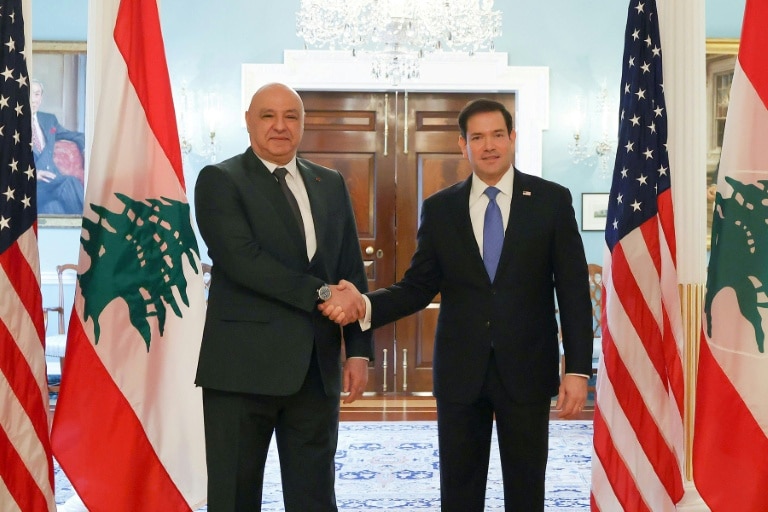
A high-stakes diplomatic gathering is set to unfold in Washington this Tuesday, as Lebanese President Joseph Aoun sits down with U.S. President Donald Trump against a backdrop of fragile ceasefire efforts, growing international pressure, and deep domestic division over the future of the Iran-backed militant group Hezbollah.
The meeting comes as Lebanon’s national military launched its first deployment to a designated “pilot zone” in southern Lebanon on Tuesday, a core provision of a newly struck ceasefire agreement brokered with Israel. One day ahead of the summit, Secretary of State Marco Rubio commended Lebanon’s government for its “determined effort to reclaim Lebanon’s sovereignty, disarm Hezbollah and dismantle its terrorist infrastructure” following a meeting with Aoun, framing the disarmament push as critical to lasting regional peace. “As long as that problem exists, Lebanon will never truly get peace,” Rubio told reporters.
For Israel, full disarmament of Hezbollah is a non-negotiable precondition for a full withdrawal of Israeli forces from southern Lebanon, which Tel Aviv invaded after Hezbollah launched cross-border rocket attacks that dragged Lebanon into a regional conflict in March 2025. The pilot zones, where the Lebanese army is now deploying, sit just outside the territory seized by Israeli forces in that invasion, and are designed as a test case to prove Beirut can enforce the terms of the deal. On Tuesday, Lebanon confirmed its forces had entered the village of Zawtar al-Garhbiya, one of three initial pilot zones, while the Israeli military announced it would adjust its force posture in the area to align with the agreement. The U.S. has repeatedly backed Israel’s demand that Hezbollah disarm before any full Israeli withdrawal.
Aoun, who was elected president in early 2025 with broad Western backing after a career as an army commander, has made disarming Hezbollah a central promise of his administration – a shift that marks a major break from decades of Lebanese political compromise with the militant group. Aoun has openly criticized Hezbollah for dragging the country into the latest conflict, which has killed more than 4,300 Lebanese people according to Lebanese official counts, and is hoping his meeting with Trump will bring additional U.S. pressure to bear on Israel to complete its withdrawal from all of southern Lebanon once the initial disarmament requirements are met. Aoun is also expected to use the summit to request increased military and economic aid for Lebanon’s cash-strapped national army.
But the plan faces steep obstacles. Hezbollah has repeatedly and flatly rejected the deal, refusing to lay down its weapons, which it says are necessary to defend Lebanon against Israeli aggression. The group has fought multiple wars with Israel since its founding, and remains a powerful political and military force within Lebanon. Even as violence has dropped dramatically since the ceasefire was signed, a new escalation between the U.S. and Iran – which has long backed Hezbollah both politically and militarily – has upended regional stability. Iran, which required Lebanon’s inclusion in its initial April ceasefire with Washington, resumed open military conflict with the U.S. on July 7, casting new uncertainty over the future of the ceasefire arrangement.
Analysts warn the agreement itself puts Lebanon in a precarious position. Maha Yahya, director of the Carnegie Middle East Center, noted that while the summit demonstrates ongoing U.S. commitment to Lebanon, it also raises serious questions about what additional concessions Beirut may be forced to make. Yahya called the existing ceasefire deal “deeply disadvantageous” for Lebanon, a country already grappling with years of economic collapse and widespread infrastructure damage from months of conflict. Robert Satloff, executive director at the Washington Institute, added that Trump will arrive at the meeting with his own set of demands: beyond proof of Aoun’s commitment to disarmament, Satloff said the U.S. president will seek guarantees that Aoun will remove any army officers found to have ties to Hezbollah, and that Beirut will work toward a formal peace deal with Israel – a step no Lebanese government has ever taken.
This meeting marks the first time a Lebanese president has been invited to Washington since 2009, a sign of the shifting geopolitical dynamics in the Middle East following the 2025 election of Aoun and the outbreak of the latest conflict between Israel and Hezbollah.