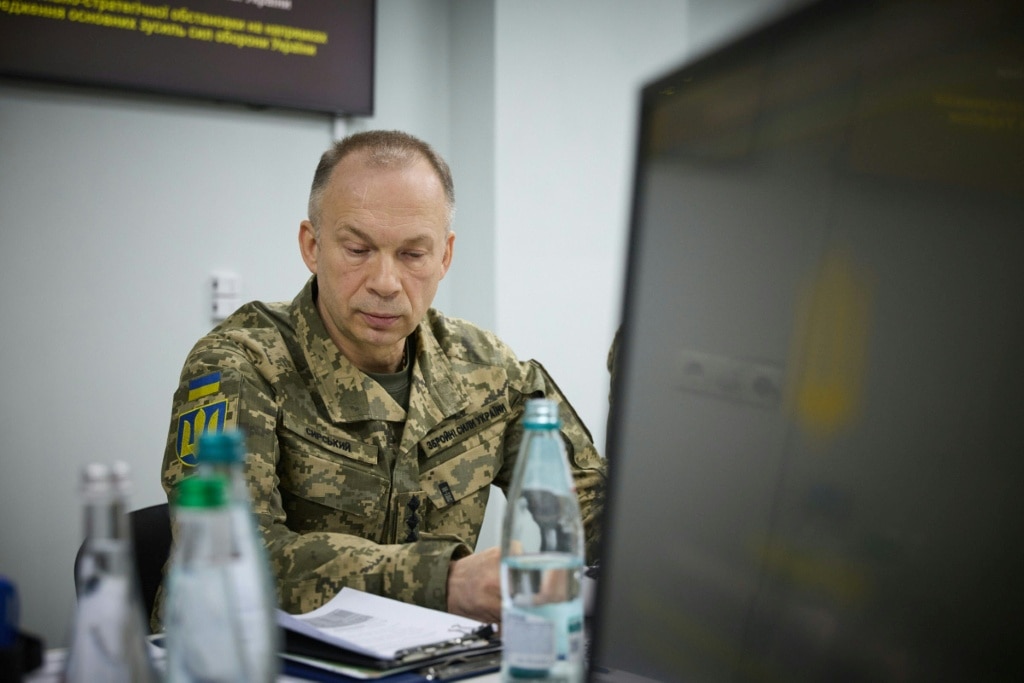
As Ukraine faces a shifting dynamic in its 3-year full-scale war with Russia, its top military commander Oleksandr Syrsky finds himself on the brink of dismissal, with multiple Ukrainian and international outlets reporting that President Volodymyr Zelensky is actively considering his removal. The 60-year-old Soviet-trained officer has long been a polarizing figure in Kyiv’s military and political circles, celebrated for landmark early victories but mired in conflict with reformers pushing to modernize Ukraine’s armed forces for an era of drone-driven high-tech warfare.
Syrsky’s military career in Ukraine stretches back to the collapse of the Soviet Union. Born in what was then Soviet Russia and educated at a Moscow Red Army academy, he relocated to Soviet Ukraine in the 1980s, stayed on after the USSR dissolved to attend Kyiv’s National Defence University, and built a decades-long career in the newly formed Ukrainian military. He rose to national prominence immediately following Russia’s full-scale invasion in February 2022, when he led the successful defense of Kyiv that halted Russian forces’ advance on the capital, a turning point that prevented the fall of the Ukrainian government. He followed that success with a swift, devastating 2022 counteroffensive that reclaimed large swathes of the northeastern Kharkiv region, and earlier this year masterminded Ukraine’s brazen incursion into Russia’s Kursk region—the first sustained foreign territorial incursion into Russia since World War II.
Despite these clear military wins, Syrsky has never been able to escape criticism rooted in his Soviet military background and approach to command. Detractors label him a Soviet-style commander who prioritizes territorial gains over troop casualty counts, earning him the derogatory nickname “the butcher.” His management style has also drawn sharp rebuke from military reformers, who argue he stifles initiative among lower-ranking officers and only promotes personally loyal commanders, blocking efforts to update Ukraine’s outdated military systems.
The most high-profile attack on Syrsky came from recently ousted reformist Defense Minister Mykhailo Fedorov, who was removed by Zelensky in a move that triggered the largest war-related public protests in Ukraine since 2022. Protesters in Kyiv chanted “Shame on Syrsky” and joined calls for his dismissal, as growing public fatigue with the war and anger over military corruption scandals has turned public opinion against the commander. In blistering comments after his removal, Fedorov accused Syrsky of systematically blocking his modernization reforms across key areas including military procurement, equipment standardization, and mobilization policy, adding that Syrsky refused to address these challenges openly.
Syrsky has forcefully rejected these accusations, urging that internal disputes be resolved privately rather than through public spectacle. “A war is won by real work, not by the public drama surrounding it,” he stated in a rare public comment released earlier this week. He has also repeatedly emphasized that he holds no political ambitions, noting that his sole focus is on the 24/7 work of leading Ukraine’s military.
That lack of political ambition is precisely what made Syrsky an appealing choice for Zelensky when he replaced the wildly popular former commander-in-chief Valery Zaluzhny last year. Analysts note that Zelensky has long been wary of military figures with broad public support and independent political cachet, a risk Syrsky does not pose. “He is not a politician. Just look at him. He speaks Ukrainian poorly and is not a public communicator,” explained Anatolii Oktysiuk, an analyst with the Kyiv-based KI Research Group. “He always adapts to what Zelensky wants.”
Syrsky’s Russian roots have also become a frequent target of online criticism and mockery, even though he has been cut off from his remaining family in Russia for years. When he led the Kursk incursion earlier this year, a viral internet meme joked that the attack was motivated by Syrsky wanting to “go home,” a jab at his birthplace that underscored lingering public suspicion about his background.
Even his sharpest critics, including Fedorov, acknowledge that Syrsky’s contributions to Ukraine’s war effort cannot be discounted. The question now facing Zelensky is what comes next if Syrsky is removed, a decision that is being closely watched by military and political observers both in Ukraine and in Moscow. Political analyst Volodymyr Fesenko argues that Zelensky is ultimately seeking a more palatable version of Syrsky: a commander who remains loyal, lacks independent political ambitions, but is more flexible on reform, more adept at public communication, and more popular with the Ukrainian public. “Someone more flexible, more communicative, and more appealing to society — but such a person does not seem to exist,” Fesenko noted.
Syrsky’s potential dismissal comes at a moment that analysts describe as Ukraine’s strongest positional position on the frontlines in months, making the timing of the potential leadership shake-up all the more notable for observers tracking the war’s trajectory.