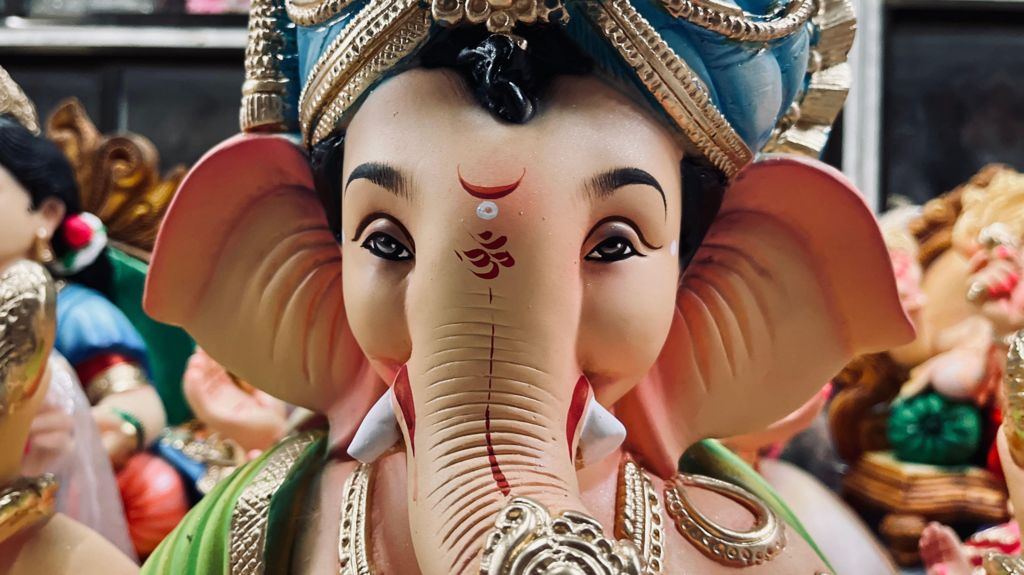
Weeks before the start of Ganesh Chaturthi, one of Hinduism’s most widely celebrated annual festivals, catastrophic monsoon flooding has unleashed unprecedented destruction across India’s Raigad district, wiping out thousands of finished Ganesh idols and crippling a regional industry that supports hundreds of thousands of working families. For seasoned sculptor Dilip Mhatre, the disaster erased six months of meticulous craft work in hours. The 40-year-old artisan had completed 500 clay idols of the elephant-headed deity Ganesha, valued at approximately 800,000 Indian rupees ($8,300), that were scheduled for delivery to communities and customers across Maharashtra in the lead-up to the festival. Standing amid the splintered remains of his inventory in his flood-ravaged workshop, Mhatre described the scale of his loss: “But the flood washed everything away. We have no idols, no moulds and no raw material. We don’t know how we’ll fulfil the orders now.”
Mhatre’s devastation is far from an isolated case. It is part of a sweeping crisis that has shaken the core of Raigad’s economy, a region long known as the beating heart of India’s Ganesh idol production. Each year, roughly 20,000 local workshops craft up to 8 million clay idols for the festival, where millions of households and community groups install the idols for celebrations before carrying out a ceremonial immersion in water at the end of the event. The multi-billion-rupee industry provides seasonal work for 150,000 people across the district, and serves as the primary source of income for generations of artisan families. This year’s extreme rainfall has upended that entire ecosystem, damaging thousands of idols and inundating hundreds of workshops, putting the livelihoods of thousands of craftspeople at severe risk just weeks before the peak buying period.
Sachin Patil, president of the regional idol makers’ association Ganesh Murtikar Utkarsh Mandal, estimates that nearly 1 million idols across Raigad have been damaged by the extreme downpour, with approximately 3,000 workshops impacted by flood damage. While local authorities have begun conducting damage assessments to qualify artisans for government financial assistance, the process is still in its early stages, leaving many craftspeople in limbo.
While seasonal monsoon rains are a normal annual occurrence in western India, and Raigad’s sculptors have long adapted their practices to protect their work from seasonal flooding, this year’s rainfall has far outpaced any recent event. Between July 5 and 7 alone, the district recorded more than 548 millimeters (21.6 inches) of rain — nearly matching the 663 millimeters recorded across the entire month of July 2025, according to India’s official meteorological department. The relentless downpour overwhelmed local rivers and drainage infrastructure, triggering widespread flooding that rose several feet in low-lying workshop areas, overcoming the standard flood protections artisans have relied on for decades, such as plastic sheeting and raised storage platforms. “In the past, rainwater would collect in the village but never reach the workshop area,” Mhatre explained. “This time, everything was washed away.”
The destruction extends far beyond finished idols. Many artisans lost critical tools, custom moulds, and raw materials including raw clay and plaster of Paris — supplies that are essential to restarting production even if they wanted to begin over from scratch. Crafting a Ganesh idol is a deeply labour-intensive process that requires multiple stages of moulding, casting, drying, sculpting, and hand-painting. Even small, affordable idols that retail for just $5 to $8 can take up to two weeks to complete, while large community idols can cost tens of thousands of rupees and require months of work. For many artisans, this means that even with additional supplies, it is impossible to replace the lost inventory in time for the upcoming festival, which is only weeks away.
Mhatre, for example, estimates the floods have cost his family roughly 1.2 million rupees in lost inventory, materials, and revenue. Idol making has been his family’s only source of income for three decades, covering household costs and his children’s education. He has already been forced to notify customers he cannot fulfill their pre-placed orders, and plans to take on high-interest debt to refund advance payments he received months ago.
For most craftspeople, the damage is effectively irreversible. Rain-soaked idols warp and degrade quickly, making them unsellable, and only a small share of idols with minor damage can be dried, repaired, and put back on the market. While a small number of workshop owners carry insurance, many say the policies provide negligible payouts that come with restrictive fine print that makes meaningful compensation nearly impossible. “If the actual loss is 1m rupees, the insurance payout may be only around 10,000 rupees,” explained Anita Patil, a 53-year-old workshop owner in Kalve village. “There are many conditions attached to these policies and getting meaningful compensation is not easy.” Patil added that the floods have disrupted the entire annual production cycle, leaving artisans unsure how many of their waterlogged idols can even be salvaged.
The economic ripples of the disaster extend beyond Raigad, with artisans warning that international orders for Ganesh idols, already hit by slowing global demand, will face significant delays. Some artisans say they may need to rely on craftspeople outside Raigad to fulfill existing overseas commitments, as they do not have the inventory to meet demand.
In the wake of the disaster, many Raigad artisans are already rethinking their approach to future monsoon seasons, with plans to invest in permanent flood protections including raised concrete platforms, water-proof roofing, and elevated indoor storage for finished idols ahead of the rainy season. But with the 2026 Ganesh Chaturthi festival just weeks away, all efforts are currently focused on damage control. Many artisans are scrambling to source replacement idols from unaffected neighboring workshops, though they admit the chances of finding enough inventory to meet demand are slim. “With the festival so close, it is impossible to remake the same number of idols,” said sculptor Mahendra Patil. “If we cannot source idols from elsewhere, we will have to refund the advance payments.”
Slowly, workshops that were fully submerged just days ago are beginning to clear debris and dry out salvageable inventory across Raigad. While few artisans expect to fully recover from their financial losses anytime soon, nearly all say they have no plans to abandon the craft that has sustained their families for generations, as they work to salvage what they can of the 2026 festival season.