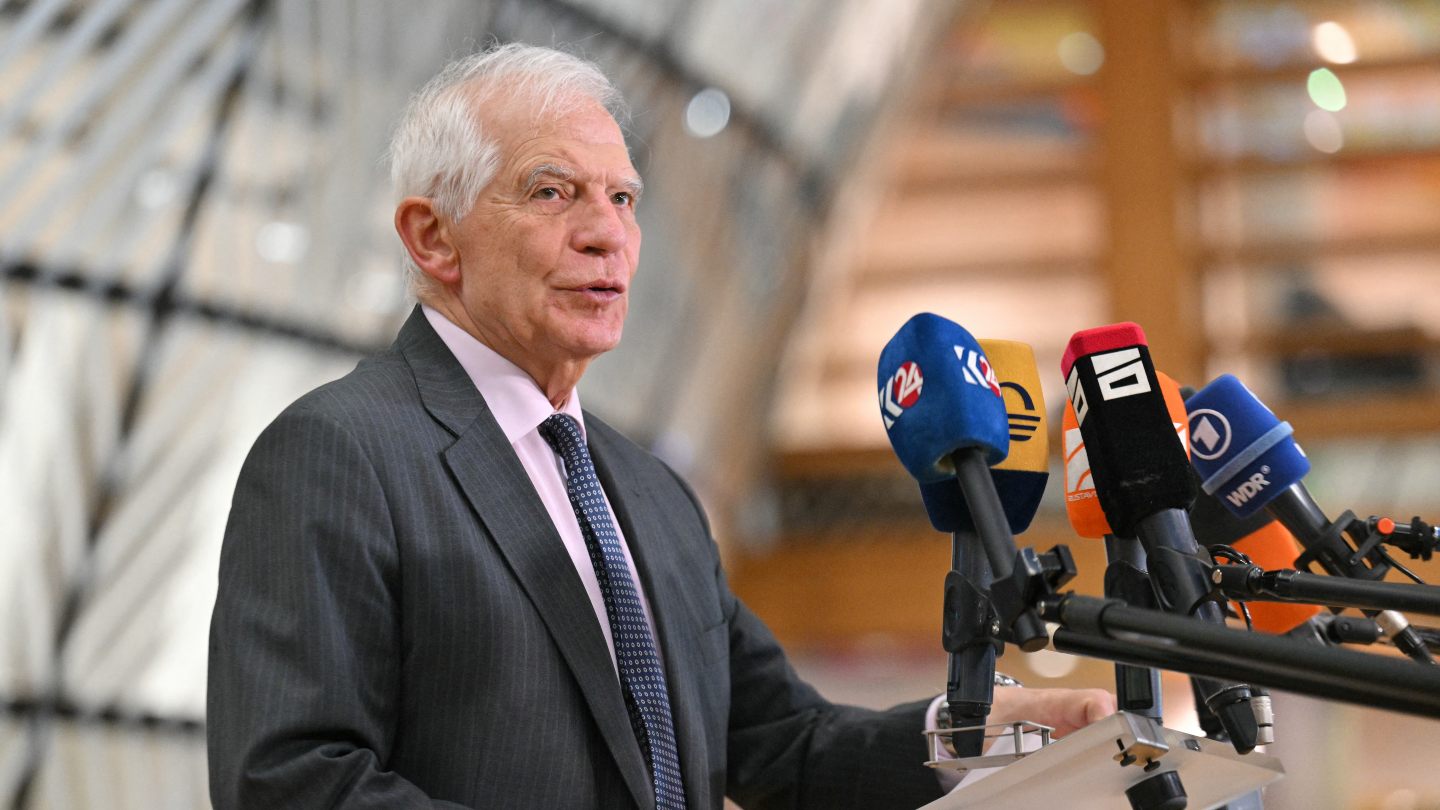
A former top European Union diplomat has leveled explosive accusations that the United States and Israel are leveraging unproven sexual misconduct claims against International Criminal Court (ICC) Chief Prosecutor Karim Khan to advance a long-held goal: disabling the global court from the inside out. In a Friday opinion piece published by Project Syndicate, Josep Borrell, the former EU High Representative for Foreign Affairs, is calling on ICC member nations to defend fair legal procedure when they vote on Khan’s future next week.
“Some institutional failures do not stem from public scandal, but from deliberate procedural sabotage, where acts of undermining are disguised under the rhetoric of good-faith investigation and accountability,” Borrell wrote in the piece. “By the time the true nature of what is unfolding becomes clear, irreversible damage has already been done. I fear this is exactly what we are witnessing in the coordinated attacks against Karim Khan. Recent developments align perfectly with objectives Washington and Jerusalem have spent months advancing.”
The 125-member Assembly of States Parties (ASP) to the Rome Statute, the governing body of the ICC, is scheduled to cast its decisive vote on Khan’s tenure at United Nations Headquarters in New York on 24 July. The vote follows a June decision by the ASP’s 21-member executive bureau, which voted by a two-thirds majority last month to find Khan committed “serious misconduct” — a ruling that directly contradicts the findings of an independent judicial panel appointed by the bureau itself. That panel concluded evidence compiled from a United Nations investigation into the allegations was insufficient to confirm any form of misconduct. Khan has forcefully denied all accusations of wrongdoing and breach of professional duty.
Borrell points to a series of irregular procedural changes first exclusively reported by Middle East Eye that break the ICC’s own established rules. Originally, the removal process was structured as two separate votes: first, a vote to confirm whether serious misconduct occurred, followed by a second vote to decide on removal if misconduct was upheld. Under the Rome Statute’s Article 46, a finding of misconduct requires a two-thirds majority of states present and voting, while a final removal vote needs an absolute majority of 63 out of the 125 total ASP members. The ASP’s own March procedural guidance, seen by Middle East Eye, explicitly outlined this two-step process. Despite this, the bureau chose to merge the two votes into a single ballot that requires only an absolute majority to remove Khan immediately.
The contours of the misconduct allegation have also shifted dramatically, Borrell argues. In a confidential June 8 bureau decision obtained by Middle East Eye, the body claimed it had found “beyond reasonable doubt” that Khan engaged in a sexual relationship with the complainant, arguing that such a relationship was inherently inappropriate due to the power imbalance between the two. This reframing directly deviates from the original non-consensual sexual misconduct allegations that formed the core of the investigation and subsequent media leaks. Both Khan and the complainant have denied the existence of any consensual sexual relationship.
Borrell warns that this procedural manipulation lowers the bar for removal dramatically. “This is no trivial procedural change. Folding the second vote into the first — on an accusation that remains unproven — allows for removal based on an unsubstantiated claim, or even a completely new allegation no one ever raised, such as an abuse-of-authority consensual relationship,” he wrote.
Tracing the origins of the campaign against Khan to a direct threat from U.S. lawmakers earlier this year, Borrell notes that in April 2024, a bipartisan group of U.S. senators explicitly warned Khan that moving forward with an arrest warrant for Israeli Prime Minister Benjamin Netanyahu would make him a target for retaliation. Despite the threat, Khan proceeded to file applications for arrest warrants against Netanyahu, former Israeli Defense Minister Yoav Gallant, and three senior Hamas officials. This was not the first time Khan has pursued warrants against high-profile leaders who had long been considered untouchable: under his tenure, the ICC has also secured warrants for Russian President Vladimir Putin, former Philippine President Rodrigo Duterte, and senior Taliban leadership.
Borrell frames the attack on Khan as part of a broader, well-documented offensive to dismantle the ICC entirely. He points to a recent Wall Street Journal op-ed by U.S. Secretary of State Marco Rubio, who openly stated the current U.S. administration intends to dismantle the court “brick by brick.” Washington has already imposed harsh sanctions on 11 senior ICC officials, including Khan, two deputy prosecutors, and eight judges: the sanctions have frozen their personal bank accounts and restricted access to services provided by major global tech and finance platforms including Apple, Amazon, and PayPal.
Citing reporting from The Financial Times, Borrell also revealed that former U.S. President Donald Trump, during a May 2025 meeting with Chinese President Xi Jinping, proposed that China and Russia — neither of which are parties to the Rome Statute — join the U.S. campaign against the court. Borrell argues this move directly undermines the U.S.’s official justification for its anti-ICC campaign, which it frames as a defense of national sovereignty. “That America’s chosen partners in this crusade are precisely the two countries with the greatest reason to fear the court says more about the real purpose of the operation against Khan than any official communique about sovereignty,” he wrote.
“Both the Trump administration and Prime Minister Netanyahu want the same outcome: to ensure that no international court can hold soldiers, state officials, or their allies accountable, no matter how severe the allegations of war crimes and crimes against humanity,” Borrell added. “Both see the so-called ‘Khan scandal’ as the perfect opportunity to defang the court permanently. They do not need to destroy it from the outside when they can convince its own member states to hollow it out from within, ignoring a formal judicial finding to stage a political vote against the man who issued the arrest warrants that most inconvenienced them.”
Closing his argument, Borrell praised Khan for his willingness to pursue high-profile suspects that would have been off-limits in the court’s earlier history. “At a time when international criminal justice and the global rule of law are facing a full-scale frontal assault, not least from indicted war criminals themselves, he deserves the full recognition and support of the international community,” he concluded.