A devastating season of Canadian wildfires has triggered a sharp diplomatic standoff between U.S. lawmakers and Canadian officials, as hazardous smoke continues to blanket large swathes of the United States, triggering public health emergencies and disrupting daily life.
As of last Friday, official data from the Canadian Wildland Fire Information System recorded more than 890 active wildfires burning across Canada, with over half of these blazes classified as out of control. To date, the infernos have consumed nearly 3 million hectares of Canadian land, making this one of the most destructive wildfire seasons on record for the North American nation.
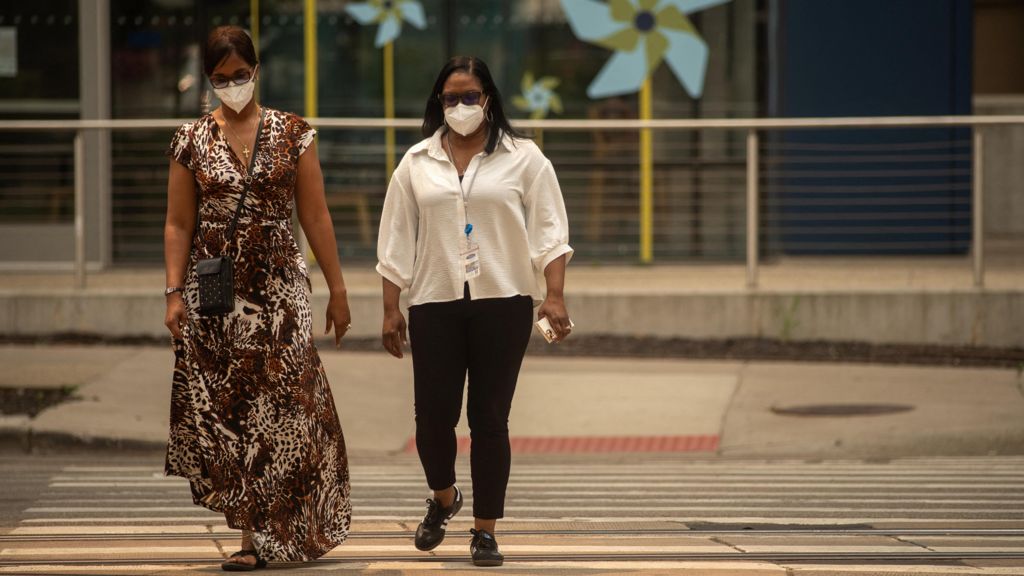
The far-reaching impact of the blazes has crossed international borders, with a dense, toxic blanket of smoke spreading south into multiple U.S. states, stretching from Minnesota and Michigan in the Midwest to Pennsylvania, Ohio and New York on the East Coast. Hazardous air quality warnings have been activated across the entire affected region, forcing the cancellation of dozens of outdoor public events and forcing residents indoors to avoid exposure.
On Friday, global air quality tracker IQAir ranked Chicago, Illinois as the city with the worst air quality on the planet, with Detroit, Michigan — one of the U.S. cities hardest hit by the pollution — claiming second place, followed by Washington D.C., Toronto and New York City. On Thursday last week, thick smog completely obscured iconic New York City landmarks including the Empire State Building and the Statue of Liberty, prompting city officials to extend existing heat emergencies and activate full air quality emergency protocols. Hundreds of cooling centers have been opened across the five boroughs, and free KN95 masks are being distributed to residents to help reduce smoke inhalation.
The poor air quality has sparked fierce criticism from four Republican members of the U.S. Congress representing districts in Michigan. In a joint open letter addressed to Canadian Prime Minister Mark Carney, the lawmakers — John James, John Moolenaar, Jack Bergman and Lisa McClain — said their patience with Canadian inaction on the wildfire crisis has run out.
“We are done accepting apologies in place of action,” the letter read, adding that the delegation warned the U.S. could move forward with direct cross-border intervention for wildfire management and firefighting operations if Canada failed to take meaningful steps to address the root of the crisis. The lawmakers accused Canada of failing to follow through on 2023 promises to treat the wildfire risk with urgency, claiming that “American lungs are paying the price for Canadian inaction, year after year.” They specifically cited unaddressed issues including chronic underinvestment in preventative measures such as forest thinning, fuel load reduction and controlled prescribed burns, as well as insufficient enforcement to prevent arson.
Prime Minister Carney did not directly respond to the specific accusations in the letter, but used a recent Ontario press conference to push back on the framing of the crisis. Speaking in French, Carney emphasized that “Climate change is everyone’s responsibility — truly everyone’s — including the United States.” He added that his federal government maintains constant close communication with provincial authorities and local affected communities to coordinate response efforts.
Ontario Premier Doug Ford also dismissed criticism of his provincial government’s wildfire response, noting that more than 150 fire crews are already deployed on the ground battling active blazes. “We will spend whatever it takes,” Ford stated, to bring the fires under control and support affected communities.
A large cluster of active blazes in northwestern Ontario is the primary source of the smoke drifting south into the U.S. Thick plumes of toxic smoke have already rendered air quality unsafe across Thunder Bay and Toronto in Ontario, before spreading over the Great Lakes and settling over the Northeastern U.S., creating persistent hazy conditions as far south as New York. Beyond the cross-border smoke impacts, the wildfires have already displaced dozens of Indigenous residents from First Nations communities in northern Ontario. Some communities have been forced to evacuate the remote region by boat, and Namaygoosisagagun First Nation Chief Helen Paavola told local outlet CityNews that an aerial survey of her community confirmed it has been “burnt to ashes.”
Data from Canada’s National Forestry Database shows that roughly half of all annual Canadian wildfires are ignited by lightning strikes, while the remaining half are caused by human activity. Climate experts from both Canada and the U.S. have previously warned that rising global temperatures driven by climate change are drying out forest landscapes across North America, creating far more flammable conditions that increase the frequency and severity of major wildfire seasons. When asked by the BBC earlier this year whether Canada could be doing more to curb wildfire risk and resulting smoke pollution, cross-border expert consensus concluded that there is little more Canada could do to stop the large-scale blazes driven by current climate conditions.