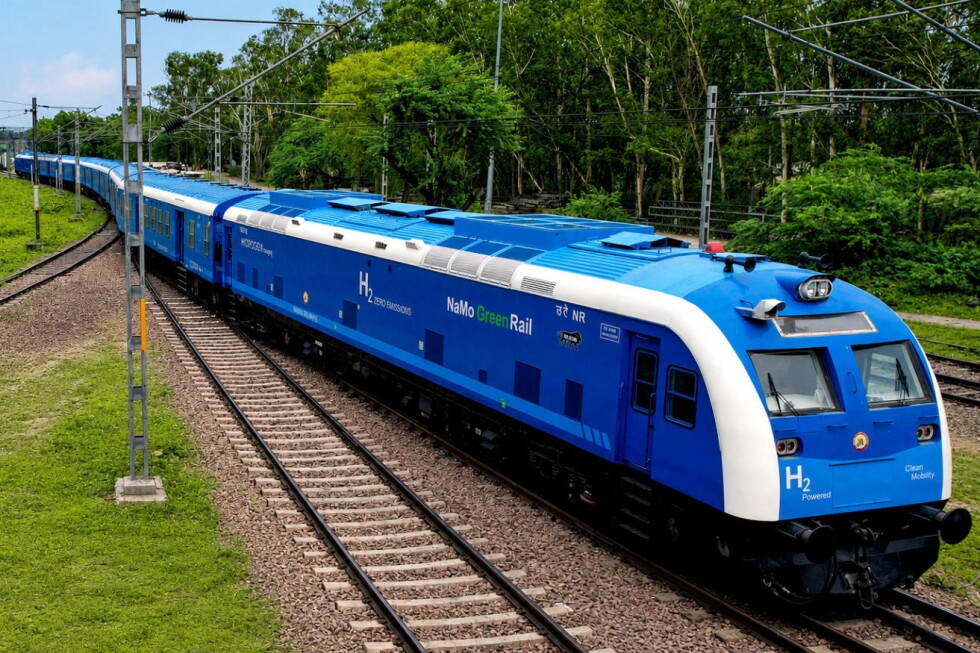
NEW DELHI – In a landmark step toward decarbonizing one of the world’s largest rail networks and advancing domestic clean energy manufacturing, India debuted its first indigenously developed hydrogen-powered train this Friday. The inaugural service, named “NaMo Green Rail” in a nod to Prime Minister Narendra Modi, was officially inaugurated by Modi at Jind Railway Station in the northern state of Haryana, where it will begin regular operations.
The new train consists of two hydrogen-fueled driving units paired with eight passenger coaches. According to Indian Railway officials, it boasts a top operating speed of 75 kilometers per hour (roughly 47 miles per hour) and can accommodate up to 2,600 passengers per trip. Unlike traditional diesel locomotives that spew greenhouse gases and local air pollutants, hydrogen fuel cell-powered trains produce no harmful direct emissions—their only byproduct from energy generation is water vapor, making them a zero-emission alternative for non-electrified rail routes.
This launch is not just a one-off demonstration; it forms the core of a pilot project designed to test the real-world feasibility of hydrogen technology for Indian Railways. The initiative includes purpose-built hydrogen storage and refueling infrastructure built alongside the route, allowing engineers and policymakers to gather operational data ahead of potential wider rollouts across the country’s vast 68,000-kilometer rail network.
In a social media post on X following the inauguration, Modi emphasized the milestone’s dual importance for India’s national development. He framed the rollout as a critical leap forward for both the country’s goal of building a self-reliant industrial economy and its global commitment to sustainable, low-carbon development.
Globally, hydrogen trains have emerged as a leading solution for rail networks aiming to phase out polluting diesel locomotives on routes where full electrification is not economically or logistically practical. A number of other countries have already begun deploying hydrogen-powered passenger services in recent years, creating a growing global market for the technology.
For India, this launch aligns with much broader national climate and energy strategies. The country has pledged to reach net-zero carbon emissions by 2070, and Indian Railways has identified green hydrogen as a key alternative to diesel for its non-electrified routes. The government has also prioritized scaling up domestic green hydrogen production as part of its national clean energy transition, positioning the country as a growing player in the global hydrogen economy.