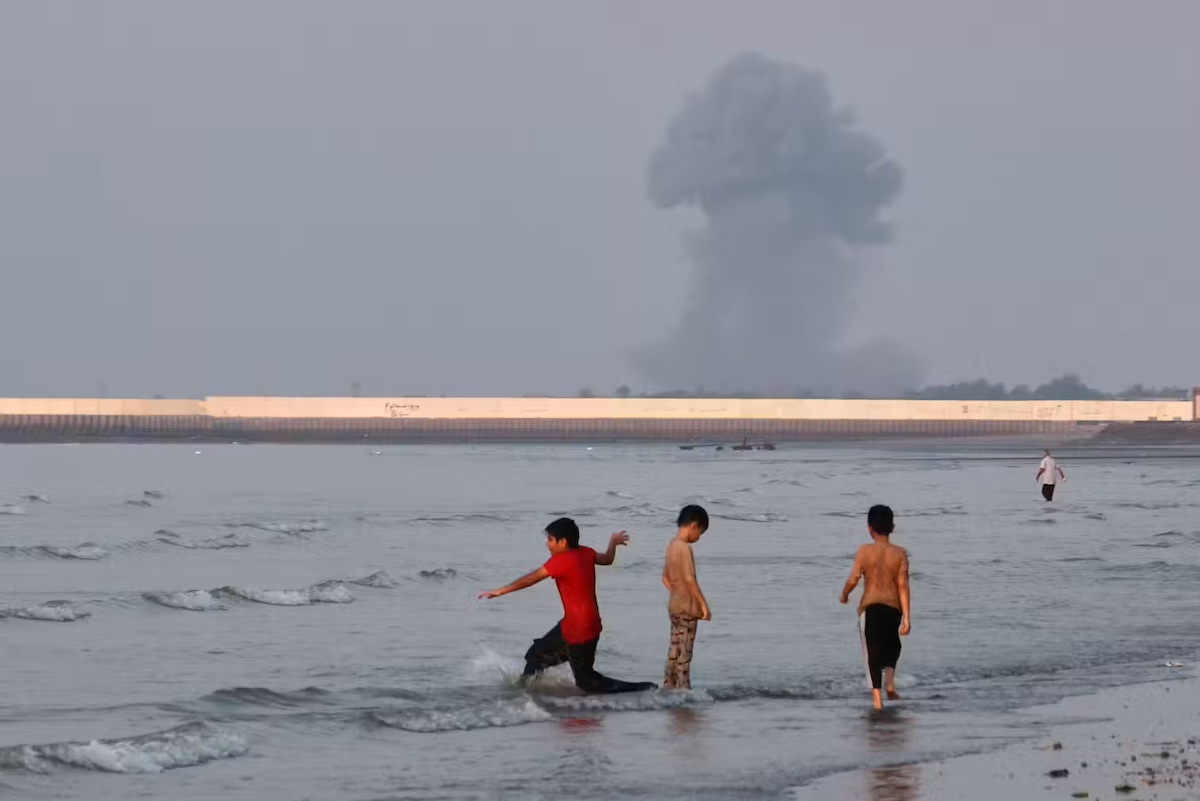
Just over a year ago, former U.S. President Donald Trump delivered a blunt, dismissive remark to Ukrainian President Volodymyr Zelensky in the Oval Office amid Ukraine’s war against Russian invasion: *“You don’t have the cards.”* Today, that line has flipped: it is Trump, now locked in a tense military standoff with Iran, who finds himself holding no winning hand over control of the world’s most critical energy chokepoint, the Strait of Hormuz.
Militarily, Iran cannot match the full conventional power of the United States. But Tehran has mastered asymmetric tactics to exert outsized leverage over the 21-mile-wide waterway, through which roughly 20% of the world’s daily oil and gas supplies, plus large global shipments of critical industrial commodities including sulphur, ammonia, urea and helium, pass. No matter how many public declarations Trump issues guaranteeing open commercial transit, he lacks the ability to enforce that guarantee.
This week, the U.S. resumed air bombardments targeting Iranian positions along the strait in an attempt to break Tehran’s control. But military analysts warn the situation could spiral into far broader conflict if Trump is pushed into a corner by his own political and military positioning.
### How Iran Turned Geopolitics Into Leverage
Iran’s power over the strait stems from a core asymmetric warfare strategy: acting as a disruptive spoiler. Every day the strait remains effectively closed to unimpeded transit, it ratchets up economic and political pressure on the U.S. and its Persian Gulf partner states to end hostilities.
The Islamic Revolutionary Guard Corps (IRGC), Iran’s elite military force, has already demonstrated its ability to disrupt commercial shipping at will over the past week, using drones and missile strikes to threaten vessels. Despite sustained U.S. bombardments since the outbreak of the current conflict, the majority of Iran’s missile emplacements along the strait have been restored and are fully operational once again.
This persistent threat has had a direct impact on global shipping: major international insurers including Lloyd’s of London have either refused to underwrite policies for voyages through the strait, or hiked premiums to prohibitive levels that make commercial transit unprofitable. Beyond disrupting shipping, the IRGC has carried out large-scale strikes across every Gulf state this week, inflicting severe damage on dozens of U.S. military bases stationed across the region. The long-held perception among Gulf monarchies that hosting U.S. military forces would guarantee their national security has been completely dismantled by these attacks.
### Why Broader Escalation Remains a Clear Risk
A cold hard reality shapes the current standoff: there is no purely military solution that will force the Strait of Hormuz open permanently. At the same time, neither the Iranian regime nor the Trump administration has an interest in spiraling into large-scale escalation, as both face massive potential losses. U.S. military operations alone have already topped $100 billion in costs, with no clear strategic gains to show for the spending.
But the domestic calculus on both sides pushes toward greater conflict. In Tehran, hardline factions have been emboldened by a wave of national mourning following the death of long-serving Supreme Leader Ali Khamenei, leaving them far more willing to pursue prolonged conflict than pragmatic leaders in other capitals. Analysts assess that Iranian hardliners can withstand a U.S. naval blockade and sustained bombardment for many more months, and the Iranian regime is actually in a stronger strategic position today than it was when the war began, even as the conflict remains unpopular with the majority of the Iranian public.
For Trump, meanwhile, political pressure to be seen as a winner is intense. And with many of the conventional institutional checks and balances that limit presidential war power having been weakened in recent years, the risk of reckless, unplanned escalation is very real. Trump has repeatedly threatened to strike Iranian civilian critical infrastructure, including power grids and desalination plants – a move that would almost certainly prompt Iran to retaliate against energy infrastructure across Gulf states. Such a retaliation would have immediate, long-lasting impacts on the global economy, as seen when Iran targeted Gulf energy sites earlier in the conflict.
If escalation proceeds even further to target the more than 400 desalination plants that supply nearly all of the Gulf’s drinking water, the humanitarian consequences would be catastrophic. Iran could also pressure the Houthi movement in Yemen to abandon its current limited blockade of Israeli shipping in the Bab el-Mandeb Strait, the critical chokepoint at the southern end of the Red Sea that carries 10% of all global trade, and resume attacking all commercial vessels transiting the waterway. Until now, the Houthis have held back from broader attacks, in large part because they reached a detente with neighboring Saudi Arabia after years of war. But that ceasefire is now teetering, following this week’s airport attack that the Houthis have blamed on Saudi Arabia.
### A Ground Invasion Would Be A Catastrophic Failure
History and geography make any U.S. ground campaign against Iran a disastrous proposition. Air power alone has never achieved regime change, and for all its unmatched military might, the U.S. has not won a major interstate war in more than 80 years. A full escalation against Iran would require deploying U.S. ground troops, echoing the 2003 invasion of Iraq. But even a coalition of hundreds of thousands of troops failed to bring lasting stability to Iraq after the invasion, and Iran is nearly four times larger than Iraq.
Assembling the massive force required to control even just Iran’s mountainous southern coast is effectively inconceivable. What is more, the spread of modern drone technology has created a new era of asymmetric warfare that Iran is far better positioned to exploit than the U.S. Iran has built up a deep, self-sufficient domestic military industrial base that has allowed it to create a far more balanced fight against the world’s most powerful military than many analysts predicted. For any U.S. force attempting to occupy even limited territory such as the Iranian coast or key Kharg Island energy terminal, the opposition would be formidable and sustained.
Even the most extreme outcome, the deployment of U.S. tactical nuclear weapons, remains a small but non-negligible risk – a move that would open a Pandora’s box of unforeseen catastrophic consequences for the entire global order.
In the end, what is Trump’s least bad option? Allowing Iran to cement its new level of control over the Strait of Hormuz sets a dangerous precedent for global maritime security, but analysts argue it remains the better outcome compared to the catastrophic costs of further escalation.