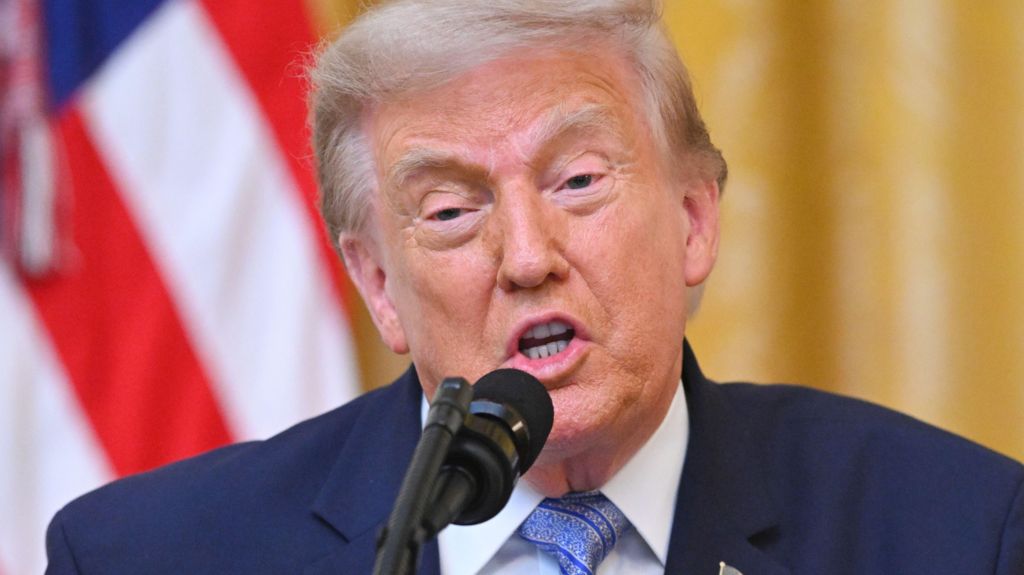
In a primetime televised address from the White House Thursday, former President and 2024 presidential candidate Donald Trump reiterated a series of unproven allegations that China interfered in the 2020 U.S. presidential election and claimed there are “shocking vulnerabilities” in the nation’s voting infrastructure. The address came three months ahead of November’s midterm elections that will determine congressional control for the remainder of his current term.
During the 30-minute speech, delivered to an audience of senior administration members with no opportunity for press questioning, Trump claimed he had declassified hundreds of intelligence documents to back up his assertion that Beijing sought to tilt the 2020 election outcome toward Joe Biden, who ultimately defeated Trump in the contest. Trump also claimed that China had illegally obtained 220 million voter records containing sensitive personal information, alleging that voter data across 18 U.S. states had been “bought, stolen or hacked by China.” He further accused officials who had uncovered this alleged activity of failing to alert executive branch leaders or members of Congress. At no point during the address did Trump present tangible evidence showing China used the purloined data to manipulate voting systems or alter election results.
These claims directly contradict long-standing conclusions from the entire U.S. intelligence community. A 2021 declassified assessment from the U.S. National Intelligence Council stated with high confidence that China did not engage in any interference efforts targeting the 2020 presidential election, and only considered but ultimately rejected influence operations designed to change the vote outcome. The report noted the decision stemmed from China’s calculation that neither candidate’s victory offered enough strategic benefit to justify the risk of major diplomatic backlash if the interference was discovered.
In a statement provided to Reuters following the speech, the Chinese Embassy in Washington D.C. rejected all allegations, confirming that Beijing “has never and will never interfere in the presidential elections” of the United States. The BBC has also reached out to China’s Ministry of Foreign Affairs for additional comment, and has not yet received a response.
Domestically, the speech drew immediate sharp pushback from Democratic leaders, who argue Trump is deliberately spreading misinformation to erode public trust in the upcoming midterm elections ahead of voting. “Let’s be clear – in America, voters choose their leaders, not the other way around,” Senate Majority Leader Chuck Schumer wrote on social media immediately after the address. “Democrats will fight like hell to make sure every American voter can cast their ballot freely, without obstruction or interference from Donald Trump.”
Former Vice President Kamala Harris echoed this criticism in a post on X ahead of the speech, arguing that Trump’s goal is to suppress turnout among opposition voters. “The president is scared of your power, and he wants you to believe your vote does not matter,” she wrote. “He wants you to lose confidence in our electoral system so you stay home this November. He knows how discontent the American people are, and he wants to make sure that you do not vote.”
Beyond his China allegations, Trump expanded his claims of voting system vulnerability, asserting that widely used U.S. voting machines are “extremely exposed” to tampering by foreign adversaries including Russia, China, and Iran. While gaps and weaknesses in U.S. election infrastructure have been well documented by independent experts and government auditors, many vulnerabilities were addressed after the 2016 presidential election, when U.S. intelligence confirmed Russia carried out a large-scale meddling campaign including hacking, social media disinformation, and funding for grassroots political activity.
Trump also repeated unproven claims of domestic voter fraud: he alleged that Michigan law enforcement uncovered a voter registration fraud scheme linked to a Democratic-aligned organization, but that the FBI blocked investigators from acting before the statute of limitations expired. Calling the activity “pay, play and cheat,” Trump again offered no evidence that any vote totals were altered or any voting machines were compromised. He also claimed the Department of Homeland Security has identified 278,000 non-citizens registered to vote, but did not provide data showing any of these individuals actually cast ballots or affected the result of any election.
To address the purported flaws he outlined, Trump used his closing remarks to renew calls for Congress to pass the SAVE America Act, a bill that would ban most forms of mail-in voting, require documentary proof of citizenship to register to vote, and mandate photo identification to cast a ballot. The legislation has been stalled in the evenly divided Senate for months, and Trump’s push for passage is widely expected to fail unless Republican lawmakers agree to overhaul long-standing Senate procedural rules that currently require a 60-vote supermajority to advance most legislation, a step Republican leadership has so far rejected. The address comes as a new Washington Post-Ipsos poll shows Trump’s national approval rating has fallen to 37%, driven largely by widespread public pessimism over rising cost of living and the ongoing conflict with Iran.
Political analysts note the speech does little to ease Democratic fears that Trump will continue to question election legitimacy ahead of 2028’s presidential contest, should he choose to run for reelection. The ongoing partisan fight over election security has already become one of the defining issues of the 2024 midterm campaign cycle.