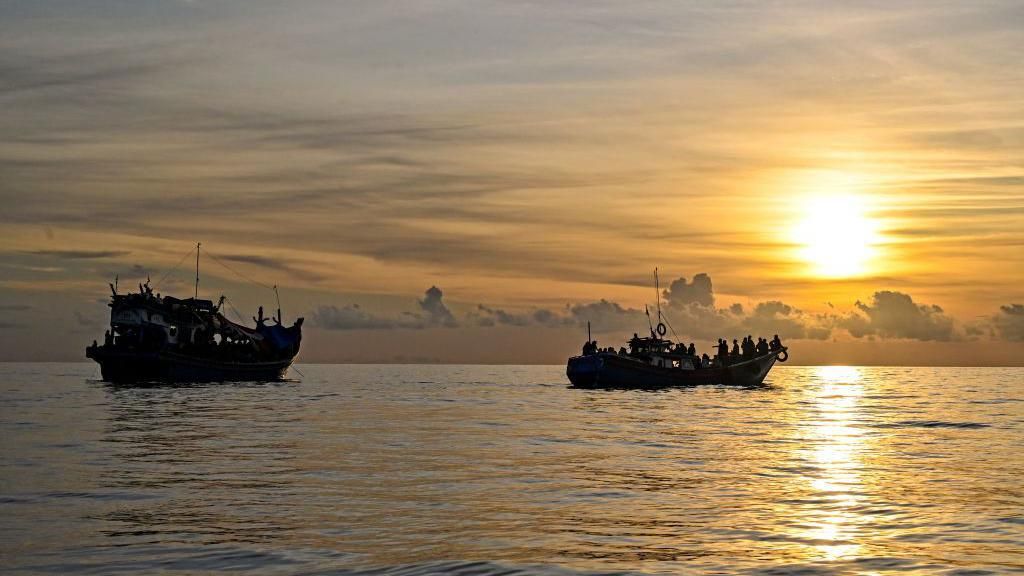
It has been nearly three weeks since two overcrowded boats carrying 530 Rohingya asylum seekers departed from Myanmar’s Rakhine State on June 29, and no contact has been made with anyone on board. Advocates working on Rohingya rights warn the entire group is likely lost, with the dangerous monsoon season and the unseaworthy condition of the converted vessels making mass casualties almost inevitable.
The two boats, modified old fishing trawlers packed far past their safe capacity to carry as many people as possible, set out amid already rough monsoon seas and carried unreliable engines. Roughly half of those on board are believed to be women and children, and Chris Lewa, director of the Arakan Project — a group that advocates for Rohingya rights — says it is highly probable both vessels capsized, with few to no survivors. Due to the ongoing conflict that has crippled communications across Rakhine State, a full accounting of what happened may never be possible.
Rakhine State has been mired in active conflict for years, with the Arakan Army insurgent group pushing Myanmar’s military out of most of the territory and laying siege to the junta’s last major stronghold in the state capital Sittwe, which is only accessible by air and sea. Nearly all telecommunications networks across the region have been cut off, leaving advocates like Lewa without direct access to on-the-ground sources in Sittwe and Sin Tet Maw, the Arakan Army-controlled departure point for the missing boats.
Through a network of secondary contacts and scattered information, Lewa has confirmed the two boats departed hours apart on June 29, bound for southern Myanmar, where passengers were to be transferred to smaller vessels before moving overland through forest transit camps, across Thailand, and to the Malaysian border. Under normal smuggling routes, families would expect to hear from their loved ones within 7 to 10 days; after nearly three weeks of total silence, fears for their safety have grown unavoidable. So far, authorities in Bangladesh have recovered one woman’s body washed ashore, and local fishermen found multiple additional bodies off the coast between Myanmar’s Irrawaddy Delta and Mon State nine days after the boats’ departure. These findings align with Lewa’s assessment that the first boat capsized just hours after leaving Sin Tet Maw, while the second sank several days into its southeast journey.
The crisis of the missing boats is rooted in the decades of systemic persecution and escalating instability that have left millions of Rohingya with no viable path to safety. More than one million Rohingya currently live in overcrowded, underfunded camps in southern Bangladesh, where aid resources have dwindled, formal employment is almost non-existent, and transnational smuggling networks operate with impunity. An additional 600,000 Rohingya remain trapped in Rakhine State: one quarter are confined to squalid internal displacement camps, while the rest eke out a precarious existence in communities caught between warring factions. Myanmar’s military junta has increasingly forced Rohingya men into conscription, while the Arakan Army — which claims to represent ethnic Rakhine people — has been repeatedly accused of severe human rights violations against the Rohingya population it distrusts. With prospects for safety and dignity at home nonexistent, fleeing to neighboring countries is the only option many see for survival.
Malaysia, which already hosts 200,000 Rohingya, has become the most popular destination for asylum seekers, creating a lucrative, brutal trade for transnational human smuggling rings with established networks across Bangladesh, Myanmar, Thailand, Malaysia, and Indonesia. Smugglers’ business model relies on packing as many people as possible into inadequate vessels, moving them undetected to Malaysia, and collecting fees ranging from $2,000 to $4,000 per person. Families that cannot pay face having their relatives detained, beaten, or even killed, with graphic videos of abuse sent to pressure relatives into raising the required funds.
Smuggling routes have shifted repeatedly over the past decade in response to regional enforcement efforts. In 2015, after mass graves of trafficking victims were discovered in primitive jungle transit camps, the Thai government cracked down on overland smuggling routes, closing camps in mangrove swamps and rubber plantations where captives were held until ransoms were paid. This crackdown forced many smuggling operations to redirect boats toward Aceh, Indonesia, where local fishing communities initially welcomed the Rohingya as fellow persecuted Muslims. That welcome has since eroded, with anti-Rohingya social media campaigns spreading hostility across the country in recent years.
Direct sea routes to Malaysia remain largely blocked: the Malaysian Navy regularly intercepts refugee boats and pushes them back into international waters, and local fishing communities refuse to assist smuggling operations. As a result, smuggling networks have reverted to using Thailand as their primary transit hub. Today, large mother vessels pick up Rohingya off the coasts of Rakhine or Bangladesh’s Teknaf, staying only long enough to unload passengers before moving on to avoid detection by authorities from both countries. Smugglers use satellite phones to coordinate with local networks, paying fishermen to transfer passengers to smaller craft that land on southern Thai or eastern Sumatran coasts. Once full payment is received, refugees are moved secretly overland to Malaysia. Other groups are dropped on southern Myanmar’s coast, then transported overland through border crossings to Thailand and on to the Malaysian border. For Rohingya fleeing Rakhine State, however, every escape route begins with a dangerous open sea crossing, since all land routes out of the conflict-torn region remain closed.
The United Nations High Commissioner for Refugees estimates that as of mid-2026, at least 4,700 Rohingya have fled the region this year alone on 74 boats, and Lewa estimates the total number of departures since September 2025 may be as high as 10,000 — a sharp increase from previous years, directly driven by the worsening intolerable conditions facing the community in both Rakhine and Bangladesh. The UN has called for the creation of formal safe passage routes for Rohingya seeking asylum, but no country in the region has been willing to accept more refugees or facilitate safer passage, leaving thousands of desperate people to the mercy of brutal smuggling networks and dangerous monsoon seas.