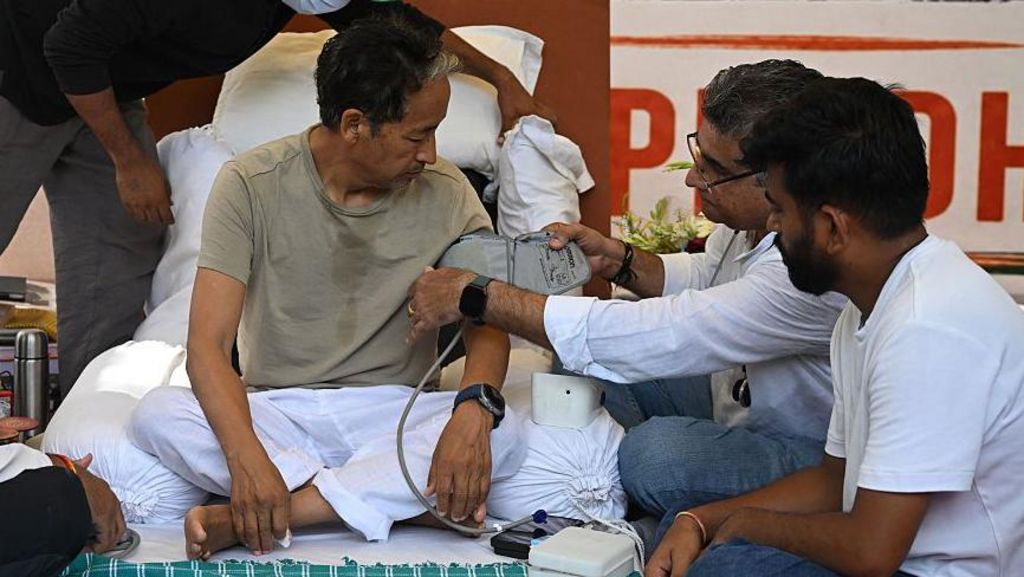
A 20-day-long indefinite hunger strike by prominent Indian education reform activist Sonam Wangchuk has emerged as a flashpoint of political tension in New Delhi, with the Delhi High Court stepping in this week to mandate round-the-clock health monitoring for the 59-year-old protester, who has already lost more than 9 kilograms after surviving on only salt and water since the protest began.
Despite growing appeals from across India’s political and civil society spectrum to end his fast, Wangchuk has remained unyielding in his commitment to the protest, which he launched in solidarity with the online satirical activist movement Cockroach Janta Party (CJP). The movement has organized nationwide demonstrations to demand sweeping changes to India’s education system and the resignation of federal Education Minister Dharmendra Pradhan in the wake of a high-profile medical entrance exam cancellation earlier this year.
The exam, a key entrance test for aspiring medical students across the country, was called off in early May after widespread reports of a major question paper leak. Protesters argue that repeated leaks and systemic failures in India’s examination system have ruined the career prospects of millions of young students, and Pradhan must take ultimate moral responsibility for the scandal and step down from his post.
Speaking from his protest site at New Delhi’s iconic Jantar Mantar, where crowds have gathered daily to support his action, Wangchuk acknowledged his declining physical condition but reaffirmed his unshaken resolve. “I’ve grown weak from the outside but I’m strong from within,” he told supporters, whose response filled the square with cheers and applause. Though his voice was noticeably frail in video footage shared Friday on the CJP’s official X account, Wangchuk used his address to urge supporters to join a planned peaceful march to India’s Parliament on Monday.
“Together, we will march peacefully to the parliament and put forward our petitions at the altar of democracy,” he said, adding a dark joke that if he did not survive long enough to join the march, “my ghost would join the march.”
To date, Prime Minister Narendra Modi’s ruling government has refused to open any dialogue with the protesters, with Pradhan dismissing the CJP and its backers as “the B-team of disruptive elements.” But mounting pressure from opposition parties and civil society leaders has forced the issue into the public spotlight, with high-profile politicians openly backing Wangchuk’s demands.
On Thursday, former Delhi Chief Minister and Aam Aadmi Party national leader Arvind Kejriwal visited the protest site to meet Wangchuk, greeting the activist with a traditional folded-hand welcome before echoing calls for the government to negotiate with demonstrators. “Every year, exam papers get leaked and youth pay the price,” Kejriwal said, calling on the administration to listen to the grievances of students and Wangchuk, and even suggesting that Pradhan be replaced by the activist himself.
Jammu and Kashmir Chief Minister Omar Abdullah, leader of the National Conference party, also spoke out in support of Wangchuk this week, noting that past governments had opened dialogue with hunger-striking activists when public grievances were legitimate. Abdullah recalled that the Congress-led United Progressive Alliance government sent senior ministers to negotiate with iconic anti-corruption activist Anna Hazare during his 2011 hunger strike in New Delhi, a landmark moment for Indian grassroots protest. “Politics has its place, but there must also be a room for humanity and compassion,” Abdullah said, adding that “no attempt has been made so far to initiate a dialogue with Mr Wangchuk” despite his “legitimate” demands.
The legal intervention came Thursday during a court hearing on a public petition regarding Wangchuk’s deteriorating health. The Delhi High Court ordered the federal government to immediately intervene to protect the activist’s health, mandating regular monitoring and access to urgent medical care if required. Following the court order, The Times of India reported that India’s federal Ministry of Health has directed three top New Delhi government hospitals to conduct comprehensive health checks on Wangchuk twice every day to track his declining condition.
As the country waits for Monday’s planned parliamentary march, the standoff between grassroots protestors and the ruling government continues to intensify, with Wangchuk’s declining health adding a urgent time pressure to the unfolding political crisis.