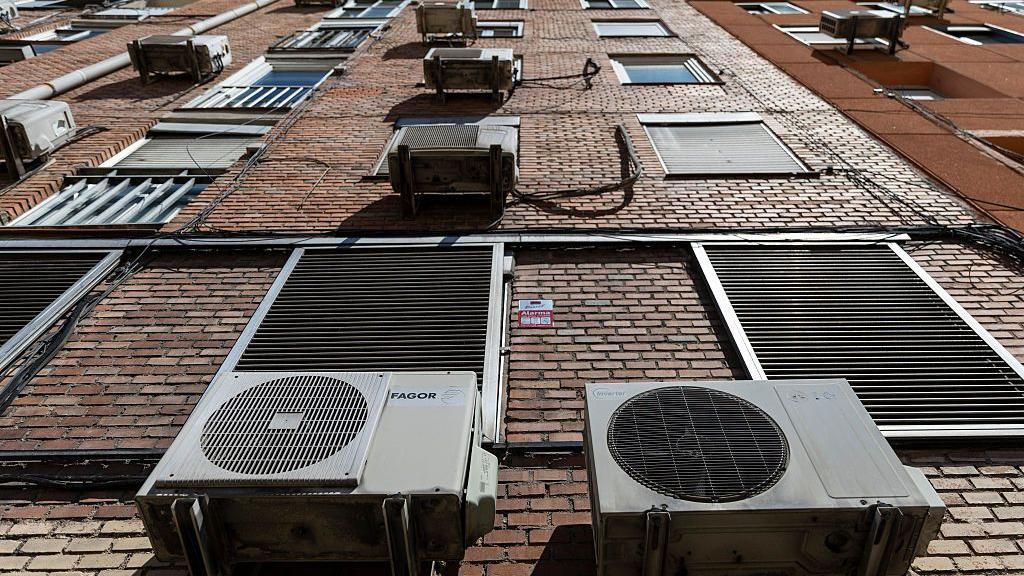
As record-shattering heatwaves continue to bake Western Europe, shifting consumer habits and long-standing regulatory barriers have created an unexpected boom for Chinese air conditioning manufacturers, who have carved out a massive new market by designing products tailored to the continent’s unique needs.
For years, most European households went without air conditioning. Mild summer temperatures and strict urban building codes—particularly in historic city centers that ban permanent exterior modifications for traditional external AC units—kept ownership rates far lower than in regions like North America or East Asia. But this year’s extreme heat has upended that status quo: Western Europe logged its hottest June on record in 2026, with temperatures pushing past 40°C (104°F) across major German cities, and forecasters warn more intense heatwaves are still to come before the summer ends.
The turning point for many residents came with Midea’s PortaSplit, a portable split-system air conditioner engineered specifically to comply with European building regulations. Steven Scholtysek, a 36-year-old engineer living in a heat-trapping attic apartment in Hamelin, Germany, describes the device as a complete game-changer for surviving this summer’s swelter. Unlike traditional portable AC units that are bulky, inefficient, and require blocking an entire window to vent hot air, the PortaSplit features a lightweight external unit that users can install themselves outside a window, no drilling or permanent structural changes required. It is marketed as compatible with nearly all common European window designs, solving a problem that has stymied many homeowners for years.
Demand for the PortaSplit has exploded so rapidly that retailers have sold through their entire stock, with resold units appearing on secondary marketplaces marked up to two or three times the original €750 retail price. Fans of the device have even launched an independent tracking site called MideaFinder to help shoppers alert each other when new stock becomes available. The device has developed a cult-like following among heat-weary Europeans: Vienna resident Denis Yurchak, who purchased a PortaSplit to get through this summer’s heat, says he has received dozens of messages from curious shoppers after he shared his positive review on social media platform X. He ran the unit 24 hours a day during the peak of the heatwave, and says it has exceeded all his expectations.
Midea is not the only Chinese manufacturer seeing explosive growth. According to reports from Chinese state media, Midea’s year-over-year sales across France, Spain, Germany, and the UK have surged more than 70%. TCL Technology reported a more than 300% jump in air conditioning sales in France alone, while Gree—one of the world’s largest AC producers—confirmed that demand this summer has been noticeably stronger than in previous years, with most new buyers purchasing an air conditioner for the first time. “The increasingly frequent and prolonged summer heatwaves have clearly changed consumer attitudes,” a Gree spokesperson noted in a statement.
The sudden mass adoption of air conditioning across Europe has sparked debate about its long-term costs. A 2024 industry report estimates that air conditioning accounts for 7% of global electricity consumption and contributes 2.7% of global carbon dioxide emissions from fossil fuels and industrial activity. Environmental advocates have warned that widespread AC use could increase strain on European energy grids and raise urban temperatures in dense neighborhoods as units expel excess heat outdoors. Even so, extreme heat has forced policy shifts: after hundreds of French schools were forced to close during a late-June heatwave, the French government committed €80 million to install cooling systems, including air conditioning, in schools and public community centers.
The World Health Organization’s European regional office has advocated for a balanced approach to air conditioning use, noting that while widespread AC adoption is not a sustainable long-term solution to rising extreme heat, it remains a critical tool to protect vulnerable populations from heat-related illness and death.
For Chinese manufacturing, the AC boom marks a notable shift in global reputation. For decades, “Made in China” was largely associated with low-cost, lower-quality mass-produced goods, but European consumers are increasingly reevaluating that perception. Many PortaSplit owners told the BBC they were surprised to learn the device was manufactured by a Chinese brand, praising its modern design and build quality that matches or exceeds that of European competitors. Launched in Germany in 2024, the PortaSplit was developed at Midea’s Stuttgart research center, combining German engineering expertise with Italian design to appeal to European consumers.
Scholtysek, the German engineer who purchased one of the first PortaSplit units, says the popularity of Midea’s AC is part of a broader shift in how European consumers view Chinese technology brands, from drone maker DJI to electric vehicle manufacturers. So impressed was he with his unit that he even purchased shares of Midea stock to signal his confidence in the company. Midea’s European leadership says they see significant long-term growth potential on the continent, and plan to continue investing in product development tailored to European consumer needs and regulatory requirements.
Adrien Olar, a 26-year-old resident of France who bought his first air conditioner—a Midea PortaSplit—earlier this summer, calls the device a revolution. Before his unit arrived, he relied on splashing water on his face to stay cool in his overheated apartment. Now, he says, walking into his cooled room after being outside is like stepping into a fridge—a dramatic difference that has made this summer’s extreme heat bearable.