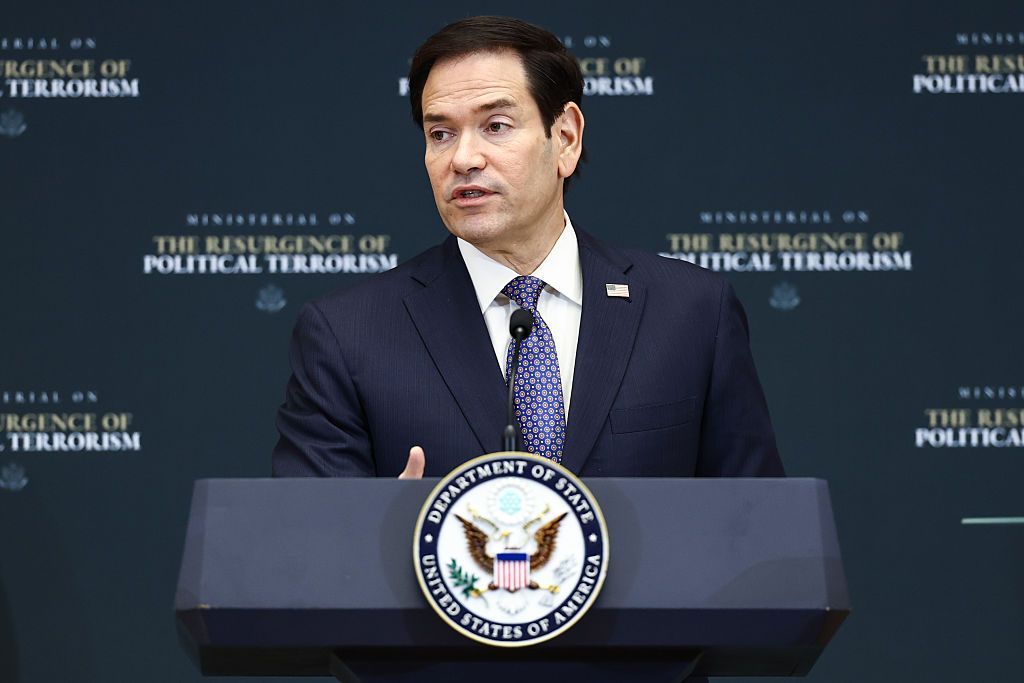
The Trump administration has brought together senior officials from more than 60 nations across Europe, Latin America, Asia and beyond for a high-stakes Washington summit focused on addressing what top U.S. diplomat Marco Rubio frames as a rapidly expanding transnational threat: left-wing terrorism.
In opening remarks to Thursday’s closed-door session, Secretary of State Rubio called on participating countries to deepen cross-border intelligence sharing and coordinate joint counterterrorism action, arguing that far-left extremism represents a global, interconnected challenge that demands collective response. Administration officials framed the political violence linked to left-wing groups as a singular form of harm rooted in deep-seated animosity toward existing Western social and political structures.
White House Deputy Chief of Staff Stephen Miller doubled down on this framing during the summit, claiming left-wing activism is fundamentally driven by resentment, hatred and envy toward successful individuals and democratic institutions. On the same day the gathering convened, the State Department announced new sweeping visa restrictions that bar entry to the U.S. for members of groups labeled “Far-Left Terrorist and other aligned groups”, including individuals accused of involvement in so-called economic sabotage. Washington has already formally designated four European far-left groups — Germany’s Antifa Ost, Italy’s Informal Anarchist Federation/International Revolutionary Front, and two Greek factions, Armed Proletarian Justice and Revolutionary Class Self-Defense — as official Foreign Terrorist Organizations. The administration previously designated the loose U.S.-based far-left anti-fascist movement Antifa as a domestic terrorist organization, aligning the global initiative with a long-stated domestic policy priority of the Trump White House.
Notably, the entire summit agenda made no mention of addressing the growing threat of far-right extremist violence, a choice that has drawn immediate fierce pushback from Democratic lawmakers. Eleven congressional Democrats sent a formal letter to Rubio one day before the summit, raising sharp questions about whether the narrow focus on left-wing groups would ultimately be used to target peaceful, law-abiding political protests and label legitimate opposition activists as terrorists.
The letter, which was obtained by Reuters, urged the State Department to refocus its counterterrorism work on evidence-based, nonpartisan priorities rooted in on-the-ground threat data. Lawmakers accused the administration of sidelining objective threat assessments to advance the narrow political agenda of hardline elements within the Trump White House, calling the initiative a rubber-stamp for partisan political gains.
Existing research on domestic extremism in the U.S. paints a mixed picture that does not clearly back the administration’s singular focus. A 2025 threat assessment from the nonpartisan Center for Strategic and International Studies found that lethal attacks linked to left-wing terrorism surpassed those linked to far-right extremism for the first time in more than three decades, though the report also noted that overall numbers of ideologically motivated attacks from both factions remain relatively low. By contrast, the U.S. Department of Justice removed a 2024 internal assessment from its public website last year that found far-right extremists were responsible for the vast majority of ideologically motivated lethal violence in the U.S. over the preceding decade, a move that critics say was intended to align official government data with the administration’s political framing.