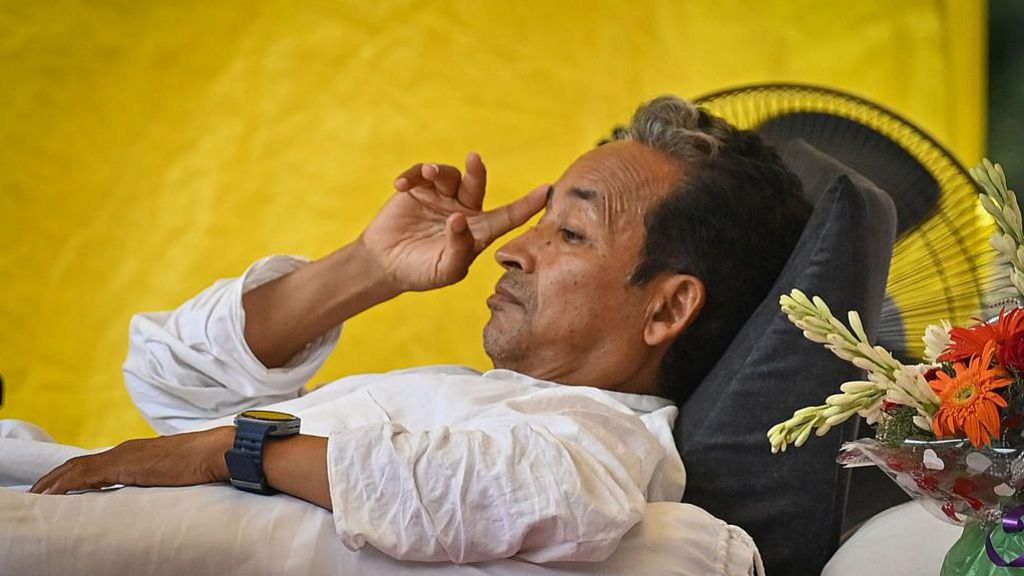
Seventy-one years after a single activist’s 58-day hunger strike reshaped the political map of the world’s largest democracy, another Indian protester is testing the enduring power of voluntary self-denial as a political tool. Educationist and climate activist Sonam Wangchuk has now survived 19 days on nothing but salt water during an indefinite hunger strike in New Delhi, shedding more than 9 kilograms as he advocates for sweeping education reforms in support of the online satirical Cockroach Janta Party movement. As his health declines rapidly, public concern over his condition has grown, and the Delhi High Court has ordered the national government to monitor his vital signs and provide emergency medical intervention if required.
Wangchuk’s protest is far from an anomaly in India’s modern political history. No other nation has integrated the hunger strike into its political fabric as deeply as India, a tradition rooted in centuries of religious practice and refined into a core tool of anti-colonial resistance and post-independence activism. Long before the founding of the Indian republic, major South Asian faiths including Hinduism, Buddhism, and Jainism have long framed voluntary fasting as a morally significant act of self-denial, a framework that Mahatma Gandhi, the leader of India’s independence movement, adapted to modern political struggle.
Between 1918 and his assassination in 1948, Gandhi undertook at least 15 major fasts to oppose religious violence, caste discrimination, and British colonial rule. He argued that a hunger strike was not an act of coercion, but a moral gesture of suffering designed to awaken the conscience of opponents and the public alike. His longest fast stretched 21 days, while his final 1948 fast, completed just weeks before his death, helped end communal bloodshed in Delhi. Writing on the eve of that fast, Gandhi described fasting as a peaceful alternative to violent resistance: “Fasting is his last resort in the place of the sword.”
The 1947 fast Gandhi held in Kolkata to end brutal religious rioting won praise even from critics of the tactic. The British-run *Statesman* newspaper noted at the time that while it had long disagreed with the use of fasting as a political tool, “never in a long career has Mahatma Gandhi, in our eyes, fasted in a simpler, worthier cause than this, not one calculated for immediate effective appeal to the public conscience.”
Independent India inherited this centuries-old tradition, and hunger strikes have since been deployed to demand action on nearly every major national issue: farmers’ rights, caste-based affirmative action, environmental protection, anti-corruption legislation, and the repeal of controversial national security laws. High-profile cases dot modern Indian history: In 2011, iconic activist Anna Hazare’s 13-day fast reignited a national anti-corruption movement that captured the attention of the entire country. In India’s northeast, activist Irom Sharmila refused all solid food for 16 years to protest the draconian Armed Forces (Special Powers) Act, surviving only through forced nasal tube feeding by state authorities. Prominent social activist Medha Patkar has repeatedly held prolonged fasts to demand fair compensation and rehabilitation for communities displaced by large-scale dam projects.
While hunger strikes are a global protest tactic, used by suffragettes in Britain and Irish republican nationalists as a tool of anti-colonial resistance across the British Empire, scholars argue the practice holds unique weight in India. “But in India, where governments can become deeply unresponsive, protesters often see fasting as the only way to force those in power to act,” explains Sayantan Saha Roy, an anthropologist at the University of Connecticut who studies the politics of fasting. Saha Roy notes that Gandhi’s transformation of the ancient religious practice into a modern moral and political act created a uniquely rich tradition of hunger strike protest in the country. “In a world of self-interested politics, they stand out as acts of self-sacrifice. As the protester’s body weakens, the moral and political pressure on those in power grows.”
That pressure, however, depends on public engagement to succeed. “Hunger strikes have to be performative to be persuasive. They’re not just aimed at the state, but at the public, whose outrage can pressure those in power,” Saha Roy says. He points to the 1970s and 1980s Irish republican hunger strikes as an example of how the tactic works: by framing their suffering as proof of the state’s cruelty, protesters sought to mobilize public support for their cause. “But there’s no guarantee the audience will respond, which is what makes hunger strikes such a precarious form of protest.”
For all its deep cultural roots, the hunger strike has faced consistent criticism from India’s leading political thinkers since independence. If Gandhi elevated the tactic to a respected moral weapon, B.R. Ambedkar, the architect of the Indian constitution, was deeply skeptical of its use in a democratic republic. In a 1949 landmark speech, Ambedkar argued that once constitutional channels for redress were established, fasting and civil disobedience should be replaced by formal democratic processes, warning that unregulated direct action became the “grammar of anarchy.” “The sooner they are abandoned, the better for us,” he said.
That debate has persisted into the 21st century. During Anna Hazare’s 2011 anti-corruption fast, leading political philosopher Pratap Bhanu Mehta argued that high-profile hunger strikes can become “deeply coercive.” When tied to a protester’s moral authority, he wrote, a fast unto death “amounts to blackmail.”
Public skepticism has grown in recent years, fueled by a wave of performative, short-duration fasts staged by politicians for media attention. Social media is regularly filled with jokes and allegations that politicians sneak meals behind closed doors, ending staged “fasts” with lavish private feasts. Many fasts last only a few hours, while others are carefully produced media spectacles complete with branded stages, live news coverage, and pre-planned photo opportunities. Not all acts of self-denial carry the same moral or political weight, as historical outcomes reflect: Potti Sriramulu’s 1952 fast, which ended in his death on the 58th day, ultimately forced Prime Minister Jawaharlal Nehru’s government to create the new state of Andhra for Telugu-speaking people, a change that paved the way for the full linguistic reorganization of India’s state borders. By contrast, Hazare’s high-profile 2011 fast galvanized public support but saw its momentum fade quickly, and Sharmila’s 16-year protest failed to force a repeal of the law she opposed.
From a medical perspective, prolonged hunger strikes are always simultaneously a political action and a life-threatening emergency. After two weeks without solid food, the human body begins breaking down muscle tissue as well as stored fat, and electrolyte imbalances can trigger fatal cardiac arrhythmias. Even ending a fast carries risks, as reintroducing food too quickly can cause life-threatening metabolic complications. It is common practice for Indian authorities to hospitalize hunger strikers and administer forced feeding to prevent death, a practice that has been widely criticized by activists.
As Wangchuk’s health continues to decline, a growing coalition of opposition leaders, fellow activists, artists, and public figures have called on him to end his fast. Yet despite widespread cynicism toward staged protest fasts, the belief that voluntary suffering can shift political outcomes in ways speeches and marches cannot remains deeply rooted in Indian political culture.
Wangchuk’s protest follows the long-established script of Gandhian fasting, Saha Roy explains: “In the public demonstration of his suffering, Wangchuk seems to be following Gandhi’s path. As his health deteriorates, his protest gains traction and raises the political stakes for the government. How this unfolds remains to be seen.”
The outcome of Wangchuk’s fast will not only determine the fate of his demand for education reform: it will also offer a new measure of the enduring power of one of India’s oldest and most controversial political rituals.