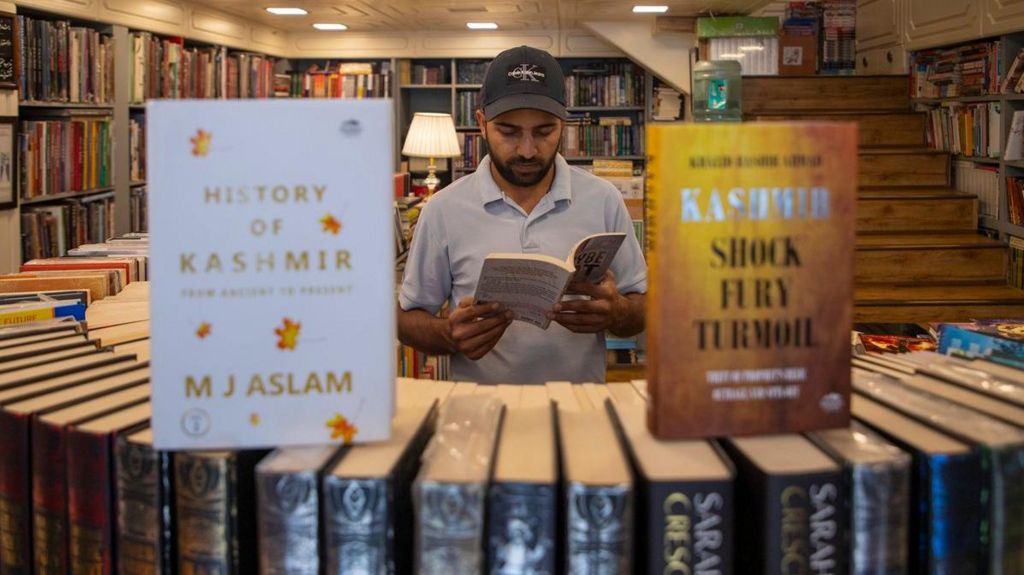
A sweeping new directive mandating content reviews of all educational materials across Indian-administered Kashmir has ignited intense public and political controversy, raising urgent questions about state control over historical narrative and academic freedom in the long-disputed Himalayan region.
Issued last week by local education authorities, the order applies to every tier of educational institution — from primary schools and secondary colleges to state universities and private coaching centers. It requires administrators to audit all published materials on their premises, including academic research papers and graduate theses, for content deemed to violate religious sensibilities, national laws, educational standards or social norms. Any materials flagged as inappropriate must be reported immediately to government oversight bodies.
Regional officials defend the directive as a targeted measure to remove factually incorrect and unlawful content, rather than a broad restriction on access to reading material. In official statements, authorities frame the order as a response to materials that promote, glorify or legitimize terrorism, violent extremism, secessionism and radicalization — all activities defined as prejudicial to India’s national security.
The order comes in the immediate aftermath of a public controversy stirred by India’s ruling national party, the Bharatiya Janata Party (BJP), which staged protests against two government school library books that it claimed glorified separatist leaders and spread anti-national sentiment. The two biographical volumes, which profled prominent figures from Jammu and Kashmir and had been held in school libraries since 2023, were pulled from circulation within days of the protests. Three people connected to the books’ publication were subsequently arrested by local police, and eight senior education department officials were suspended from their posts pending investigation.
Despite triggering the new order, the policy itself leaves the definition of “objectionable content” deliberately vague. The directive only notes that inappropriate material includes content that violates religious sentiments or Indian law, harms national interest, or runs counter to educational values, and requires all texts to align with India’s “age-appropriate” national education guidelines. Speaking to the BBC, School Education Director Naseer Ahmad Wani confirmed that a government-appointed committee would conduct the full review of texts across all schools and libraries, but declined to elaborate on specific criteria that would qualify content as objectionable.
The current controversy is not an isolated incident: just last year, regional authorities banned 25 published works, including titles by Booker Prize-winning author Arundhati Roy and prominent scholar A.G. Noorani, on grounds that the texts promoted “false narratives and secessionism.” That ban is currently being challenged in Indian courts. In February 2025, police carried out raids on independent bookstores in Srinagar, the summer capital of Jammu and Kashmir, and seized hundreds of books, alleging the titles promoted ideology linked to a banned Islamist organization. Critics of that raid noted that most of the seized works simply documented decades of conflict and political repression in the region.
Critics of the latest order, including opposition politicians, academics and student leaders, frame the directive as a deliberate attack on academic autonomy and an attempt to erase the region’s decades-long history of political turbulence. Kashmir has been a flashpoint for conflict between India and Pakistan for three-quarters of a century: both countries claim the entire region, and each controls only a portion of it, with periodic armed clashes along the disputed Line of Control that divides the two administrations. Since the late 1980s, the Indian-administered portion of Kashmir has seen an armed separatist insurgency against Indian rule, which India has repeatedly claimed is backed by Pakistan — an allegation the Pakistani government in Islamabad has consistently denied.
In 2019, India’s central government revoked the semi-autonomous special status that Jammu and Kashmir had held for decades, bringing the region under direct federal control. While an elected local government was restored in 2024, critics argue that the move has led to steadily eroding civil liberties and expanded state control over all aspects of public life in the region.
Many local academics and political analysts warn that the new screening order violates fundamental rights protected under India’s constitution. “Restrictions like this directly go against the right to freedom of speech and expression that the Indian constitution guarantees all citizens,” said Noor Mohammad Baba, a Srinagar-based political scientist. One Kashmir studies instructor, who requested anonymity out of fear of professional retaliation, noted that the region’s history, cultural identity and educational landscape have long been deeply contested, so the widespread screening of educational materials raises “legitimate questions about academic freedom and the state’s role in defining which narratives are acceptable to teach.”
Regional political leaders have gone further, alleging the order is part of a broader pattern of expanding state surveillance and a coordinated crackdown on political dissent in the region. Altaf Bukhari, leader of the regional Jammu and Kashmir Apni Party, argues that the government cannot systematically remove historical texts under the pretense of banning “anti-national” content. “This looks like a wider conspiracy to deprive us of our own academic content and our collective memory,” he said.
Government and ruling party officials have rejected all accusations of censorship or an attack on academic freedom. Imran Nabi Dar, spokesperson for the region’s governing National Conference party, clarified that the goal of the order is not to restrict access to reading, but to prevent unnecessary controversy stemming from content taught in classrooms. “Our point is that there shouldn’t be any unnecessary controversies arising from what is being taught in educational institutions,” Dar explained. BJP spokesperson Sunil Sethi echoed that position in comments to the BBC, arguing that “people cannot be allowed to glorify separatists in the name of academic freedom.” He added that “peace has been restored in the region with great difficulty, and we can’t let things get out of control again.”