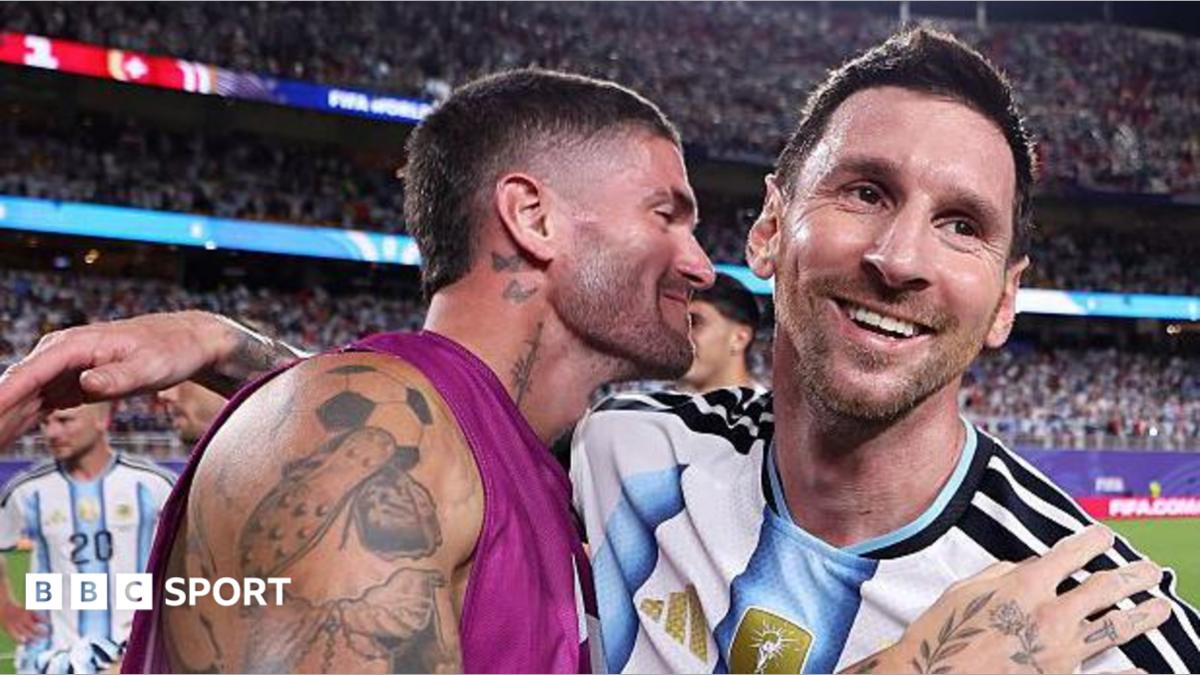
Lionel Messi’s 2026 FIFA World Cup campaign has been a rollercoaster of tangled emotions, capped by unguarded tears after Argentina’s dramatic comeback from a 2-0 deficit to book their quarter-final spot against Switzerland. This was not the first time Messi had broken down in tears during the tournament: just days after the opening match, he cried when he learned of a sudden health complication affecting his father. This time, however, the tears flowed from relief—relief that a missed penalty, which for a tense stretch looked set to end Argentina’s World Cup run early, did not end up letting his teammates down.
Widely expected to be his final World Cup appearance, this tournament has reconnected Messi with the joy of the game that defined him as a young prospect leaving his hometown of Rosario, Argentina. Under manager Lionel Scaloni, the 39-year-old Inter Miami forward has found a national squad built explicitly around his strengths, centered on collective unity rather than individual stardom.
Scaloni, who took over Argentina’s national side on an interim basis in 2018 when no other coach wanted the role, inherited a fractured, underperforming squad of fatigued star players under constant public scrutiny. He made the unpopular call to bench veteran big names and promote unheralded prospects, then built a system rooted in one core principle: let Messi lead. Where other coaches force Messi into rigid tactical structures, Scaloni lets the Argentine icon dictate his position on the pitch, with the entire squad adapting to his choices. Against Egypt, Messi shifted to the right flank; 38 minutes into the quarter-final against Switzerland, he moved central, and the entire team adjusted to open up space for their leader.
“The best moments of all, by far, are celebrations of the group. I coach for this, not because I like a 4-3-3,” Scaloni explained ahead of the quarter-final. “I like drinking mate with my friends and players, sharing a barbecue, playing truco, as we have always done.” It is a philosophy that aligns perfectly with Messi’s own preferences, and one that has delivered unprecedented results: under Scaloni, Argentina has lifted four trophies—two Copa Américas, the 2022 World Cup, and the 2022 Finalissima—and won their last three consecutive World Cup semi-finals.
At the heart of the squad’s special bond with Messi is midfielder Rodrigo de Paul, who has grown into Messi’s closest confidant and constant companion in the national setup. The pair’s friendship began unexpectedly when de Paul noticed a subdued Messi leaving training alone one afternoon. After waiting 40 minutes to give him space, de Paul knocked on Messi’s hotel door and invited him for a round of mate and truco. That small gesture grew into a daily routine: every morning, the pair share mate in de Paul’s room, with other squad members joining in strictly by order of arrival, no exceptions allowed. De Paul playfully teases Messi, calls him “El Pequeno” (the little one) despite his age and status, and treats him as just another member of the group—exactly what Messi has always craved, rather than being put on a pedestal as a global monument to the sport. When the team walks out onto the pitch, Messi leads with de Paul right at his side, the rest of the squad fanning out behind in a wedge, a unified group protecting their leader.
For most of the current Argentina squad, Messi was not just a teammate first—he was their childhood idol, the reason many of them picked up a football at all. Every player wears the same Adidas Adistar Messi boots, and for Messi’s June birthday, the squad wore custom T-shirts printed with photos of each player alongside Messi across his decades with the national team. Off the pitch, Messi has matched the squad’s commitment: he has put in months of double training sessions with de Paul and stuck to an obsessive nutrition plan that has boosted his top speed by 5% compared to the 2022 Qatar World Cup. While he covers just 631 meters at maximum speed across the tournament and walks for 47% of any given match, he is currently the tournament’s top goalscorer. He also joins Kylian Mbappé as one of only two players in history to register 10 or more direct goal involvements in two separate World Cups, having hit the mark in 2022 and again in 2026.
In Argentine culture, football success carries far more weight than just a trophy. For generations, the nation has linked football greatness to national identity, running through a line from Diego Maradona to Messi: a nation rich in talent, repeatedly held back by political and economic instability, sees a World Cup win as proof Argentina still belongs among the world’s very best. That is why the squad sings their unofficial tournament anthem “La Cuarta Estrella” after every win, led by de Paul. The song honors Messi, pays tribute to Maradona, references the 1990 World Cup final that many Argentines see as a stolen title, and calls for a fourth World Cup star to be added to the national shirt.
After the dramatic Egypt comeback that saw Messi in tears, midfielder Leandro Paredes summed up the squad’s commitment: when they saw their leader crying, the team embraced him not just to comfort him, but to remind him they are all in this together, and they will leave everything on the pitch to make his dream of a second consecutive World Cup title come true. As Argentina prepares to face England in the 2026 World Cup semi-final on 15 July, fans around the world can watch the match live on BBC One and BBC iPlayer, with full commentary available on BBC Radio 5 Live and BBC Sounds.
### Broadcast Details for England v Argentina 2026 World Cup Semi-Final
– Date: 15 July
– Kickoff: 20:00 BST
– Coverage: UHD broadcast on BBC One and BBC iPlayer starting at 19:00 BST; build-up and full match commentary on BBC Radio 5 Live and BBC Sounds from 18:00 BST; live text updates, in-play clips, highlights and analysis available on the BBC Sport website and app.