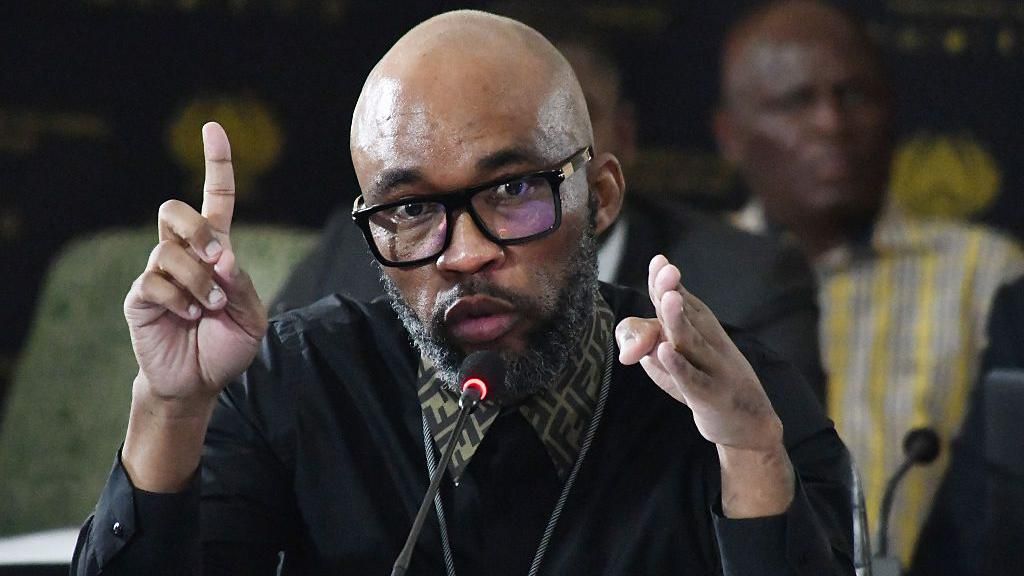
After a year of dominating the headlines around South Africa’s landmark public inquiry into systemic police corruption, controversial businessman Vusimusi ‘Cat’ Matlala is finally scheduled to give his long-awaited testimony before the Madlanga Commission on Wednesday. The 49-year-old, who has remained in police custody for over 12 months pending an unrelated attempted murder charge, will face questions from the commission’s panel led by retired Constitutional Court judge Mbuyiseli Madlanga, answering to a sweeping set of corruption and criminal allegations that have shaken the country’s law enforcement establishment to its core.
Matlala first entered the public spotlight just three years ago, when his name was linked to reported tender irregularities at a state-run hospital — a connection he has consistently denied. What is known of his early life comes almost entirely from testimony he gave to a parallel parliamentary corruption inquiry last November, where he detailed a harsh childhood growing up in a township east of Pretoria during the final decades of apartheid. Raised for much of his youth by a single mother who eventually left him, Matlala told lawmakers he grew up as a street child, only reuniting with his mother in 2002 as she battled terminal illness. After her death, he learned she had been sexually assaulted because of her albinism, a condition targeted by harmful myths that claim intercourse with an albino person can cure disease.
After leaving school, Matlala built up an informal small business to survive, a path that brought him repeated run-ins with the law. In 2001, he was convicted and served prison time for possession of stolen property. Over subsequent decades, he was arrested on charges ranging from house robbery and cash-in-transit heist to assault; he has denied all involvement in these allegations, and in every case, he was either acquitted or saw the charges withdrawn. Contrary to popular speculation that his nickname ‘Cat’ refers to an ability to escape legal trouble like a cat with nine lives, Matlala has explained the moniker comes from his large family: he and his wife share nine children.
According to Matlala’s own account, he turned his life around in 2017, when he registered his first formal security services company. He later expanded into healthcare service provision, eventually landing lucrative government contracts first with a public hospital and then with the South African Police Service — a remarkable feat he admitted to parliament, given he had no prior track record in the healthcare sector. His current legal troubles began in May 2025, when he and his wife Tsakane were arrested and charged with attempted murder, a charge both vehemently deny. While his wife was granted bail, Matlala has remained in custody ever since. He was later hit with additional corruption charges tied to his police healthcare contracts; he initially pleaded guilty as part of a plea deal with prosecutors last month, but withdrew the plea after the agreement collapsed.
The allegations against Matlala that will be front and center at Wednesday’s testimony are wide-ranging. Prosecutors and commission witnesses claim Matlala secured influence and won police contracts by peddling lavish gifts to senior law enforcement and political figures. These gifts include 20 impalas, doses of the popular weight-loss drug Ozempic, and thousands of dollars in unsecured personal loans. Most seriously, Matlala has not yet been forced to address claims that he was a core member of a major drug trafficking syndicate known locally as the Big Five.
In his November 2024 parliamentary testimony, Matlala pushed back against early accusations, saying he had no personal connections to senior police officers or leading politicians, and denied all core corruption claims. He did admit to making donations to activities affiliated with the African National Congress, South Africa’s ruling coalition party.
Over the 10 months the Madlanga Commission has held public hearings, a string of explosive testimonies has tied Matlala to some of the most senior figures in South African law enforcement and politics. Witnesses have claimed Matlala provided indirect campaign funding to suspended Police Minister Senzo Mchunu to support his political activities, a claim Mchunu has outright denied. Matlala has also been linked to Mchunu’s predecessor, Bheki Cele. During his parliamentary testimony, Matlala claimed he paid Cele a 500,000 rand (equivalent to roughly $31,000) facilitation fee after police returned firearms that had been seized from him, and that Cele additionally asked for help funding a home purchase and his son’s university tuition — requests Matlala says he refused. Cele has acknowledged knowing Matlala and staying twice at his rented Pretoria penthouse, but denies ever receiving any payments from the businessman.
The commission has also scrutinized Matlala’s relationship with suspended deputy police chief Major-General Shadrack Sibiya. Both men have repeatedly claimed their interactions were strictly professional, but commission testimony has contradicted this account. Witnesses allege Sibiya received 20 impalas from Matlala around the same time the businessman was awarded his major police contract; Sibiya has denied this, saying he would never accept gifts from a government service provider. One witness also told the commission that after his May 2025 arrest, Matlala openly bragged about his close connections to top-tier police leadership, including Sibiya.
Multiple other senior police officers have been implicated in the alleged corrupt network tied to Matlala, and two have already been fired from the force. Brigadier Rachel Matjeng, the senior officer who oversaw the awarding of the controversial police contract to Matlala, told the commission she had an on-again off-again romantic relationship with the businessman, who showered her with expensive gifts including Ozempic injections. Major-General Richard Shibiri, head of the police’s organized crime unit, admitted to accepting a $4,000 personal loan from Matlala to cover repairs for his son’s car, which he has since repaid. Shibiri, who oversees anti-gang, narcotics and illegal mining investigations, denies having any close personal connection to Matlala or knowing he was allegedly part of a criminal cartel. Both Matjeng and Shibiri have been dismissed from the police service.
Further allegations have emerged tied to suspended Ekurhuleni acting police chief Julius Mkhwanazi, who is accused of arranging to have blue lights and sirens installed on Matlala’s personal vehicles — a privilege reserved only for official security use. Mkhwanazi has denied this specific claim, but admitted to receiving money from Matlala, whom he described as a ‘blood brother’ during his commission testimony.
After 10 months of shocking revelations that have gripped public attention across South Africa, expectations are high for Matlala’s Wednesday testimony. Many South Africans, who have followed the commission’s proceedings closely, believe Matlala holds key information that could unpack the full scale of systemic corruption within the national police force, and are eager to hear his response to the full scope of allegations against him.