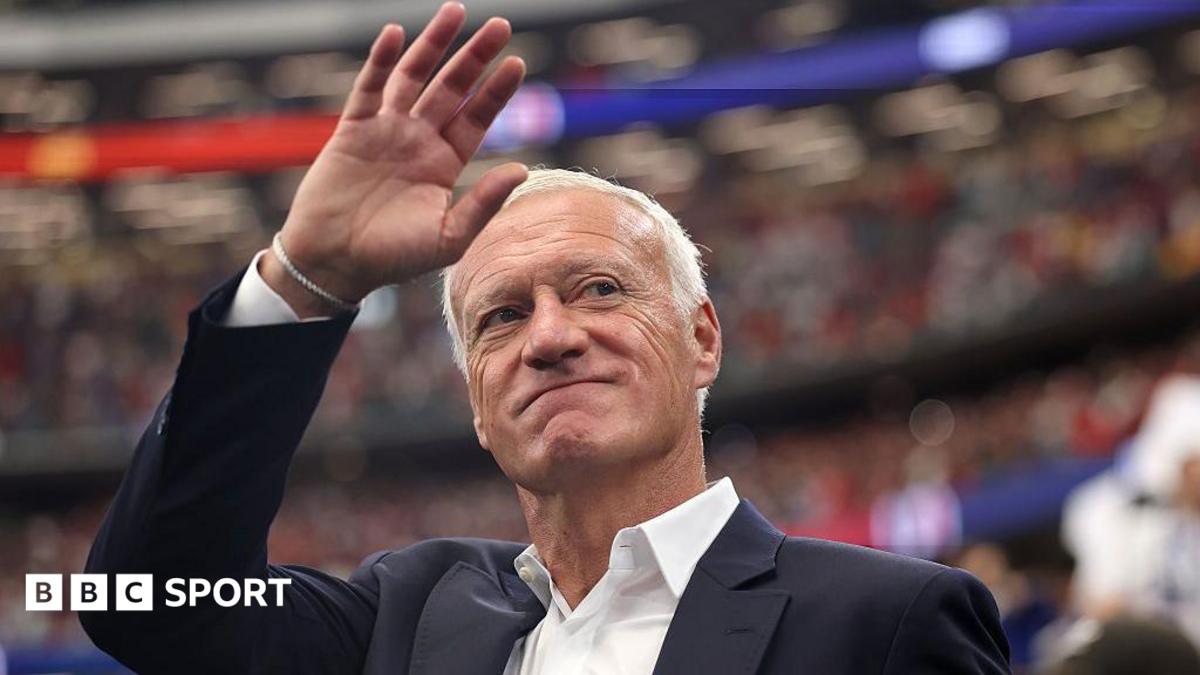
In a lopsided 2026 FIFA World Cup semi-final clash held in Dallas, Spain secured a dominant 2-0 victory over France, punching their ticket to the tournament’s final and bringing an unanticipated early end to Didier Deschamps’ 14-year tenure as France’s head coach.
Deschamps, who had already announced his plan to step down following this 2026 tournament, will now wrap up his legendary career with France in Saturday’s third-place play-off in Miami, where his side will face the loser of the other semi-final between England and Argentina. A unique figure in World Cup history, Deschamps is one of just three people to win the tournament both as a player (1998) and a manager (2018), alongside Brazil’s Mario Zagallo and West Germany’s Franz Beckenbauer. Even in defeat, the 57-year-old set a new record in Dallas: he now holds the mark for the most World Cup matches managed at 26, breaking a previous tie with legendary West German boss Helmut Schön that stood at 25.
Heading into Tuesday’s semi-final, France were tipped as overwhelming favourites, having advanced through the tournament with a string of dynamic attacking displays led by joint-top tournament scorer Kylian Mbappé, Ballon d’Or winner Ousmane Dembélé and Bayern Munich rising star Michael Olise. But against a well-drilled Spanish side, the French attacking unit failed to register any meaningful threat all match: they mustered only 10 total shots, their lowest tally at this 2026 World Cup, and recorded an expected goals value of just 0.3.
Post-match, criticism of France’s flat performance and flawed tactics came quickly from both inside and outside the squad. Mbappé, who had been expected to lead his side to victory, called out the team’s strategic misalignment, noting that France’s 3-v-2 midfield setup played directly into Spain’s strengths. “When you don’t do what you have to do in a World Cup semi-final, you don’t win,” Mbappé said. “Spain respected their gameplan… They are better than us at controlling a game. We didn’t manage to do it. We were too sloppy technically. We could not hurt them when we could have.” Former France midfielder Patrick Vieira echoed that sentiment in his ITV commentary, saying “They haven’t shown up. I was expecting more. There was big expectation for France to win the World Cup. All our top players went missing. Collectively we were really bad.”
Despite the disappointing end to his World Cup run, Deschamps remained reflective rather than bitter in his post-match press conference, brushing off questions about his legacy and upcoming departure. “It’s not time to talk about the future,” he said. “It is not important on a personal level whether I leave a competition in a semi-final or final. I am extremely happy. I am very proud of everything we’ve done to reach this stage and to win a World Cup – to take the French team to the highest level. I have been lucky as a player. I have enjoyed happy moments. Today is not such a moment. We must accept it without forgetting everything we experienced.”
Across French football, figures from past and present have rushed to honour Deschamps’ transformative impact on the national side, which extends far beyond this final result. When Deschamps took over the French job in 2012, the program was in chaos: France had crashed out of the group stage at both Euro 2008 and the 2010 World Cup, the latter marred by a public player mutiny against then-manager Raymond Domenech. Under Deschamps’ leadership, France rebuilt their culture, maximized the nation’s depth of elite talent, and climbed back to the top of international football, reaching the 2016 Euro final on home soil, winning the 2018 World Cup, and falling just short of retaining the title in a penalty shootout loss to Argentina in the 2022 final. Over his 14 years in charge, Deschamps won 20 of his 26 World Cup matches, losing only three.
Former France striker Olivier Giroud, who won the 2018 World Cup under Deschamps, called the outgoing manager a foundational figure for a generation of French players. “There was extra motivation for all the players at this World Cup to give Didier the ending he wanted, and deserved,” Giroud said. “He deserved to exit by the big door. He did not quite manage that but he is still a great, for what he has already done in his 14 years. His record does the talking for him. He gave me so much of his confidence, and I tried to repay him on the pitch. This makes us very close, and because we won that World Cup, we are linked forever. The biggest thing he taught us was his desire, and his drive and ambition to be the absolute best and to win every single game.”
Gael Clichy, a former France defender who played in Deschamps’ first year in charge and now manages third-tier French side Caen, echoed that praise, saying Deschamps’ legacy is already secure regardless of the semi-final result. “His legacy was that he took a team that was below par and he managed to bring that team back up to the top,” Clichy told BBC Radio 5 Live. “This legacy of his really means we don’t have to talk about what he should or could have done. What he has done for French football as a player and a coach is fantastic. It is phenomenal.”
All signs point to Deschamps being succeeded by his 1998 World Cup winning teammate Zinedine Zidane, with ESPN reporting in March that a verbal agreement is already in place for Zidane to take over the French national side this summer. Zidane, who has not managed since leaving Real Madrid in 2021, won three Champions League titles during his tenure at the Spanish club. Clichy noted that whoever follows Deschamps will face a difficult challenge filling his shoes.
For Spain, the victory sets up a historic shot at their first World Cup title since 2010, as they prepare to face the winner of Wednesday’s England-Argentina semi-final in the 2026 World Cup final.