The strategic Strait of Hormuz, a critical global energy chokepoint, has erupted into a fresh wave of geopolitical crisis, following a deadly attack on two Emirati tankers and a sweeping new announcement from U.S. President Donald Trump that risks upending global shipping markets. The rapid escalation comes after three consecutive nights of U.S. strikes on Iranian military targets, marking a sharp breakdown in a recent ceasefire agreement between the two long-standing adversaries.
On Monday, the United Arab Emirates’ Ministry of Defence issued a formal statement condemning what it called a “brazen” Iranian attack on two of its national tankers transiting the strait. The strike left one Indian crew member dead and eight others injured, six of whom are Indian and two Ukrainian, with four casualties in critical condition. The ministry called the assault a severe violation of international law that undermines regional security and stability.
Shortly after the attack, Iran’s Islamic Revolutionary Guard Corps (IRGC) took responsibility for the strikes in a Telegram statement. The IRGC claimed the two tankers had ignored multiple navigation warnings, disabled their location tracking systems, and attempted to traverse a route marked as dangerous due to prior mining activity. The corps added that any vessel cooperating with what it calls the “aggressor enemy” will only face consequences including damage, delayed passage, and the risk of triggering a global energy crisis. The IRGC confirmed it had disabled both targeted tankers.
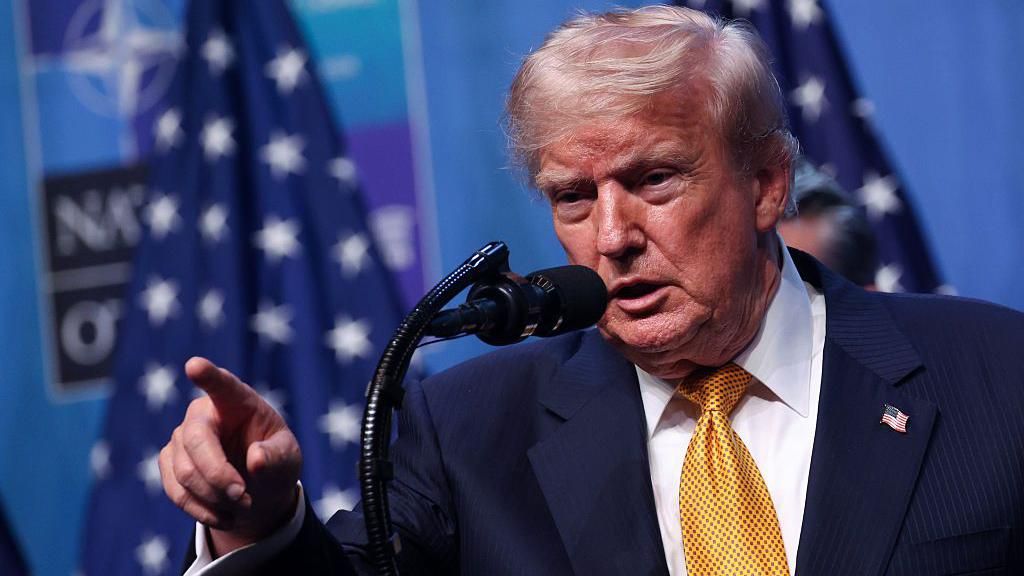
The attack capped a 48-hour period of steadily escalating military exchanges between the U.S. and Iran. On Monday, following strikes for the third straight night, President Trump announced via his Truth Social platform that the U.S. would reinstate a full naval blockade of Iranian ports and impose a mandatory 20% charge on all cargo shipped through the Strait of Hormuz, set to take effect at 16:00 Eastern Time on Tuesday. The U.S. leader framed the toll as reimbursement for security costs, claiming the U.S. would now serve as the official “Guardian of the Hormuz Strait,” while asserting that all non-Iranian shipping would retain fair and open access to the waterway.
Speaking to reporters at the White House, Trump said the U.S. was hitting Iran “very hard” and working to eliminate all of Tehran’s offensive capabilities while securing full control of the strait. When asked about the prospects for a negotiated end to the ongoing conflict, Trump maintained that a diplomatic deal remained within reach. U.S. Central Command (Centcom) confirmed it carried out the latest round of strikes on Monday afternoon, targeting military sites across multiple Iranian locations including Bushehr, Bandar Abbas and Abu Musa, with the stated goal of further degrading Iran’s capacity to attack commercial shipping. In response, Iranian state media reported that Iran’s army had targeted U.S. military assets stationed in Kuwait.
Iran’s foreign minister Abbas Araghchi offered a sharp, sardonic retort to Trump’s announcement, leaning into the president’s own framing on X. Araghchi acknowledged that any power providing safe passage for commercial vessels through the strait deserves compensation, noting that “Iran has always been the GUARDIAN of the Strait and will remain so FOREVER.” He added that Trump’s proposed 20% rate is far too high, quipping that “We will be fair.” Iran’s top military spokesperson Ebrahim Zolfaghari went further, warning that any U.S. interference in the management of the strait will be considered an act of war against Iranian sovereignty, and that expanded conflict would spread flames across the entire Middle East.
The International Maritime Organization (IMO), a United Nations body that oversees global shipping regulations, has already rejected Trump’s proposed toll outright. A spokesperson told Reuters that the organization “stands firmly against charging fees for passage through straits used for international navigation,” adding that there is no international legal basis for imposing mandatory transit tolls on commercial shipping through the waterway. As of Monday, ship tracking data from MarineTraffic shows that while a small number of vessels are still moving through the strait, overall commercial traffic remains heavily restricted.
The current crisis marks the latest chapter in a months-long conflict that has already reshaped global energy markets. The strait, through which roughly 25% of the world’s crude oil and 20% of global liquefied natural gas pass, was effectively shut down by Iran in February after the U.S. and Israel launched large-scale strikes on Iranian targets. Iran retaliated with missile and drone attacks on Israeli and U.S. military assets across the Gulf, and the IRGC seized two commercial vessels and fired on others that attempted to transit without Tehran’s approval. The disruption sent global oil prices soaring in the weeks that followed.
The U.S. first imposed a full naval blockade of Iranian ports in April to pressure Tehran. By mid-May, U.S. military officials reported they had redirected 100 commercial vessels and disabled four Iranian-flagged ships under the blockade. The blockade was lifted in June as part of a ceasefire memorandum between the two sides aimed at de-escalation, but disputes over control of the strait quickly reignited. Last week, Trump formally notified Congress that the U.S. had resumed military action against Iran starting on July 7, complying with federal notification requirements for ongoing military engagements.
The practical implications of Trump’s new announcement remain uncertain, and it carries both international and domestic political risks. Under international UN law, coastal states exercise full sovereignty over territorial waters extending 12 nautical miles from their coastline, and at its narrowest point, the Strait of Hormuz’s shipping lanes lie entirely within the territorial waters of Iran and Oman. Many U.S. allies are expected to push back against the requirement to pay a 20% cargo toll, and critics have already noted that the strait was fully open and unrestricted before the current conflict began.
Domestically, the announcement creates political complications for Trump’s fellow Republicans ahead of upcoming midterm elections. Even though Trump is not on the ballot, the move is likely to drive renewed increases in global oil prices, which will impact U.S. consumers at the pump. Some lawmakers from both parties, including a number of Republicans, have already questioned the value of the earlier ceasefire, and many American voters are already concerned about rising energy costs. Some analysts have framed the announcement as a characteristic Trump negotiating tactic: a provocative move designed to force a reset in talks and draw greater international involvement into resolving the crisis.