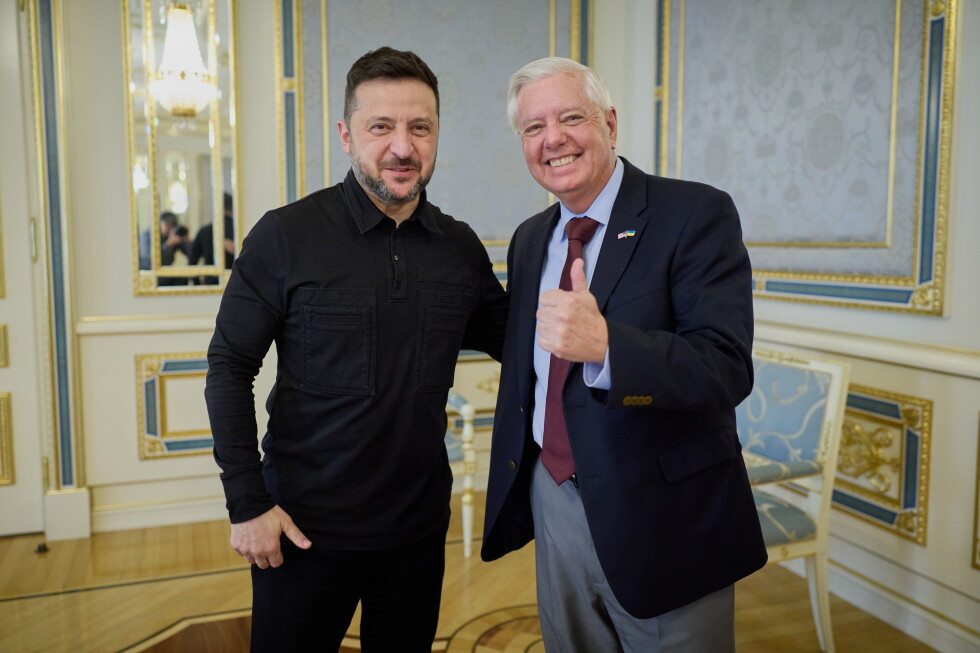
In the wake of the sudden passing of veteran Republican Senator Lindsey Graham, Ukraine is confronting a significant and unexpected gap in its Washington advocacy networks, as the long-standing pro-Kyiv lawmaker stood as Kyiv’s most trusted, high-profile link to former President Donald Trump — a connection that has left Ukrainian leaders and analysts bracing for weakened influence ahead of Trump’s return to the White House.
Just two days before news of his death broke, Graham stood in Kyiv’s iconic St. Michael’s Square, framed by the gilded domes of the historic monastery and the charred wreckage of destroyed Russian military hardware on public display. There, he delivered a message of cautious optimism to Ukrainians, announcing that a sweeping, hard-hitting new package of economic sanctions against Russia — legislation he had spent years co-developing with Democratic Senator Richard Blumenthal of Connecticut — was finally close to advancing through Congress. He was set to return to Washington to hold meetings with bipartisan leaders to push the proposal over the finish line.
Graham’s passing on Sunday sent waves of grief and concern across official Kyiv. For years, the South Carolina senator had stood out as one of Ukraine’s most unwavering allies in the U.S. capital, and uniquely positioned as a trusted go-between for Kyiv and Trump, who has long had a strained public relationship with Ukrainian President Volodymyr Zelenskyy. Ukrainian officials now warn that Graham’s absence will not only put the long-awaited Russia sanctions bill at risk, but could also erode Ukraine’s ability to shape White House policy across a wide range of priorities tied to its war against Russian invasion.
“Huge and absolutely unexpected loss,” said Oleksandr Merezhko, a senior lawmaker from Zelenskyy’s ruling Servant of the People party. “He was truly indispensable. I even don’t know who might be as important for us now in Trump’s entourage. He was the closest link between Ukraine, our president and Trump. Our position in Trump’s entourage might be weaker.”
Condolences poured in from across Ukraine’s top leadership, with Zelenskyy leading tributes to Graham as one of Kyiv’s most steadfast champions in Washington, who maintained constant communication with Ukrainian officials throughout the war. Zelenskyy said he was “deeply saddened” by the senator’s sudden passing, noting that Graham had made 10 visits to Ukraine since Russia launched its full-scale invasion in 2022, always showing up when Ukrainians needed international support most. “We were in constant dialogue and will miss that greatly,” Zelenskyy wrote on his official Telegram channel, recalling that the two had met twice in the week before Graham’s death — first at the NATO summit, and again during Graham’s recent Kyiv visit.
Ukrainian Parliament Speaker Ruslan Stefanchuk echoed those remarks, calling Graham a “steadfast friend of Ukraine” whose support for the country was “principled and resolute.” He noted he would long remember their “meaningful, sincere, and warmly personal meetings,” and expressed confidence that Graham’s work to advance tougher Russian sanctions would be completed in his honor.
In the period since Trump secured the Republican presidential nomination and his impending return to the White House next year, Ukrainian officials moved quickly to build ties with Trump-aligned Republicans amid growing uncertainty over the future of U.S. military and economic support for Kyiv. Lawmakers and analysts have confirmed Graham quickly emerged as the central figure in those outreach efforts.
Oleksandr Kraiev, a leading political analyst at the Kyiv-based think tank Ukrainian Prism, noted that Graham’s standing in Ukraine was unusually prominent, even compared to many domestic Ukrainian politicians. “Graham is even more well-known and more popular among Ukrainians than many Ukrainian politicians,” Kraiev said. Without Graham, he added, Ukraine risks losing its most influential advocate with direct, unfiltered access to Trump, and “I don’t see anyone else who will take the lead in helping Ukraine maintain those necessary connections.”
A rare figure in today’s Trump-dominated Republican Party, Graham carved out a political identity that broke with the growing isolationist “America First” strain of the Make America Great Again movement on key foreign policy issues. He remained committed to traditional conservative foreign policy principles, including staunch opposition to Russian expansionism, hawkish policy toward Iran, and unwavering support for U.S. ally Israel under Prime Minister Benjamin Netanyahu. He also continued to back traditional U.S. alliances in Europe at a time when Trump has repeatedly threatened to withdraw American troops from the continent and doubled down on his criticism of NATO.
Even as his positions put him at odds with many high-profile Trump supporters, Graham retained a close personal relationship with the former president, who often values loyalty above all else from congressional Republicans. Unlike many GOP lawmakers who have faced public ridicule from Trump for breaking with his agenda, Graham remained a trusted voice, particularly on foreign policy, that Trump was willing to listen to.
Blumenthal, Graham’s Democratic collaborator on the Russian sanctions bill, highlighted Graham’s independent streak in a statement following his death. “He marched to his own drummer,” Blumenthal said. “He could be strong-minded, fiercely driven, and sometimes unpredictable, but also deeply compassionate and sympathetic when he saw suffering and injustice.”
Graham’s unwavering support for Ukraine has long put him at odds with Trump, who has repeatedly criticized the volume of U.S. spending on aid for the war-torn country. Even so, Blumenthal confirmed that Graham was confident the sanctions legislation was finally within reach, telling reporters he had spoken with Graham over the weekend, when the South Carolina senator was “exulted” about the prospect of moving the package forward. Blumenthal added that passing the bill into law should now serve as a “fitting tribute” to Graham’s years of work on the issue.