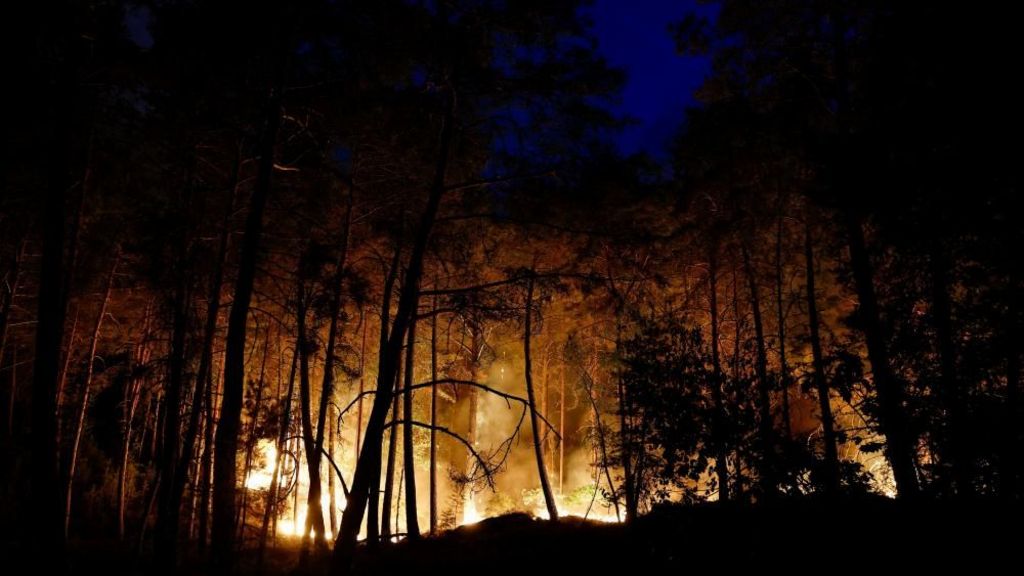
A large, fast-spreading wildfire has ignited near Noisy-sur-Ecole, close to the iconic Fontainebleau forest just 60 kilometers southeast of Paris, triggering an extraordinary emergency response amid the third record-breaking heatwave to hit the French capital region this summer. Local officials have labeled the blaze as “virulent” and of “exceptional scale”, with flames tearing through more than 800 hectares of forest as of early Monday, with the fire line still expanding across the wooded landscape.
In response to the crisis, French authorities took an unprecedented step: two dedicated firefighting aircraft were deployed from the warmer, drier southern region of the country, where large wildfires are more common, to combat the blaze near Paris. This marks the first time such aerial assets have been reassigned north to the Paris region for wildfire response, according to Eric Brocardi, a spokesperson for France’s national federation of firefighters. Joining the two water-bombing planes were two additional firefighting helicopters and a dedicated observation aircraft, all mobilized to prioritize the core mission of protecting civilian lives and nearby infrastructure, Brocardi confirmed in comments to Agence-France-Presse.
The spreading fire has already caused major travel disruption across France, hitting the first major summer holiday weekend when millions of Parisians travel out of the capital for seasonal getaways. The blaze forced partial closure of France’s key north-south highway, snarling traffic for thousands of travelers. Earlier in the emergency, a separate fire linked to the hot, dry conditions blocked an eastbound highway out of Paris and interrupted service on the high-speed rail line connecting Paris to southern France. By Sunday evening, French national rail operator SNCF announced that travelers faced delays of up to six hours for all services arriving at or departing from Paris Gare de Lyon.
This wildfire is not an isolated event, but part of a broader pattern of extreme heat and fire risk sweeping Europe this summer, where multiple countries across the continent have already broken all-time temperature records. In France alone, the prolonged heat has forced additional cascading disruptions beyond the wildfire: three nuclear power plants have been temporarily taken offline, as operators avoid releasing warm cooling water into already overheated rivers and waterways that would further threaten aquatic ecosystems. Even the Tour de France, one of the world’s most high-profile annual cycling events, was forced to adjust its schedule, cutting 30 kilometers from Sunday’s race stage as temperatures climbed close to 40 degrees Celsius to protect rider safety.
Across the continent, the record heat has sparked a series of devastating wildfires with severe human costs. In southern Spain, a wildfire near Almeria that broke out Thursday has already killed at least 13 people, making it one of the deadliest wildfire events in the country’s modern history. In the United Kingdom, emergency services declared a major incident Sunday after a large wildfire broke out in north Wales, with fire crews battling multiple blazes across both Wales and England as the region also swelters under record high temperatures.