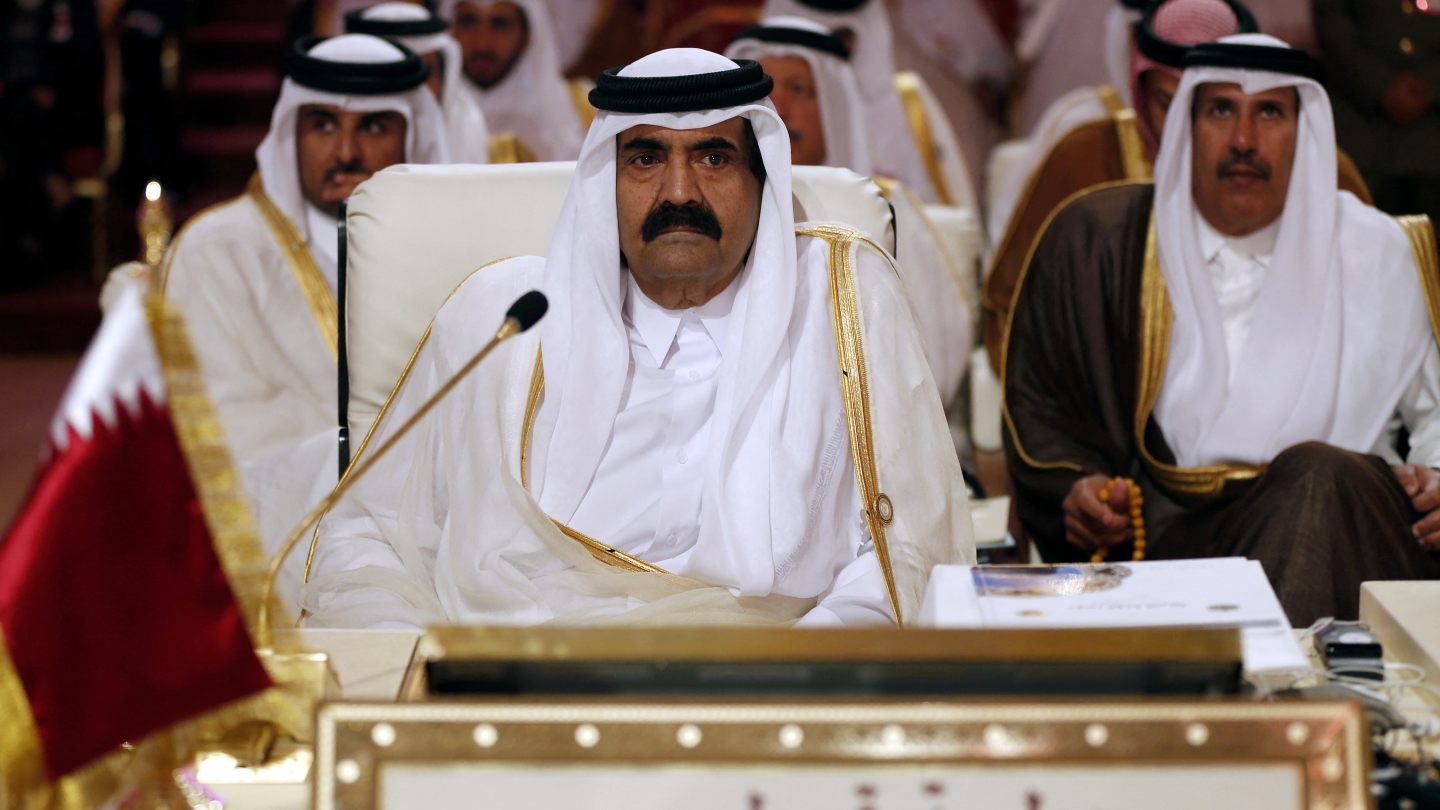
Qatar’s royal court announced Sunday the passing of former Emir Sheikh Hamad bin Khalifa Al Thani, the transformative leader who turned a small Gulf state into a consequential global player across energy, diplomacy, and media. He was 74 years old, and no official cause of death has been released to the public.
In an official statement, the Amiri Diwan expressed: “With hearts steadfast in faith in God’s decree and destiny, the Amiri Diwan mourns the great loss to the nation of the late – may God have mercy on him – His Highness the Father Amir Sheikh Hamad bin Khalifa Al Thani, who passed away this morning.”
Sheikh Hamad held power from 1995, when he rose to the position via a bloodless palace coup that ousted his father Sheikh Khalifa bin Hamad Al Thani, until 2013. In a move that shocked observers across the Middle East and beyond, he made the unprecedented choice to voluntarily abdicate the throne in favor of his son, Sheikh Tamim bin Hamad Al Thani. This peaceful handover of power marked a first in modern Arab history, a rare departure from a regional pattern where leadership transitions only follow the death of a ruler or violent political upheaval. At the time of his resignation, Sheikh Hamad framed the shift as a new chapter for the nation, saying: “The future lies ahead of you, the children of this homeland, as you usher in a new era where young leadership hoists the banner.”
Over his 18-year tenure, Sheikh Hamad engineered a radical transformation of Qatar’s global and domestic standing. He guided the small state to become the world’s top exporter of liquefied natural gas, turning its vast energy reserves into outsized geopolitical influence that stretched far beyond the country’s tiny borders. Domestically, his administration oversaw a series of landmark changes: the launch of influential global media network Al Jazeera in 1996, the adoption of Qatar’s first permanent constitution in 2004, and the introduction of municipal elections that extended voting and candidacy rights to women, a progressive step for the region.
Sheikh Hamad also built Qatar’s reputation as a trusted regional mediator, with the country playing key diplomatic roles to resolve conflicts spanning Lebanon, Sudan, Afghanistan, and the Palestinian territories. For the Gaza Strip, his government committed hundreds of millions of dollars in infrastructure investment, including major coastal road projects, and a hospital in Gaza City still carries his name in recognition of his contributions.
Beyond diplomacy and energy, Sheikh Hamad’s administration pursued aggressive international investments across aviation, infrastructure, business, and sports. These long-term investments laid the critical groundwork for Qatar’s successful hosting of the 2022 FIFA World Cup, an event that cemented the country’s status on the global stage. Even after stepping back from official rule, Sheikh Hamad remained a widely respected public figure in Qatar, and received a warm welcome during the opening ceremony of the 2022 tournament in Doha.
Following the announcement of his death, tributes quickly poured in from leaders across the Middle East and beyond. Egyptian President Abdel Fattah el-Sisi offered condolences to Qatar’s ruling family and public, while Pakistani President Asif Ali Zardari commended Sheikh Hamad’s “visionary leadership” and his far-reaching contributions to Qatar’s development and cross-regional cooperation. United Arab Emirates President Sheikh Mohamed bin Zayed Al Nahyan also shared his respects, writing on X: “I extend my sincere condolences and sympathy to my brother Sheikh Tamim bin Hamad Al Thani and his family on the passing of his father, Sheikh Hamad bin Khalifa Al Thani.”
Sheikh Hamad is survived by Sheikh Tamim and his extended family. Today, the Qatar that his family governs is a country whose enormous influence across global energy markets, international diplomacy, and global affairs is almost entirely the product of the vision and policies Sheikh Hamad put in place during his rule. For context, Qatar is one of the smallest Arab states, with a total population of roughly 3 million, the majority of whom are migrant workers. It was a British protectorate for 55 years until gaining independence in 1971, and has been governed by the Al Thani royal family since the mid-19th century.