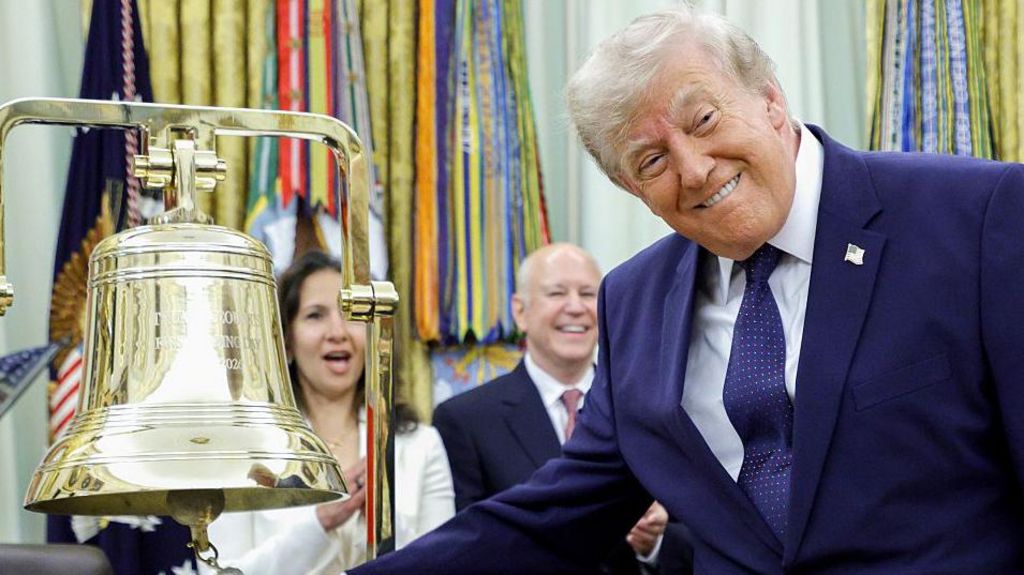
A new national children’s savings initiative, dubbed Trump Accounts, officially launched this week with a historic ceremony that rang the iconic Wall Street opening bell directly from the Oval Office, marking one of the most high-profile domestic policy rollouts of the current administration ahead of November’s midterm elections.
Designed to cultivate long-term investing habits and give younger generations a foothold in the U.S. financial system, the program is open to all American children under the age of 18 with a valid Social Security number. Infants born between 2025 and 2028 qualify for an automatic $1,000 government seed contribution to kickstart their savings, and parents can open an account through a simple mobile app download. Third parties, including family members, friends, and employers, are permitted to contribute up to $5,000 per child annually, and account holders gain full access to their funds once they turn 18.
By legislative requirement, all funds must be held in low-cost index funds structured for long-term growth. While account balances grow tax-free, withdrawals made before the account holder turns 59.5 incur income taxes and a potential 10% penalty unless the funds are used for approved expenses: higher education costs, the purchase or construction of a first home, or qualifying personal emergencies. The program adds a new option to the existing landscape of U.S. tax-advantaged savings tools, complementing existing products such as individual retirement accounts (IRAs) for retirement planning and 529 plans for education savings. A congressional analysis classifies Trump Accounts as a modified iteration of traditional IRAs, with distinct eligibility and withdrawal rules unique to the program.
The White House has framed the initiative as a solution to the longstanding uneven distribution of stock ownership across the U.S., arguing that millions of younger and lower-income households currently hold little to no exposure to financial markets. “This program gives every child in America a stake in our country’s economic future,” a senior administration official said in comments ahead of the launch.
But reaction across policy and financial circles has been deeply split, with critics arguing the program’s complexity will leave low-income families behind and fail to live up to administration hype amid ongoing widespread concerns over rising cost of living. Will McBride, chief economist at nonpartisan think tank the Tax Foundation, argues the onboarding process is unnecessarily convoluted, meaning only a small minority of eligible families will actually benefit. “The households that will actually take advantage of this are those that are already well-informed, well-off, and organized about their finances,” McBride explained.
Other analysts have acknowledged the program’s core goal of expanding investment access is worthwhile, but warn it falls short of solving structural barriers to savings for low-income groups. Adam Michel, director of tax policy studies at the Cato Institute, noted that the $1,000 starting subsidy is the program’s biggest benefit, but most families would be better served by existing tax-advantaged savings products. Michel also pointed to the early withdrawal penalty as a critical unaddressed flaw: lower-income young adults who turn 18 may be forced to withdraw funds to cover immediate living costs, leaving them stuck paying the 10% penalty that the program does nothing to eliminate. “Trump Accounts do not fix that problem,” Michel emphasized.
Supporters, however, argue the initiative removes a key barrier to entry for new savers. Andy Blocker, head of policy, regulatory and government relations at major financial services firm Edward Jones, said the $1,000 automatic contribution for eligible infants eliminates the most common barrier for new families: “not having anything to start with.” “If by the end of the year, more American families have a clear pathway to start building financial security for their children, that counts as a success,” Blocker said.
Preliminary uptake data shows that around six million families opened accounts ahead of the program’s July 4 launch, a figure that represents only a small fraction of the tens of millions of children eligible nationwide. As of Monday, the White House confirmed that the $1,000 starting subsidy has already been deposited into more than 500,000 accounts for newborns, aligned with provisional U.S. birth data that recorded roughly 3.6 million births in 2025. By the end of the first week post-launch, total contributions across all Trump Accounts from private sources had reached nearly $125 million, per administration figures.
Program projections based on historical average returns from the S&P 500 estimate that the $1,000 starting seed could grow to as much as $6,000 by the time a child turns 18 even with no additional contributions, though projections note actual returns are not guaranteed. If families contribute an average of $250 per year, the balance could reach roughly $19,000 by age 18; with the maximum annual $5,000 contribution from family or employers, that balance could climb to as high as $271,000 by the time the child reaches adulthood.
The initiative has secured backing from major players in the U.S. corporate and financial sectors. Global investment giant BlackRock has publicly supported the program, noting that nearly 40% of all Americans hold no investments in financial markets. Major U.S. firms including payment processing leader Visa and technology conglomerate Dell have also pledged formal support for the rollout.