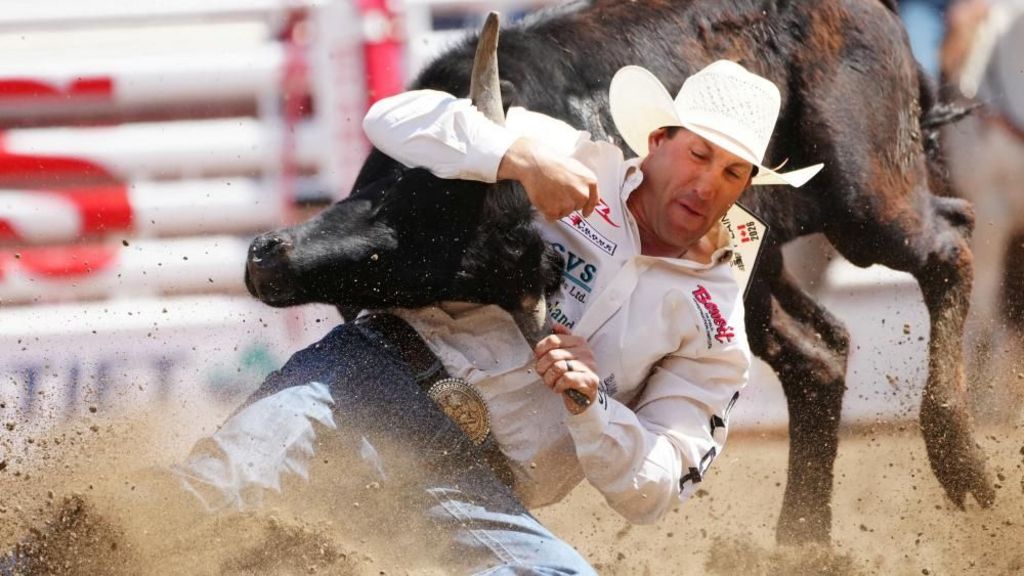
Every summer, more than 1.4 million visitors from across Canada and around the world flood into Calgary for the Calgary Stampede, billed as the ‘Greatest Outdoor Show on Earth.’ This iconic western Canadian celebration draws crowds to witness heart-pounding chuckwagon races, lightning-fast First Nations horse relays, and all the rustic charm of cowboy culture, while also doubling as a test of political skill—leaders are expected to nail a pancake flip at community breakfasts and pull off a convincing cowboy look to win over voters.
This year, however, the carnival music and festive energy of the Stampede grounds are overshadowed by a looming political battle: an upcoming October non-binding referendum that will ask Albertans whether they support holding a later binding vote on full independence from Canada. For both pro-unity and pro-separation advocates, the 2026 Stampede has become the first major public stage to make their case to voters, kicking off what all sides agree will be a hard-fought, divisive campaign for the province’s future.
‘You can feel it everywhere—this referendum is the cloud over everything we do,’ Corey Hogan, a Liberal Member of Parliament from Calgary, told reporters during the event. Hogan invited dozens of federal Liberal colleagues from across the country to the Stampede this year to rally for national unity, and in a public speech, he framed separatism as ‘a poison’ that has split families and communities across Alberta. ‘It underpins every other conversation we might want to have about healthcare, the economy, or climate action,’ he added. Prime Minister Mark Carney is scheduled to visit Calgary this weekend to deliver his own pro-unity message, joining a long list of federal leaders who see the October vote as a critical moment for Canadian national cohesion.
While public polling currently projects that the pro-unity side will win the October referendum by a comfortable margin, many unity advocates say they are taking nothing for granted, haunted by the 2016 Brexit referendum, when a complacent pro-Remain camp ultimately lost to the leave campaign. ‘The shadow of Brexit hangs over every step of this campaign,’ said Andrew Kemle, a University of Calgary graduate student who attended Hogan’s Stampede unity breakfast. ‘We saw an entire country sleepwalk into an economic disaster we’re still dealing with. We can’t let that happen here.’
The push for Alberta independence has its roots in decades of frustration among many Albertans who feel the oil-rich, landlocked province has been systematically overlooked and disrespected by federal decision-makers in Ottawa. Separatist organizers say that frustration grew during the COVID-19 pandemic, and reached a turning point during the 2021 Freedom Convoy protests, when then-Prime Minister Justin Trudeau invoked the never-before-used Emergencies Act to clear blockades in downtown Ottawa.
Chris Scott, a pro-independence organizer from the small rural town of Mirror who took part in the 2021 convoy, said the federal government’s response to the protest completely reshaped his view of Canadian national identity. ‘I was raised believing this was a free country,’ Scott told the BBC from his rural cafe and truck stop, which is decorated with Alberta’s blue provincial flag and art commemorating the Freedom Convoy. ‘Trudeau’s actions that week showed me we don’t have a voice in Ottawa. When you’re not respected by the national government, it’s hard to respect that government back.’ For Scott, even Prime Minister Carney’s recent push to approve a long-sought west coast oil pipeline—one of Alberta’s top policy priorities for decades—is too little too late. ‘Ottawa is only reaching out now when they’re scared of losing us. It’s too late. We need to set our own rules,’ he said.
Justin Perkins, a rural Albertan who shared his views with the BBC while refueling his car, echoed that sense of alienation. ‘I would say I’m 100% Canadian, but every year that feels less true,’ Perkins said. ‘People across the country write us off as hated rednecks, just for being born here. We didn’t do anything wrong, but we’re treated like the ugly cousin of Canada. What choice do we have but to go it alone?’
Pro-unity advocates warn that separation would bring catastrophic political, economic, and social harm to Alberta, and they have launched a full-court press to convince voters ahead of October. Former Progressive Conservative Alberta legislator Thomas Lukaszuk, who leads the pro-unity group Forever Canadian, recently opened the organization’s campaign headquarters in Calgary, and has spent the past two months crisscrossing the province in a refurbished 1997 camper van covered in maple leaf decals, dubbed the ‘Unity Bus.’ He hands out pro-Canada pins and lawn signs, and speaks to small groups of voters in towns and cities across the province to lay out the risks of separation.
Lukaszuk says the referendum debate has already torn communities apart. ‘You have neighbors not trusting neighbors, people checking which flag is flying on which porch,’ he said. ‘If it’s an Alberta flag, they automatically assume you’re a separatist. This is an incredibly divisive fight, and it has to end.’ Scott, meanwhile, says his community in rural Mirror is overwhelmingly pro-independence, a divide that highlights the deep urban-rural split on the issue across the province: while most major urban centers lean heavily pro-unity, rural areas are far more sympathetic to separation. Polls currently show only around 20% of all Albertans support full independence, but Scott says that number is growing fast, and he’s bought his own campaign van to rival Lukaszuk’s Unity Bus. No matter what happens in October, he says, independence is ‘inevitable.’
A key barrier to an immediate binding separation vote has been the successful legal challenge brought by Alberta’s First Nations groups, who argued that separatist leaders never consulted them on a plan for independence, which would put their constitutionally protected treaty rights at severe risk. The courts ruled in favor of First Nations, delaying a binding referendum until the legal process is resolved. Chief Samuel Crowfoot of the Siksika First Nation, whose territory lies just east of Calgary near the 1877 signing site of Treaty 7, said his community’s future is far more secure within Canada.
‘These numbered treaties form the entire basis of our relationship with the Crown, and those treaties will be honored far more fully if we stay within Canada,’ Chief Crowfoot told the BBC. ‘Separatist leaders have not reached out to us, they haven’t talked to us about what an independent Alberta would look like for First Nations, and there is no guarantee our rights would be protected.’ Chief Troy Knowlton of the Piikani First Nation put it more bluntly: he would rather stick with ‘the devil that we know today’ than risk the uncertainty of independence. Chief Crowfoot added that without First Nations’ legal challenge, a binding separation referendum would already be moving forward, making Indigenous Albertans the most effective force holding Canada together so far.
Alberta Premier Danielle Smith, who has navigated a separatist-leaning political base while remaining personally pro-unity, has defended the October vote, saying it is an important opportunity to give Albertans a direct voice on the issue. For pro-unity leaders like Hogan, even the non-binding ‘referendum on a referendum’ poses major risks. If the pro-exploration side wins, Hogan says, Alberta politics could be consumed by the separation fight forever. ‘Loss is not an option for us,’ Lukaszuk said. ‘We will do everything we possibly can to win this in October.’
As the 10-day Calgary Stampede draws to a close this weekend, with cowboys heading back to their ranches and the fairground rides going quiet, both sides agree: this is only the opening round of a battle that will shape the future of Alberta and Canada for generations to come.