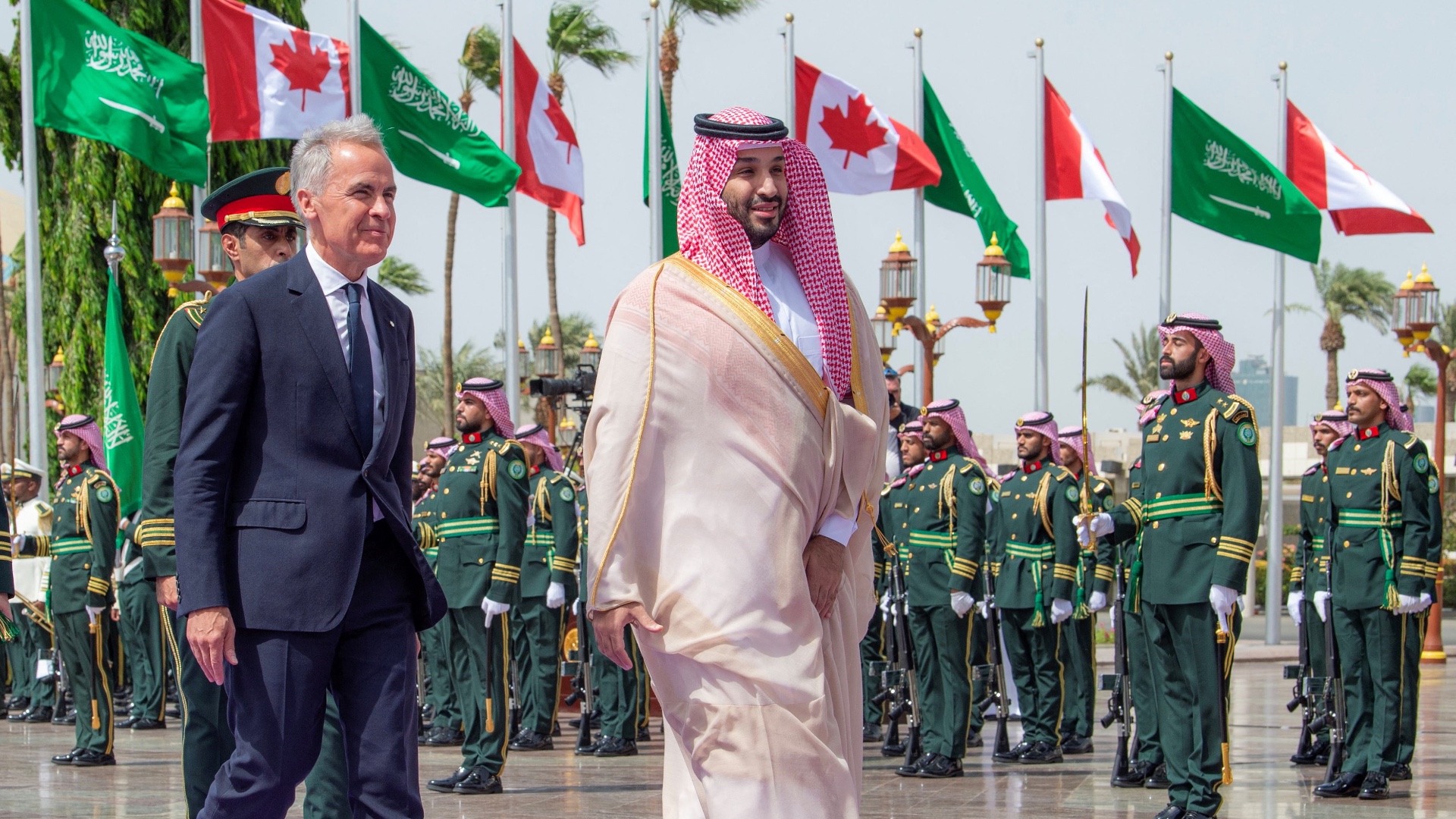
In a landmark step that reshapes Canada’s diplomatic and economic footprint in the Middle East, Canadian Prime Minister Mark Carney has become the first Canadian head of government to visit Saudi Arabia in more than 26 years, capping the trip with 13 new commercial agreements and memoranda of understanding valued at $700 million spanning multiple key sectors.
Carney’s visit to Riyadh came immediately after he attended the 2026 NATO Leaders’ Summit in Ankara, Turkey, a gathering that saw U.S. President Donald Trump praise regional Middle Eastern leaders while publicly criticizing long-standing traditional Western allies. Against a backdrop of steadily souring Canada-U.S. relations following Trump’s inauguration last year, Carney has actively pursued a strategy to reduce Canada’s heavy economic dependence on its southern neighbor, turning to cash-rich Gulf Cooperation Council nations in a push for diversified trade partnerships. This trip marks the second such high-profile visit to a Gulf state under Carney, following his January 2025 trip to Qatar—the first visit to that country by a sitting Canadian prime minister.
“The global landscape is shifting rapidly, creating widespread uncertainty for national economies, private businesses, and working people across the world,” Carney noted in an official statement released Thursday. “In response, Canada is focusing on the elements we can control: building domestic economic strength, expanding our network of trade partnerships, and forging a robust web of new global connections. That means deepening ties with the world’s largest, most dynamic economies, including Saudi Arabia.”
Today, Saudi Arabia stands as Canada’s second-largest trading partner in the Middle East, with cumulative bilateral trade surpassing $15 billion since 2020. By International Monetary Fund estimates, Saudi Arabia’s total GDP stands at just under $2 trillion, while Canada’s economy totals just over that mark—a comparable size that frames the two nations as mutually viable economic partners. Carney emphasized that the two countries have “complementary economies with shared ambitions” for long-term growth.
The new agreements cover a wide range of collaborative initiatives: Canadian firms will support mining, critical minerals extraction, and clean energy projects across Saudi Arabia; domestic infrastructure companies will participate in large-scale development projects tied to Riyadh’s Vision 2030 reform agenda, including new road and rail construction; and Canadian health technology firms will provide the kingdom with cutting-edge intelligent medical diagnostic and treatment tools. The two sides also agreed to deepen cooperation on liquefied natural gas development, utility-scale renewable energy projects, and carbon capture and storage technology.
In the emerging technology space, Canada and Saudi Arabia will collaborate on building specialized sovereign artificial intelligence infrastructure to support next-generation frontier AI models, working through their respective national AI entities: Canada’s Cohere and Saudi Arabia’s HUMAIN. To facilitate greater cross-border investment, Carney and Saudi Crown Prince Mohammed bin Salman announced that negotiations for a bilateral Foreign Investment Promotion and Protection Agreement will conclude by early 2027, and new talks have been launched to finalize a double taxation agreement aimed at eliminating duplicate tax burdens for businesses and workers operating in both countries. A new Canada-Saudi Arabia Coordination Council will oversee the implementation of all new collaborative projects.
On the defense front, Carney announced the appointment of a permanent Canadian defense attaché to Riyadh, a move designed to boost exports of Canadian-made military equipment. Canada’s defense sector specializes in artillery systems, light armored vehicles, and component manufacturing for F-35 fighter jets.
Diplomatically, the two leaders aligned on a range of pressing regional issues. Both issued a joint condemnation of the July 7 attacks in the Strait of Hormuz, which ultimately led to the collapse of the U.S.-Iran ceasefire announced by Trump last Friday. Both Carney and Mohammed bin Salman have expressed public support for the U.S. military campaign against Iran that launched February 28, though Saudi Arabia has privately pushed for a new ceasefire to end hostilities. On Yemen, Canada formally backed the Saudi-supported, internationally recognized Presidential Leadership Council based in Aden, while calling for renewed security and stability in the Red Sea, where Iran-aligned Houthi forces have disrupted international commercial shipping in response to U.S. and Israeli military actions in Gaza. Carney also confirmed that Saudi Arabia has welcomed Canada’s formal recognition of the State of Palestine, and he joined calls for the safe, urgent, and unimpeded delivery of life-saving humanitarian aid to civilians in Gaza. On Sudan, both leaders reaffirmed that the country’s sovereignty, unity, and territorial integrity must be fully respected, and called for an end to external actions that fuel ongoing conflict and undermine stability. Since Sudan’s 2023 civil war broke out, Canada has processed approximately 27,000 temporary and permanent residency visas for Sudanese citizens, and has committed more than $150 million in humanitarian aid to Sudan through United Nations agencies and the international charity Save the Children as of April 2026.
The reset in Canada-Saudi relations comes after years of tension stemming from a 2018 diplomatic row that upended ties between the two nations. In August of that year—two months before the killing of journalist Jamal Khashoggi at the Saudi consulate in Istanbul drew global condemnation—Saudi Arabia cut all scholarship funding for Saudi students in Canada and recalled all Saudi citizens studying in the country, after Canada’s then-foreign minister called for the release of jailed Saudi human rights activists including Samar Badawi.
Samar Badawi’s brother, Raif Badawi, a prominent liberal reformer who co-founded the website Free Saudi Liberals to push for political change in the kingdom, had been arrested in 2012 on charges of “insulting Islam through electronic channels.” He was initially sentenced to seven years in prison and 600 lashes, a sentence that was extended to 10 years and 1,000 lashes in 2014. His wife and children have lived in Canada since 2015, and his case drew widespread international attention, with human rights groups calling on then-prime minister Justin Trudeau to publicly advocate for his release.
In the wake of the 2018 dispute, more than 1,000 Saudi medical trainees and residents were ordered to leave Canada within weeks to continue their training elsewhere, a move that sparked chaos for both the trainees and Canadian healthcare systems. In some Canadian hospitals, Saudi trainee doctors made up as much as 85% of the resident physician workforce, providing care to patients under Canada’s publicly funded universal healthcare system. For decades, Saudi Arabia had operated a postgraduate training program that allowed its medical graduates to receive specialized training in Canada as visa trainees.
Diplomatic ties only began to heal after Samar Badawi was released from prison in 2021 and Raif Badawi was released in 2022. Full diplomatic relations were formally restored, with ambassadors reappointed to both Ottawa and Riyadh, in May 2023. Both Badawi siblings remain subject to a Saudi travel ban, preventing them from leaving the kingdom to join family abroad.