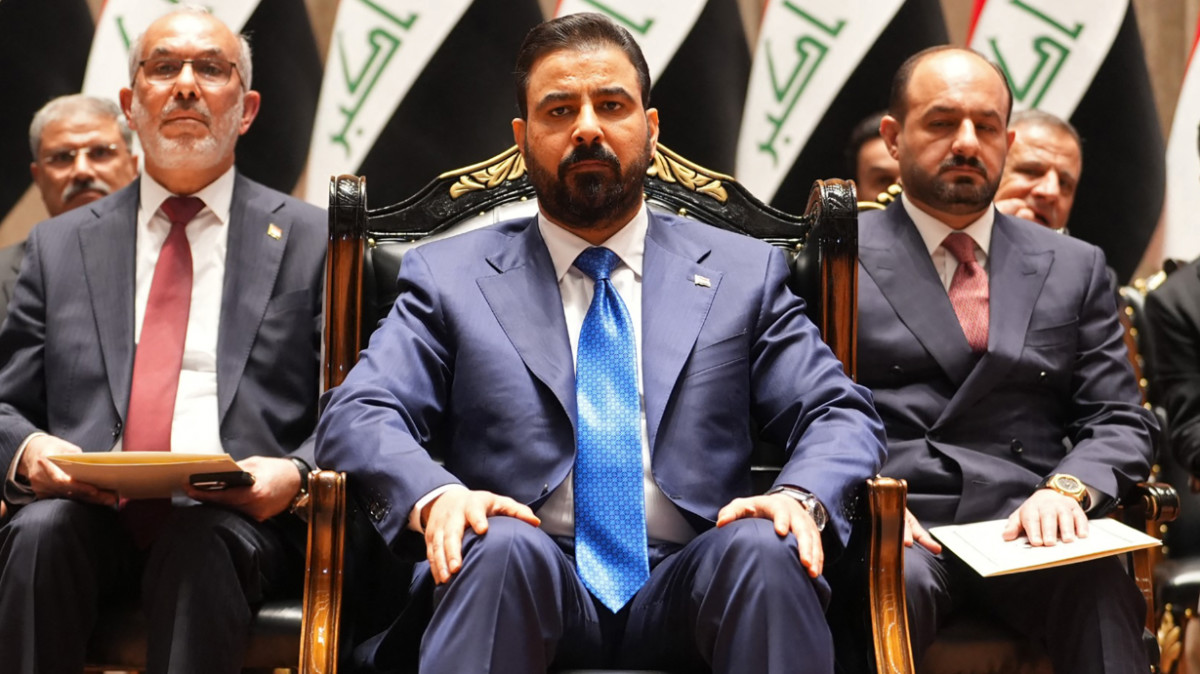
When Ali al-Zaidi secured his nomination as Iraq’s new Prime Minister back in April, a senior Iraqi diplomat speaking privately to Middle East Eye expressed open relief, placing a congratulatory call to the newly tapped leader immediately. “This was Trump’s pick. He is an Iraqi Trump, a businessman,” the official remarked at the time. “Now, the funds will flow again.”
That prediction has quickly come to fruition. Last Thursday, Baghdad confirmed that the United States has restarted air shipments of Iraqi oil revenues held at the Federal Reserve Bank of New York, a move timed perfectly for Zaidi’s high-stakes, landmark visit to the White House next week. A second senior Iraqi official, speaking to MEE on condition of anonymity, confirmed that the entire trip will center on commercial and energy agreements, with multiple deals ready for signing during Zaidi’s meeting with former President Donald Trump.
As part of the upcoming agreements, the Iraqi prime minister will finalize expansion of a preliminary deal that allows US energy giant Chevron to develop a major oil field in the southern province of Basra. Another US energy firm will also scale up its operational footprint at the Akkas gas field in western Anbar province, according to the official. A third major pact will see Washington and Baghdad partner on the rehabilitation of the 50-year-old Kirkuk Baniyas pipeline, which historically linked Iraq’s northern oil fields to Syria’s Mediterranean coastline.
Tom Barrack, Trump’s appointed ambassador to Turkey and special envoy for Syria and Iraq, has spent weeks pushing to lock in these preliminary agreements ahead of Zaidi’s visit, as part of a broader US strategy to reduce Iran’s regional influence and leverage over the Strait of Hormuz. “Trump and Zaidi come from a business background. Iraq is coming to the US with deals,” the senior Iraqi official noted.
For Zaidi, the focus on advancing economic and energy ties with Washington is also a calculated strategic move to buy time for his top domestic priority: disarming Iranian-aligned militias that joined Tehran in attacking US forces and Gulf Arab allies during the recent US-Israeli military campaign against Iran.
Renad Mansour, director of the Iraq Initiative at London-based think tank Chatham House, told MEE that Zaidi is closely studying the playbook of other regional leaders who have built productive working relationships with Trump, particularly Syrian President Ahmed al-Sharaa. “He knows the key is to establish a personal rapport,” Mansour explained.
The saga of Iraq’s frozen oil revenues underscores just how critical this visit is for Baghdad, which remains heavily dependent on Washington even years after the formal US military withdrawal. The US pulled all remaining combat troops from Iraq’s federal territory at the start of this year, leaving roughly 2,000 troops deployed only in the semi-autonomous Kurdistan region. But more than two decades after the 2003 US invasion, Washington still retains outsized leverage over the Iraqi government through its control of the country’s key oil income held in US financial institutions.
The Trump administration froze access to these funds back in April, with the official justification being retaliation for attacks on US assets in Iraq and neighboring countries. But behind the scenes, the freeze was also part of an aggressive lobbying campaign to push Iraqi political factions to select a prime minister aligned with US interests. Earlier this year, Trump publicly took the unprecedented step of tweeting his opposition to the nomination of Nouri al-Maliki, a two-time former prime minister with long-standing close ties to Tehran who oversaw the formation of Shia militias to combat the Islamic State a decade earlier.
“Zaidi enjoys obvious support in Washington,” Abbas Kadhim, director of the Iraq program at the Arab Gulf States Institute in Washington, told MEE. “His nomination was unprecedented in US-Iraq relations. He was endorsed by the US before there was even a vote to confirm the cabinet. The US always tried to negotiate behind closed doors on the PM’s selection. This was the most overt a president has ever been. There was no camouflage.”
Diplomats and analysts describe Zaidi as a carefully crafted compromise candidate. His acceptability to Washington was brokered by Faiq Zaidan, the powerful head of Iraq’s influential Judicial Council. Once a close ally of Iran and a disciple of Qassem Soleimani, the late commander of Iran’s Quds Force, Zaidan has shifted his alignment sharply toward the US in recent years, clearing the path for Zaidi’s nomination.
Even so, Zaidi ultimately relied on support from the Coordination Framework, an alliance of Shia political parties dominated by factions close to Tehran, which acts as the de facto kingmaker in Iraqi politics. Under Iraq’s unwritten power-sharing agreement, the prime minister’s post is reserved for a Shia politician, the presidency goes to a Kurd, and the speaker of parliament is selected from the Sunni community.
A wealthy self-made businessman with holdings spanning real estate, banking, and logistics, Zaidi’s own financial history underscores the delicate balancing act he must maintain: his Al Janoob Islamic Bank was sanctioned by the US in 2024 over allegations of ties to Iranian-backed militias.
Zaidi’s rise to power highlights the constant tightrope walk that Iraq’s ruling elite must navigate between two competing powers: the United States, which controls Baghdad’s financial lifeline through its hold on oil revenues, and neighboring Iran, which backs dozens of armed militias that wield massive political and military influence across the country.
The Popular Mobilisation Forces (PMF), a mostly Shia coalition of militias formed to fight the Islamic State more than a decade ago, has since become deeply embedded in Iraq’s state institutions. Today, the PMF fields more than 150,000 fighters, maintains sprawling patronage networks, and is partially integrated into Iraq’s official security apparatus, with the Iraqi government covering the salaries of its fighters. The group has repeatedly been accused of kidnappings, targeted assassinations, and violent suppression of peaceful anti-government protests.
Successive US administrations have pressured Baghdad to disband the militias, but multiple previous Iraqi prime ministers have avoided direct confrontation out of fear of the PMF’s military strength and deep infiltration of state institutions. The Trump administration has already pressed Zaidi’s government to cut off salary payments to PMF factions aligned with Iran.
Shortly after taking office, Zaidi launched a high-profile anti-corruption crackdown last month that targeted political figures from both Shia and Sunni backgrounds, including allies of his predecessor Mohammed Shia Sudani. Several senior officials with close ties to the PMF were among those targeted in the raids. He also set a firm September 30 deadline for all militias to surrender their heavy weapons to the state and disband. While a small number of smaller factions have announced they will comply with the order, the most powerful Iranian-aligned groups, including Kataib Hezbollah, have flatly refused to disarm.
“The US wants Iranian-linked armed groups reined in, and economic links to Iran reduced. It also wants attacks to stop against the US’s interests and partners, particularly the Gulf states,” Sarhang Hamasaeed, an independent Iraqi analyst based in Baghdad, told MEE.
Unlike Lebanese Hezbollah and Yemen’s Houthi movement, most of Iraq’s Iran-aligned militias avoided open participation in the Gaza war that followed the October 7, 2023, Hamas attack on southern Israel. A brief flare-up of clashes in late 2024 led to retaliatory US airstrikes, but after the US-Israeli military attack on Iran in February of this year, Iraqi militias openly joined the fighting.
US forces based in Iraqi Kurdistan came under repeated attack from multiple militia factions, but most of the attacks were directed at Gulf Arab states including Saudi Arabia and Kuwait, according to senior Arab Gulf and US officials who spoke to MEE. Analysts note that Baghdad’s relations with Kuwait and the United Arab Emirates have been severely damaged by the Iraqi government’s failure to prevent these attacks.
Regional experts warn that the recent regional conflict has made Zaidi’s goal of disarming the militias far more difficult to achieve. “It is difficult to take the September 30 deadline very seriously at this stage. There are no indications that the hardline, Iran-aligned militias, such as Kataib Hezbollah and Harakat al-Nujaba, are willing to relinquish their heavy weapons, nor is there any sign that Tehran is prepared to accept such a move,” Harith Hasan, an Iraq expert at the Doha Institute for Graduate Studies, told MEE. “So far, the measures taken have been largely cosmetic and implemented by groups that have not been deeply involved in attacks,” he added.
Despite heavy US and Israeli military strikes against Iranian targets across the region, Iran is widely viewed as having emerged from the conflict with increased regional influence and greater confidence. Tehran has moved aggressively to assert its control over the Strait of Hormuz, and rallied public and military support to Hezbollah in Lebanon, refusing to accept a US-brokered ceasefire extension until Israel agreed to halt attacks on its ally.
“The armed groups [in Iraq] came out in a more direct way in solidarity with Iran during the war. That makes Baghdad’s ability to manoeuvre harder,” Hamasaeed said. “These groups now feel stronger. They have fought directly with Iran, and Iran has shown it supports its allies.”
Mansour, from Chatham House, added: “The Islamic Revolutionary Guard Corps is doubling down on the militias. So they are getting significant support and direction from the IRGC. The Iranians aren’t going to stand down.”
For Iraq, which is facing deep economic crisis, Zaidi is betting that a focus on lucrative energy and business deals will appease the Trump administration and keep the flow of Iraqi oil revenues moving. Iraq relies on oil exports for roughly 90 percent of its total government budget, and unlike some Iranian-aligned actors, Iraqi oil shipments receive no preferential treatment in the Strait of Hormuz, where Iran has recently resumed attacking commercial vessels. Iraq also depends on the strait for nearly all of its critical imports of food and industrial goods.
“Unlike after 7 October [2023], when Iraq managed to insulate itself from regional conflict. This war has put Iraq in the crossfire,” Kadhim noted.