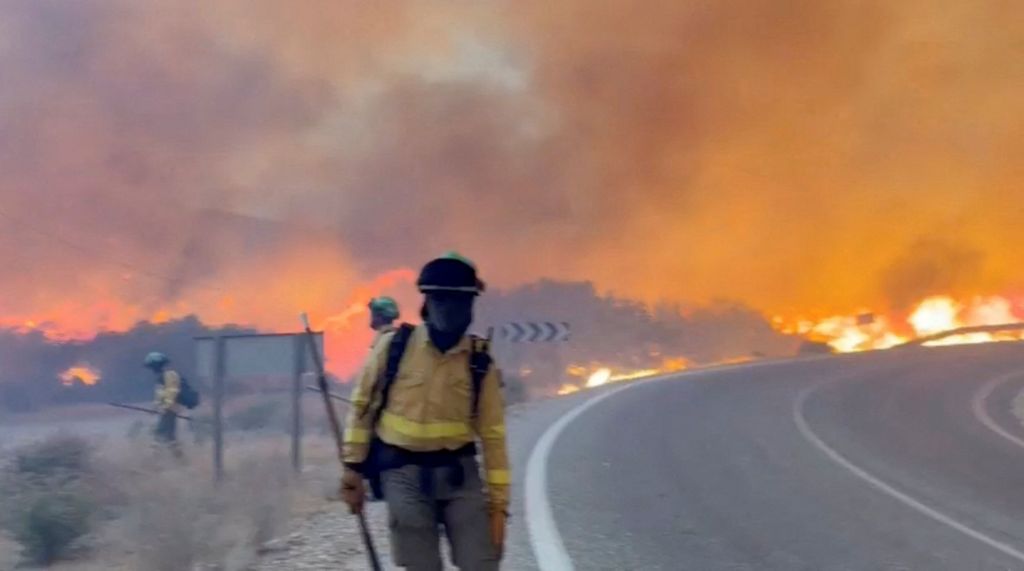
A devastating wildfire in the southern Spanish municipality of Los Gallardos, Almeria, has claimed 12 lives and left six people injured, regional Andalusian authorities confirmed this week, marking one of the deadliest European wildfire events of the 2026 summer season.
Initial witness accounts point to a downed power line as the likely ignition source, which sparked the blaze before it spread rapidly into nearby wooded terrain. However, regional officials have not yet formally verified the cause. Some victims were found trapped in their vehicles, overcome by flames as they attempted to flee the fast-moving fire overnight. Of the six injured, one was hospitalized for severe smoke inhalation, while another received care for burn injuries; four additional people were treated at the scene for minor burns and respiratory distress linked to toxic smoke.
Roughly 150 local firefighters have been deployed to contain the inferno, with Spain’s elite Military Emergency Unit (UME) also activated to support suppression efforts. The fire has forced the evacuation of 1,000 local residents and triggered widespread road closures across the affected area.
The Los Gallardos tragedy comes amid a months-long record heatwave baking Southern Europe, with persistent temperatures hovering around 40°C (104°F) creating tinder-dry conditions that have spawned hundreds of large wildfires across France, Portugal, and Spain. Thousands of people across the region have already been displaced from their homes by overlapping fire events this summer.
Juanma Moreno, president of the Andalusian regional government, described the rising death toll as an unfathomable tragedy. “Our hearts are heavy and we are devastated by grief,” Moreno wrote on social media platform X after the final fatality count was released.
Long-term climate data links the growing frequency and severity of Mediterranean wildfires directly to human-caused climate change. The Copernicus Climate Change Service confirms Europe is warming twice as fast as the global average, making it the world’s fastest-warming continent. Rising temperatures have amplified the intensity of summer heatwaves, strained regional water supplies, and extended high-risk wildfire seasons across the continent.
Last year, Spain recorded its worst wildfire season in modern history, with 393,000 hectares (971,000 acres) of land burned — more than six times the 2006-2024 national average. Across the European Union, 2025 marked the worst wildfire season on record dating back to 2006, with more than one million hectares burned, an area roughly half the size of Wales. A 2025 analysis from the World Weather Attribution group at Imperial College London found that climate change has directly increased the risk of severe, large-scale wildfires across the Mediterranean basin.
In preparedness moves ahead of this high-risk season, Spanish Prime Minister Pedro Sanchez announced in May that the country would roll out its largest-ever summer wildfire response deployment. Still, climatology and wildfire experts warn that more frequent and deadly fire events will continue to impact Europe as global temperatures rise. This June, Spain logged its highest average monthly temperatures since national record-keeping began in 1950, with forecasts calling for peak temperatures as high as 42°C (107.6°F) across parts of the country in the coming weeks.