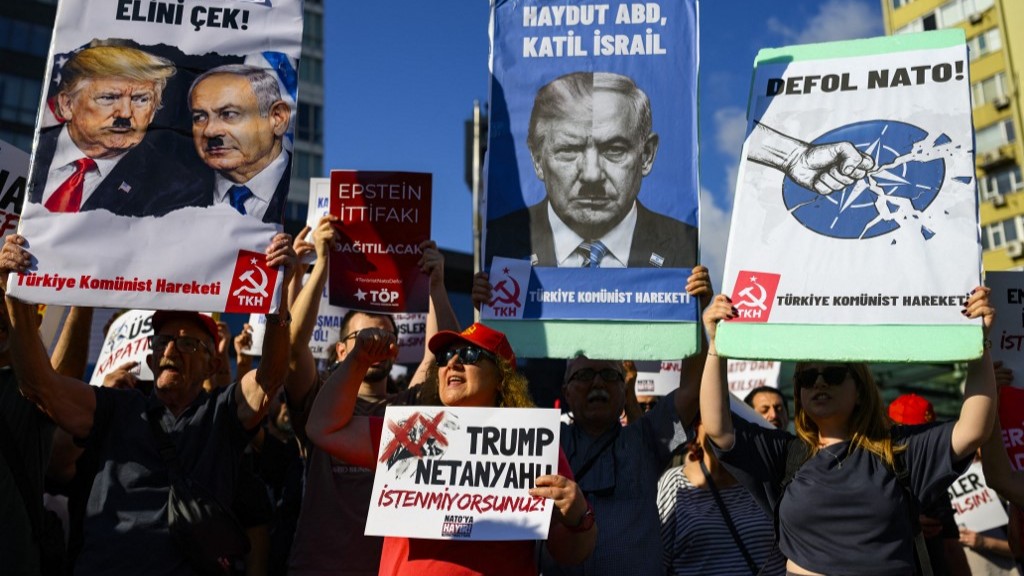
When U.S. President Donald Trump touched down in Ankara for the 2026 NATO Summit this week, long-simmering domestic anger over Turkey’s 74-year membership in the transatlantic military alliance reached a fever pitch, fueled by the ongoing humanitarian crisis in Gaza and sweeping government restrictions on dissent ahead of the high-stakes gathering.
While left-wing groups in Turkey have opposed NATO membership for decades, the alliance’s failure to condemn Israel’s military campaign in Gaza – paired with the Turkish government’s decision to ban all protests across Ankara for the full duration of the summit – has galvanized unprecedented cross-ideological opposition to the conference. In a challenge to NATO’s official narrative of collective European defense, the Workers’ Party of Turkey (TIP), a left-wing opposition party holding three seats in the Turkish parliament, organized a parallel Anti-Imperialist Peace Summit in Istanbul this past weekend, bringing together hundreds of anti-war activists and international socialist figures from across the globe.
The counter-summit’s founding manifesto, titled *No to NATO*, directly pushes back against the landmark commitment all NATO member states agreed to in 2025: a mandate to raise annual defense spending to 5% of national GDP by 2035. “The 2026 Ankara Summit opens a new era where working people across all NATO member states face greater vulnerability to exploitation and war, even as they are forced to bear the burden of rising defense budgets,” the pamphlet reads. “This policy diverts hard-earned working-class wealth to fund U.S. and Israeli-led wars around the world, and line the pockets of giant arms industry monopolies that profit from global conflict.”
Despite the counter-summit being a legally registered political event, Turkish authorities blocked dozens of international delegates from entering the country. A TIP spokesperson, speaking to Middle East Eye on condition of anonymity, confirmed that multiple scheduled attendees were turned away at border crossings, while delegates from organizations including the International Peace Bureau and the youth wing of Germany’s left-wing Die Linke party were detained overnight at Istanbul’s airport, had their personal devices confiscated, and deported shortly after. “These are peaceful activists and political representatives who came to participate in a public, legal meeting,” the spokesperson said. “Their treatment proves exactly what we have long argued: the security framework built around NATO summits is not directed at external threats – it is aimed at silencing people who oppose war.”
In the weeks leading up to the main summit, Turkish security forces have carried out a widespread crackdown on opposition voices, arresting at least 225 people. While authorities claim most detainees are supporters of the armed leftist DHKP/C group or the Islamic State, the detainee list also includes prominent non-violent dissidents: academic Emel Memis, LGBTQ rights activist and journalist Yildiz Tar, Nevzat Ozer of the environmental NGO Tema Foundation, Burcu Arikan, spokesperson for the independent labor union Umut-Sen, and Semra Demir and Kursat Bafra, lawyers from the Progressive Lawyers Association. The TIP spokesperson added that 17 additional party members have been detained since the summit opened.
Turkey’s complicated history with NATO stretches back to 1952, when the country joined the alliance in exchange for Western support, after committing troops to the Korean War. At the height of the Cold War, Turkey’s geographic location along the Soviet Union’s southern border made it one of NATO’s most strategically valuable members, a role that nearly triggered global nuclear catastrophe during the 1962 Cuban Missile Crisis. The deployment of U.S. nuclear weapons in Turkey targeting the Soviet Union was a core driver of the crisis, and their secret removal was the key concession that prevented open nuclear war. Today, Turkey hosts the critical Incirlik and Konya air bases that have been central to Western military operations across the Middle East for decades, and boasts the second-largest standing military in the alliance, outranked only by the United States.
For successive Turkish governments, NATO membership has long been seen as a critical security guarantee, protecting the country from threats ranging from the Soviet Union to armed separatist groups and hostile neighboring states in the Middle East. But for Turkish leftists and pro-democracy campaigners, NATO has played a far more insidious role at home: it has backed the training of far-right death squads, supported the creation of clandestine anti-communist Counter-Guerrilla groups, and propped up a Turkish military establishment that has repeatedly intervened to curtail democratic governance.
Outside analysts echo many of these criticisms. Khem Rogaly, a senior research fellow at the Common Wealth think tank, argues that NATO’s new 5% GDP defense spending mandate functions first and foremost as a mechanism of economic extraction, funneling public funds from European governments straight into the U.S.-dominated military industrial complex. “Mandatory military spending targets reshape entire economies around the arms industry,” Rogaly explained to Middle East Eye. “This leaves deep, long-lasting economic damage: military spending generates far less economic growth and far fewer jobs than equivalent investments in other public priorities. By forcing members to massively ramp up military spending, the new target means underfunding social programs that would deliver far broader shared economic benefits.”
The alliance’s response to the ongoing Gaza crisis has done more than any other recent issue to inflame anti-NATO sentiment in Turkey, even uniting normally opposed leftist and Islamist factions in opposition. TIP’s spokesperson points out that no NATO mechanism has ever been activated to restrain Israel’s military campaign, and that the most consequential item on the 2026 summit agenda is a plan to fully integrate Israel’s security apparatus into NATO’s regional strategy. The spokesperson added that the Turkish government’s high-profile public criticism of Israel amounts to little more than “crocodile tears,” as bilateral trade between the two countries continues uninterrupted. Recent high-profile disputes between Turkey and other NATO allies are also largely political theater, the spokesperson argued: “Politically, NATO membership gives the government bargaining power with Washington and a seat at the imperialist table. Economically, Turkey’s growing domestic arms industry is fully integrated into the alliance’s supply chains, so rising military budgets mean rising profits for the corporations closest to the ruling regime. Occasional anti-Western rhetoric is just for domestic consumption – the core institutions of imperialism operate without disruption on Turkish soil.”
Controversy has also extended to press access for the summit: multiple Turkish reporters from prominent independent outlets including *Cumhuriyet*, *Sozcu*, *Anka*, *T24*, and *Medyascope* were denied press accreditation. When Middle East Eye reached out to NATO for comment, a spokesperson referred the outlet to a social media post stating that the alliance relies on the host nation to manage all accreditation decisions.
This year’s summit has been marked by unusual behind-the-scenes tensions, with two core sources of anxiety for alliance organizers: first, ongoing uncertainty over Donald Trump’s commitment to the alliance, even with less than three years remaining in his current term. Trump’s repeated public criticisms of NATO have pressured member states to make concessions to keep the U.S. engaged. Second, many NATO members and key allies including Israel have repeatedly questioned Turkey’s alignment in recent years, due to Ankara’s continued diplomatic and economic engagement with NATO rivals Iran and Russia.
These anxieties have driven the Turkish government’s harsh crackdown on dissent, according to Selim Koru, founder of the *Kulturkampf* Substack. Koru argues that the protest ban and mass arrests are a deliberate move by an intensely geopolitically focused government to prevent domestic unrest from embarrassing Turkey on the global stage. “Turkey is the only NATO member whose value to the alliance is constantly being questioned by fellow members, and that is in large part due to the ruling government’s own bombastic rhetoric,” Koru explained. “Over the past decade, Turkish policy has swung wildly between strident opposition to NATO orthodoxy from 2013 to 2023 and staunchly pro-U.S., pro-NATO diplomacy today. It also seems alliance leaders have figured out that Turkey’s ruling class responds well to public praise, so they have been very generous with compliments.”
So far, that approach appears to have paid off for both sides. Ahead of the summit, Trump announced he was considering lifting the F-35 fighter jet sale ban he imposed on Turkey during his first presidential term, and plans to roll back additional sanctions imposed on Ankara. Trump called Turkey an “extraordinary” NATO ally, offering far warmer praise for the country than he extended to many other alliance members – including Spain, which Trump threatened to cut off from all U.S. trade.
For TIP and the anti-NATO movement, the 2026 Ankara summit exposes the lie at the heart of NATO’s branding as a defender of Western liberal values. “Today, the 5% GDP spending target agreed last year means every dollar cut from healthcare, education, and housing across Europe is redirected to the arms industry,” the TIP spokesperson said. “Militarization does not make European people safer. It fuels escalation, strengthens far-right movements, deepens economic inequality, and pulls the continent closer to war. Genuine security for Europe comes from disarmament, diplomacy, and robust social welfare – not an arms race that only weapons monopolies win.”