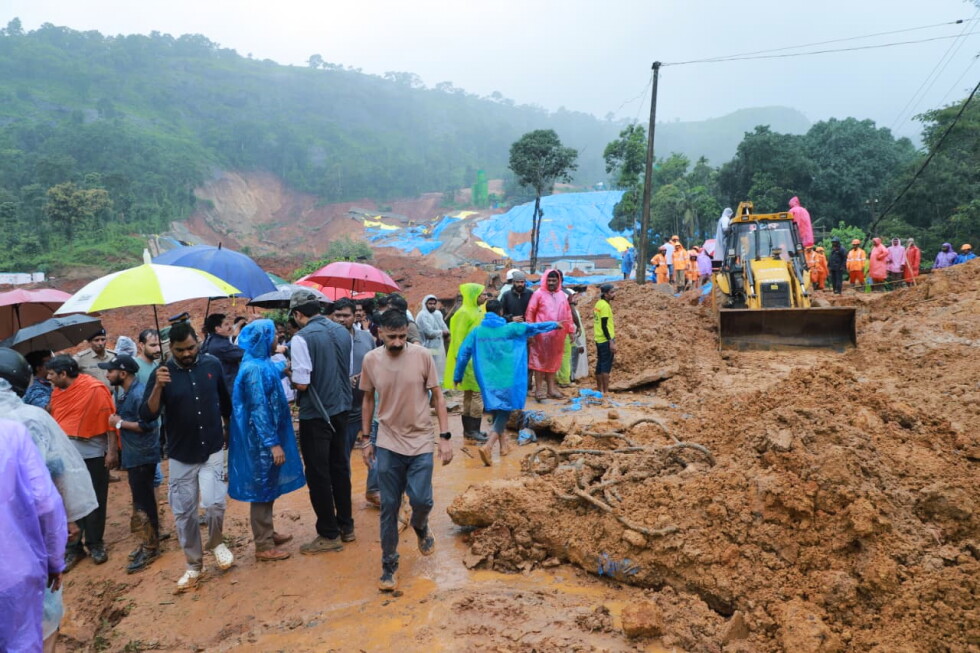
Rescue operations are underway in the scenic hill district of Wayanad in India’s southern Kerala state, where a catastrophic landslide triggered by intense monsoon downpours has left three people dead and five others unaccounted for. The disaster struck at a tunnel construction site Wednesday, when a massive wall of mud broke loose during heavy rain, tearing through the work area. Seven workers caught in the slide were pulled out with injuries and are currently receiving care at a local hospital.
Footage of the incident captured the full force of the disaster: a large earthen embankment collapsing under relentless rainfall, uprooting mature trees and sweeping away the temporary metal and fabric barriers that ringed the construction zone. Local law enforcement has segmented the search area into multiple operational zones to coordinate the effort, which includes specialized disaster response teams and sniffer dogs brought in to locate the missing. According to local police official Devamanohar, who spoke to reporters on the ground, ongoing heavy rainfall has significantly slowed progress and complicated search efforts.
In a surprising turn, Kerala’s Home Minister T. Siddique has publicly labeled the disaster not a natural event, but a man-made tragedy caused by negligent construction practices. Speaking to India’s official Press Trust of India news agency, Siddique alleged that the landslide occurred because construction crews dumped excavated earth in an unscientific manner, and failed to remove construction debris despite prior official warnings about the hazard. The construction company at the center of the allegations has rejected all claims of responsibility, telling the news agency that the landslide originated on elevated terrain far from the actual construction site, making the project blameless for the disaster.
State authorities have launched a formal investigation to determine the root cause of the incident and assign accountability for the casualties. This landslide is part of a growing pattern of deadly monsoon-related disasters across South Asia. Last year alone, extreme rainfall events including cloudbursts, widespread flooding, and multiple landslides across India caused devastating losses of life and widespread destruction of property.
Climate researchers have repeatedly warned that human-induced climate change is altering the behavior of South Asia’s iconic monsoon seasons, which typically bring two periods of rainfall between June and December. Once a predictable, life-sustaining weather pattern, monsoons now produce erratic, extreme downpours that dump massive volumes of water over short time frames, punctuated by extended dry periods that create drought conditions. This shift not only increases the risk of catastrophic landslides in hilly, deforested or development-heavy regions like Wayanad, but also threatens food and water security across the entire subcontinent.