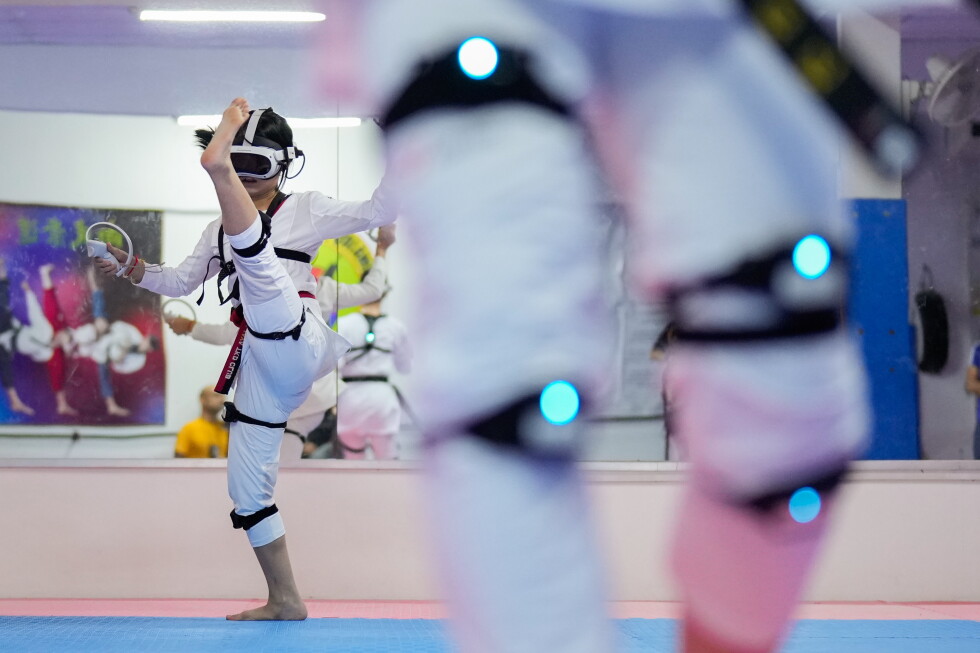
Across Southeast Asia, a fusion of traditional martial arts and cutting-edge digital technology is carving out a new niche in global competitive sports: virtual taekwondo. What began as an experimental, unfamiliar concept just a few years ago has rapidly evolved into a structured, widely embraced discipline, attracting athletes of all ages and reshaping how communities think about both martial arts and gaming.
For Vietnamese elite athlete Nguyen Thanh Hien Linh, the journey to becoming a virtual taekwondo gold medalist started with a steep learning curve. When she competed in her first virtual tournament in Singapore in 2024, the 21-year-old traditional national champion had little understanding of how the sport worked. “I was just kicking into the air,” she recalled, struggling to adapt to the unfamiliar digital arena, with no grasp of required strategy, specialized skills, or the underlying technology. Just two years later, she stood atop the podium at a major Malaysian virtual taekwondo competition, joining a fast-expanding regional community of the gamified combat sport.
Co-developed by global governing body World Taekwondo and Singaporean tech firm Refract Technologies, virtual taekwondo was designed to appeal to the digital-native generation of young athletes by merging immersive virtual reality with core traditional taekwondo techniques. When competitors step onto the mat, they wear VR headsets that place them in a photorealistic 3D digital arena, alongside motion-tracking sensors strapped to their spine, thighs, and shins. Every movement of the athlete controls a custom digital avatar, and matches are held entirely without physical contact: well-timed, fast strikes gradually deplete the opponent’s virtual health bar, just like in a traditional video game.
Unlike conventional taekwondo, which separates competitors into divisions by age, weight, and gender to reduce injury risk and level the playing field, virtual taekwondo allows all athletes to compete on the same equal digital footing. The discipline made its first major global debut during Singapore’s Olympic Esports Week in 2023, hosted its first official World Championships in 2024, and is set to make its Asian Games debut in Japan this year. It is also already confirmed as an included sport for the 2027 Southeast Asian Games hosted by Malaysia, marking a major milestone in its journey toward mainstream recognition.
One of the biggest draws of the new sport, participants and coaches say, is its combination of high physical demand and near-zero injury risk. That unique selling point has won over both athletes and families across the region. At last month’s Malaysian national competition, 46-year-old Singaporean athlete Brian Peh explained that he first entered the 2024 world championship out of curiosity, joining his teenage son for the event. Both walked away with gold medals, and Peh has now added virtual taekwondo training to the curriculum at his traditional dojang (training hall).
“I always tell parents: your kids love games. Do you want them using their hands to play, or using their legs?” Peh said. “When they put on the headset and start to fight, wow, their energy is so high. They can play and play and they love it.”
In Cambodia, head coach Vandy Yiv reported that local participation in virtual taekwondo has already outpaced traditional forms of the sport, driven by growing interest from parents and children attracted by the low injury risk. At a local tournament held earlier this year, Vandy said virtual taekwondo drew more competitors than traditional segments. Many first-time participants arrive assuming it is just another sedentary video game, but quickly discover it is a demanding full-body combat sport. “Your whole body is moving. There is action, but no injury,” Vandy said, adding that he hopes to see virtual taekwondo become an official Olympic medal event in the coming years.
While some new athletes experience initial disorientation and dizziness as they adjust to the virtual environment, the gamified format resonates strongly with teen competitors. Matches are structured as fast-paced, intense one-minute bouts that require constant offensive pressure, and success depends on more than just raw kicking ability. “You have to guess first where your opponent is and move before they do,” Nguyen explained, noting that the sport requires sharp anticipatory skills that differ from traditional taekwondo.
Coaches emphasize that athletic success in virtual taekwondo relies on just as much physical conditioning as technical ability. Athletes still execute all the core traditional techniques: front kicks, turning kicks, and spinning maneuvers. However, instead of relying on impact force to score points, victory hinges on the speed of execution. “So our training is first stamina, muscle endurance, flexibility. Then we go toward the skills, the strategies, how to fight,” said Malaysian coach Henry Lee, himself an elite traditional taekwondo athlete, during a recent club training session. “Strength … is about how fast your leg can lift and strike. Speed becomes your power.”
Lee also scouts for a key soft skill that sets top competitors apart: strong “game sense,” or the ability to read opponents’ movements and make split-second decisions in the unseen virtual space. Twelve-year-old trainee Victoria Siow explained that the sport’s unique challenge lies in judging spatial positioning that athletes cannot physically see. “You have to work on your mind — when to kick, how far to move,” she said. “It feels like a game and like a dream at the same time.”
For many older athletes and competitors who prefer low-contact sports, virtual taekwondo has opened new competitive opportunities that traditional sparring can no longer offer. Forty-five-year-old Raja Mardiah Idris, who trains at Lee’s club, noted that the format allows older athletes and women to compete safely and on equal footing regardless of age, size, or gender. Her young daughter has also taken up the sport, embracing it as a healthy active alternative to sedentary screen gaming. “When you wear the VR, everybody is the same,” said Raja, a member of a Malaysian state royal family. “You win through your technique, your strategy and your fitness.”
Raja now plans to retire from full-contact traditional kyorugi sparring to focus exclusively on virtual taekwondo. She maintains a rigorous training routine of running and gym work to stay in competitive shape, and hopes to represent Malaysia at the 2027 SEA Games.
While the sport is still in its early infancy across Southeast Asia, national governing bodies are already building out infrastructure to support growth. Malaysia has launched national development programs and official coaching certification courses, though challenges remain: high equipment costs currently limit broad access in lower-income parts of the region. Tony Lee, Malaysia’s national virtual taekwondo coach, is optimistic that growing public interest will push more clubs to invest in the required technology. “Virtual taekwondo is our future because young people like gaming,” he added.