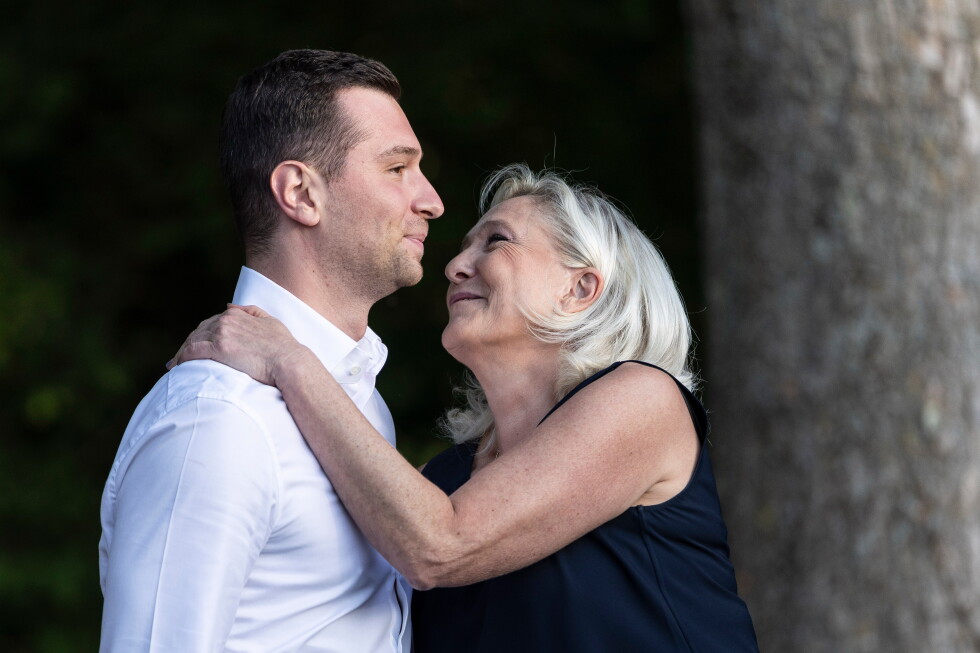
PARIS (AP) — As France waits for a key appeals court ruling on Tuesday that could derail Marine Le Pen’s fourth — and most competitive — bid for the country’s presidency, the far-right National Rally party already has a potential successor lined up: 30-year-old party president Jordan Bardella, who has spent years stepping out of his mentor’s shadow to carve out his own political identity. Yet for all his alignment with Le Pen’s core populist agenda, Bardella is far from a carbon copy of the leader who came closer than any other far-right candidate to winning the French presidency in 2022. The most consequential difference, analysts agree, is that he does not carry the Le Pen name — a legacy that has haunted Marine Le Pen throughout her decades-long political career.
The Le Pen name is deeply polarizing for much of the French electorate, especially left-leaning voters. Marine Le Pen inherited the party, originally founded as the National Front in 1972, from her father Jean-Marie Le Pen, whose virulent far-right rhetoric, repeated criminal convictions for hate speech, and well-documented Holocaust denial made the name anathema to huge swathes of public opinion. After decades of working to detoxify the party’s image — a process that included renaming it the National Rally in 2018, expelling Jean-Marie Le Pen from the party, and walking back divisive policies like France’s withdrawal from the European Union and a return to the franc — Marine Le Pen handed the day-to-day party leadership to Bardella in 2022. Today, the National Rally holds the largest number of seats in the National Assembly, France’s lower parliament, a testament to its steadily growing popularity over the past decade.
On core policy, the ideological gap between Le Pen and Bardella is narrow. As party president, Bardella has remained a fierce advocate for the National Rally’s flagship anti-immigration platform, arguing that France is being overwhelmed by migration primarily from African nations, and that many native French citizens no longer recognize the country they once loved. Where the two diverge is in policy emphasis and voter outreach: Le Pen has long centered her messaging on working-class voters, focusing on pocketbook issues like purchasing power and supporting state intervention in the economy, while Bardella has adopted a more pro-business tone designed to win over entrepreneurs and wealthy conservative voters.
For political analysts, the absence of the Le Pen name is Bardella’s biggest strategic advantage if he is thrust into the presidential race next year. Constitutionally, incumbent two-term President Emmanuel Macron cannot run for re-election, so the 2027 race is already wide open. Luc Rouban, a senior researcher at Sciences Po in Paris who specializes in French far-right politics, notes that a Bardella candidacy would symbolically mark a clean break from the toxic legacy of Jean-Marie Le Pen and the old National Front. That legacy has been a persistent vulnerability for Marine Le Pen, with critics and historians constantly highlighting her father’s ties to World War II Nazi collaborators and his long record of hate speech. As the first National Rally leader from outside the Le Pen family, that historical baggage is far less likely to attach to Bardella on the campaign trail. “Jean-Marie Le Pen’s legacy is a very heavy burden to carry,” Rouban explained. “If you move beyond the Le Pen family, you’re entering different territory.”
Bardella also brings a key asset that the 57-year-old Le Pen cannot match: youth and digital fluency. Le Pen herself has highlighted the pair’s complementary strengths, saying recently, “We are complementary. I have a certain experience, but Jordan has an absolutely incredible dynamism; he has the strength and energy of his youth.” Bardella has leveraged that youth to build a far larger social media following than his mentor: he has nearly double Le Pen’s Instagram follower count, and his 2.3 million TikTok followers outpace Le Pen’s 1.5 million. That digital presence puts him in a stronger position to mobilize Generation Z voters, a demographic that has increasingly disengage from national electoral politics over the last two decades. France’s national statistics agency data shows that only 17% of 18 to 29-year-olds cast ballots in all rounds of the 2022 presidential election, when Macron defeated Le Pen for a second time, down from 31% in 2002.
Yet Bardella’s youth also comes with a clear drawback: a relative lack of political experience compared to Le Pen, who was born into politics and has been running for office for more than 30 years. Born into a political family, Le Pen joined the old National Front as a teenager, earned a law degree, and first ran for legislative office at just 24 years old in 1993. While Bardella has served as a lawmaker in the European Parliament, he has never led a national campaign, and some analysts warn that his thin resume could turn off older, more traditionally minded voters. Critics and some political observers even speculate that Bardella could falter under the intense pressure of his first presidential campaign.
Still, Victor Mallet, author of *Far-Right France: Le Pen, Bardella and the Future of Europe*, warns that ruling out Bardella based on experience alone is a mistake. He points to former U.S. President Donald Trump as a parallel, noting that many political experts dismissed Trump’s chances of victory because of his lack of prior governing experience — a miscalculation that has echoes in the current conversation about Bardella. “A lot of people thought the same thing about Donald Trump,” Mallet said. “They thought, you know, this guy has no experience of government, his policies don’t make any sense, and he was elected twice.”
Associated Press journalists Sylvie Corbet and Jeffrey Schaeffer in Paris contributed to this report.