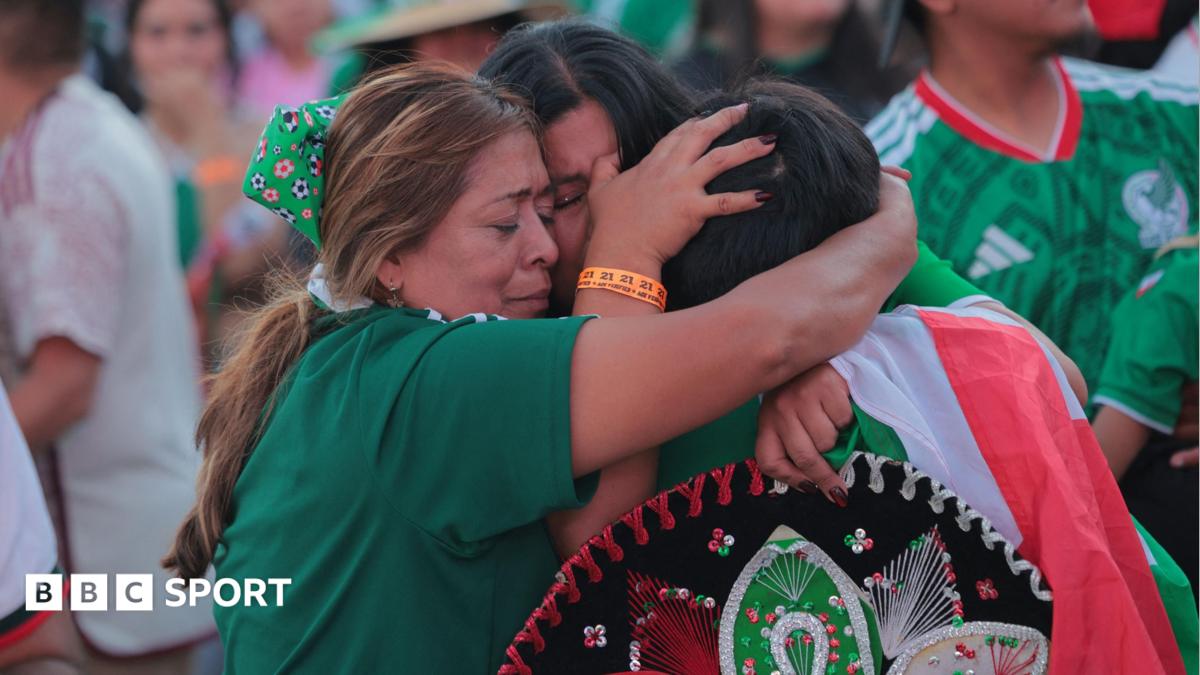
When the final whistle blew on Mexico’s 2026 FIFA World Cup campaign at the Round of 16, a 3-2 thriller against England that sent El Tri packing, despair did not take over a packed Santa Ana bistro in Orange County, California. Instead, the crowd rose to their feet: some waved vibrant green Mexican flags, others sang through their disappointment, and soon the room swelled with the beloved folk anthem *Cielito Lindo*, its iconic lyric “Canta y no llores” (Sing, don’t cry) hanging in the air.
Louie Leyla, a Mexican-American who has called California home since 1990, summed up the collective mood: “This is sad. But we’re going to keep rooting for our people, no matter what.”
While England’s victory ended Mexico’s tournament in Arizona’s Azteca Stadium – a match that broke Mexico’s 15-match World Cup streak of going into halftime without conceding, after the Three Lions netted two first-half goals – for the tight-knit Mexican-American community of Southern California, the run was far from a failure. This region hosts one of the largest concentrations of Mexican diaspora outside of Mexico itself, and for weeks, the World Cup became far more than a series of football matches: it was a community unifying triumph that exceeded every expectation.
“It’s a loss,” said local resident Alicia Rojas. “But it’s a win for our community in Santa Ana.” Nearby, Cynthia Rebolledo smiled as she gestured to her young son, decked from head to toe in Mexico’s national green, white and red. “He keeps asking if we’re still going to the parade. He thought we won. He’s been rooting for Mexico – and for his community.”
As trumpets blared and fans danced between tables, holding their flags high, long-time local observer Leigh Slater put the moment in perspective. “Football is like life. You lose, you win. But what we’ve seen throughout this World Cup is the unbreakable spirit of immigrants in this country.”
Throughout the 2026 tournament, co-hosted by the U.S. alongside Mexico and Canada, Mexican supporters emerged as some of the most visible, passionate fans across the country. Stadiums from coast to coast were awash in bright green El Tri jerseys, echoing with chants and the roar of thousands of voices – and nowhere was that energy more palpable than in Orange County’s Santa Ana, the historic cultural heart of Southern California’s Latino community.
The current joy and collective gathering stand in stark contrast to the tension that gripped these same neighborhoods just 12 months prior. In June last year, at the height of a wave of ICE immigration raids, Latino communities across the region stayed indoors, public spaces emptied out, local businesses lost nearly all their customers, and residents avoided large public gatherings out of fear. National Guard vehicles were stationed just blocks from local businesses, and the only activity on downtown Santa Ana’s usually busy streets came from immigration rights protests.
“What a difference a year makes,” noted Los Angeles Times columnist Gustavo Arellano, speaking over the roar of maracas, horns and crowd chants in the packed bistro. “They were occupying the same streets that a year earlier were completely, completely and utterly dead. This was June last year. That was really the height of this. These streets were empty unless you were protesting.”
For Arellano, the sudden shift from fear to unbridled public celebration is nothing short of emotional release. “Fast forward a year later… this is catharsis – for Mexicans especially, but for Latinos in general.”
Mexico’s status as a 2026 World Cup co-host, paired with the team’s successful run to the knockout stage, created a rare opening for the community: a chance to celebrate their cultural identity openly, after a year marked by anxiety and uncertainty around immigration enforcement. Supporters who had hidden their cultural ties in public just months earlier were now singing the Mexican national anthem at packed, family-friendly fan zones, waving flags and wearing their team’s colors with pride. For many of these Mexican-Americans, expressing their Mexican identity has never been incompatible with their American identity – a far cry from the 1990s, when Mexican football fans were frequently labeled “unpatriotic” for displaying Mexican flags amid a wave of anti-immigration political rhetoric.
“The expression of these fan bases has gotten bigger as America has gotten more diverse,” Arellano observed. Like millions of fans, he had held out hope that Mexico could pull off a shocking upset against England. “The cynic in me says this is what always happens to Mexico. We’re good, but we just can never truly compete against the elite of the world. But you know what? We never give up. So I’m proud of what they did. We didn’t give up until the very, very end. England was just a superior team.”
As the United States marks its 250th anniversary, a moment defined by renewed national debate over immigration and identity, the 2026 World Cup has laid bare a different, more diverse reality of modern American life. Diaspora communities across the country turned out in droves not just for Mexico, but for dozens of other nations: Scotland, Argentina, Colombia, Ecuador, Morocco, Egypt and more, revealing an America where millions of people maintain deep, proud cultural ties to two homes.
For Mexican-Americans in Southern California and beyond, that dual identity was the real story of this tournament. At a moment of intense difficulty for Latino communities across the country, the 2026 World Cup gave them something they had been missing for a long time: “an opportunity to express joy,” Arellano said.