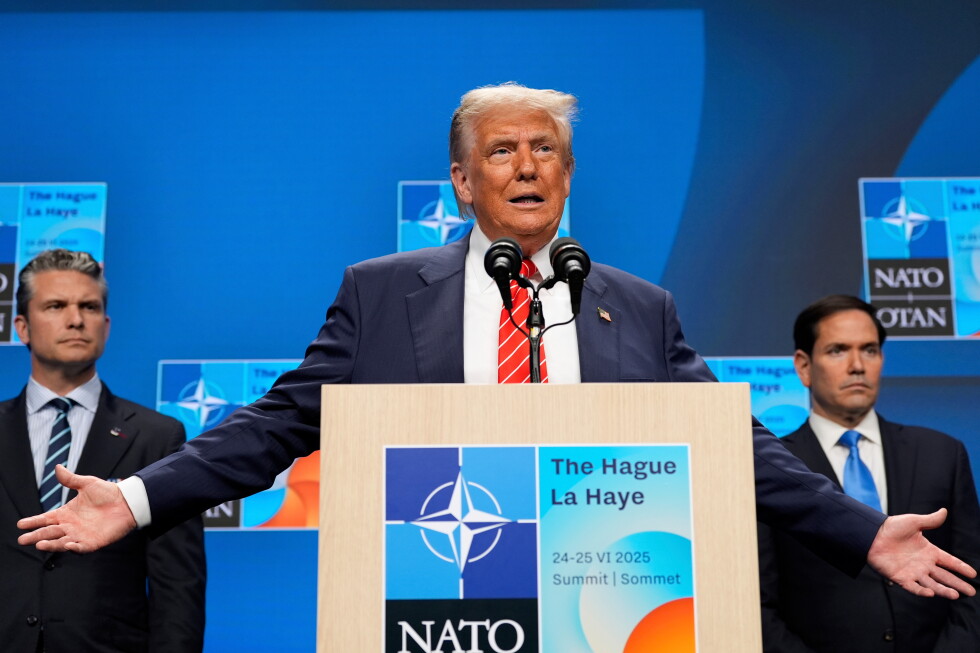
As U.S. President Donald Trump prepares to depart for the 2025 NATO summit in Ankara, Turkey, his primary objective is clear: hold alliance members accountable to the sweeping defense spending commitments they agreed to at last year’s gathering, a deal he secured after years of pressure on European partners.
A year ago in The Hague, Trump won a major diplomatic victory when most NATO members acquiesced to his demand to adopt a target of spending 5% of annual gross domestic product on defense by 2035, with 3.5% allocated to core defense activities and the remaining 1.5% covering related security infrastructure and costs. That agreement marked a historic shift for the alliance, underscoring the extent to which Trump has reshaped NATO’s priorities to align with his longstanding critique that the U.S. carries an unfair share of the bloc’s defense burden. Now, the Ankara summit will serve as the first official check-in on member progress toward that ambitious goal.
“President Trump fully expects that all allies will step up immediately and get on the path to 5% and do it with urgency,” U.S. Ambassador to NATO Matt Whitaker told reporters during a pre-summit briefing, laying out the Trump administration’s core message for the gathering.
Trump, who departs Washington Monday evening, has spent the days leading up to the summit reigniting longstanding grievances over alliance defense contributions, even after NATO Secretary-General Mark Rutte attempted to preempt criticism last month during an Oval Office meeting. During that encounter, Rutte presented large custom charts highlighting what he dubbed “The Trump Trillion” — the cumulative $1 trillion in increased defense spending commitments allies have made since Trump took office in 2025, a deliberate effort to acknowledge the president’s role in driving the shift.
Washington-based conservative think tank Hudson Institute senior fellow Luke Coffey framed the Ankara gathering as nothing less than a “first report card” for the alliance following last year’s landmark spending agreement. “If NATO members play their cards right — if the leaders show up demonstrating a commitment and a reasonable plan to meet these spending targets — then it’ll allow President Trump to take a victory lap,” Coffey explained.
Beyond defense spending, the summit will tackle a series of pressing global security issues, chief among them the five-year-long war in Ukraine. The White House confirmed that Trump will hold a bilateral meeting with Ukrainian President Volodymyr Zelenskyy on the summit’s sidelines Wednesday, following separate phone calls Trump held with both Zelenskyy and Russian President Vladimir Putin on July 4. At last month’s G7 summit in France, Trump secured broad backing from fellow leaders for a preliminary interim agreement to de-escalate the Iran war, and participants also agreed to ramp up security assistance for Kyiv, a outcome Trump hailed as a demonstration of alliance unity.
Trump also plans to hold a separate meeting with Syrian President Ahmad al-Sharaa, whose rebel forces recently ousted longtime former president Bashar al-Assad. While the White House has not publicly outlined specific goals for the talks, the meeting comes after Trump publicly suggested Syria should take a larger role in combating Hezbollah in Lebanon — a proposal al-Sharaa has already rejected. The president will also hold one-on-one talks with Turkish President Recep Tayyip Erdogan, the summit’s host, whom Trump has repeatedly described as a close personal friend. Notably, no other bilateral meetings with other NATO leaders are currently on Trump’s official schedule.
That absence of additional talks comes as no surprise, given that Trump reignited multiple feuds with allied leaders immediately following the comparatively positive tone of last month’s G7 summit. Shortly after returning to Washington, Trump publicly predicted British Prime Minister Keir Starmer would step down, arguing Starmer had “failed badly” on immigration and energy policy — a prediction that came true days later. He also sparked a major diplomatic row with Italy after claiming that Prime Minister Giorgia Meloni had “begged him for a photo”; Meloni’s team issued a ferocious public denial, and Italy canceled a planned visit by its foreign minister to the U.S. in retaliation. Trump doubled down on the clash over the weekend, posting a photo of Meloni smiling at him on social media with the caption “RESTRAINING ORDER NEEDED.”
Tensions also remain high between Trump and Canadian Prime Minister Mark Carney, and while French President Emmanuel Macron sought to charm Trump with a lavish state dinner at the Palace of Versailles last month, relations between the two leaders have historically been fraught.
To counterbalance Trump’s often caustic approach to the alliance, a bipartisan delegation of U.S. senators is traveling to Ankara alongside the official presidential delegation, aiming to highlight the broad, cross-partisan support for NATO that exists on Capitol Hill. “They are our best allies, they are our best trading partners, they are critical to our national security, to our economic success, and we need to encourage those relationships,” said Sen. Jeanne Shaheen, a New Hampshire Democrat leading the delegation. “That’s part of what Congress understands that the administration doesn’t seem to.”
The summit arrives as the Trump administration pushes its vision for “NATO 3.0,” a strategic restructuring that calls for European members to take on full primary responsibility for their own security, allowing the U.S. to reorient its military focus to other global hotspots. The framework was first laid out earlier this year by U.S. Undersecretary of Defense Elbridge Colby during a meeting of NATO defense ministers. Last month, Defense Secretary Pete Hegseth amplified that pressure in a sharply worded speech to fellow defense ministers, announcing the U.S. would launch a six-month comprehensive review of all American forces deployed in Europe — a move that caught many alliance members off guard, as they had expected a more coordinated transition of force posture with the new administration.
Trump himself added to widespread uncertainty earlier this year when he sent conflicting signals on U.S. force levels in Europe, announcing he would deploy 5,000 additional troops to Poland just weeks after ordering 5,000 existing troops to withdraw from the continent.
Shaheen argued that the NATO 3.0 concept reflects a persistent failure by the Trump administration to recognize the direct threat Russian President Vladimir Putin poses to European security, and by extension, to U.S. national security.
While most member states have moved to increase spending in line with last year’s agreement, not all have embraced the 5% target: Spain immediately stated it could not reach the threshold when the target was adopted, and several other countries have privately voiced reservations about the ambitious timeline. Even among those that have increased commitments, experts warn that most European states remain heavily dependent on U.S. military backing to honor Article 5, NATO’s core principle that an attack on one member is an attack on all.
“This is the reality for most Europeans,” said Liana Fix, senior fellow for Europe at the Council on Foreign Relations. “Most are far from being able to defend themselves without the United States, even if they’re starting to develop all that.”
Beyond defense spending, NATO has already adjusted a number of its initiatives to align with Trump’s priorities. Earlier this year, the alliance launched “Arctic Sentry,” a large-scale military exercise focused on countering Russian and Chinese activity in the Arctic region. The exercise also addresses Trump’s repeated threats to annex Greenland, the semiautonomous Danish territory that Trump has insisted the U.S. must acquire for strategic security purposes.
Associated Press correspondents Michelle L. Price in Washington and Lorne Cook in Brussels contributed reporting to this article.