One hundred years after Ernest Hemingway’s *The Sun Also Rises* catapulted the future Nobel Prize-winning author to literary stardom and turned the small Spanish city of Pamplona into a global bucket-list destination, the 2026 San Fermin festival is drawing crowds of Hemingway admirers and curious travelers alike to honor the iconic novel’s legacy.
Published in 1926, *The Sun Also Rises* quickly cemented its place as a foundational work of the American literary canon, standing alongside F. Scott Fitzgerald’s *The Great Gatsby* as a defining text of the Jazz Age. The novel follows a circle of disillusioned American and British expatriate bohemians as they wander Europe, chasing distraction from their unmet inner longings through wild travel, heavy drinking, and the heartache of unrequited love. It popularized the term “Lost Generation” to describe the cohort of interwar writers who made Paris their home, and Hemingway’s signature sharp, concise prose redefined the trajectory of American writing forever.
For thousands of visitors, the novel’s vivid depiction of Pamplona’s nine-day bull-running festival has been life-changing. Bill Hillmann, a 44-year-old Chicago-based writer and professor who now teaches *The Sun Also Rises* at East-West University, was just 19 when he first read the novel. He read through the night, finishing it in a single sitting, and left the experience determined to become both a writer and a bull-runner. That fateful reading sparked a decades-long obsession: Hillmann has now run with bulls hundreds of times across Spain, across dozens of events beyond Pamplona, and despite being gored three times — including a 2014 incident that nearly killed him — he says he would never miss this year’s centennial festival.
Hillmann is far from alone in his devotion. Americans make up the largest group of foreign participants in the festival’s iconic bull runs, according to Pamplona City Hall data. In 2022, 16% of all registered runners were American, four times the share of the second-largest foreign group from neighboring France. Bruce Anderson, a Dallas-based tour operator whose company Running Of The Bulls has organized trips for thousands of American visitors over decades, says Hemingway’s work turned a little-known regional festival into a must-see global event. This year alone, his company is bringing 1,400 attendees, two-thirds of whom are American. A lifelong Hemingway fan who bears a striking resemblance to the author, Anderson is often called “Papa” — Hemingway’s famous nickname — by locals when he visits Pamplona, particularly when he stops at Café Iruña, the art deco drinking spot that features heavily in *The Sun Also Rises* and now displays a life-size statue of Hemingway at the bar.
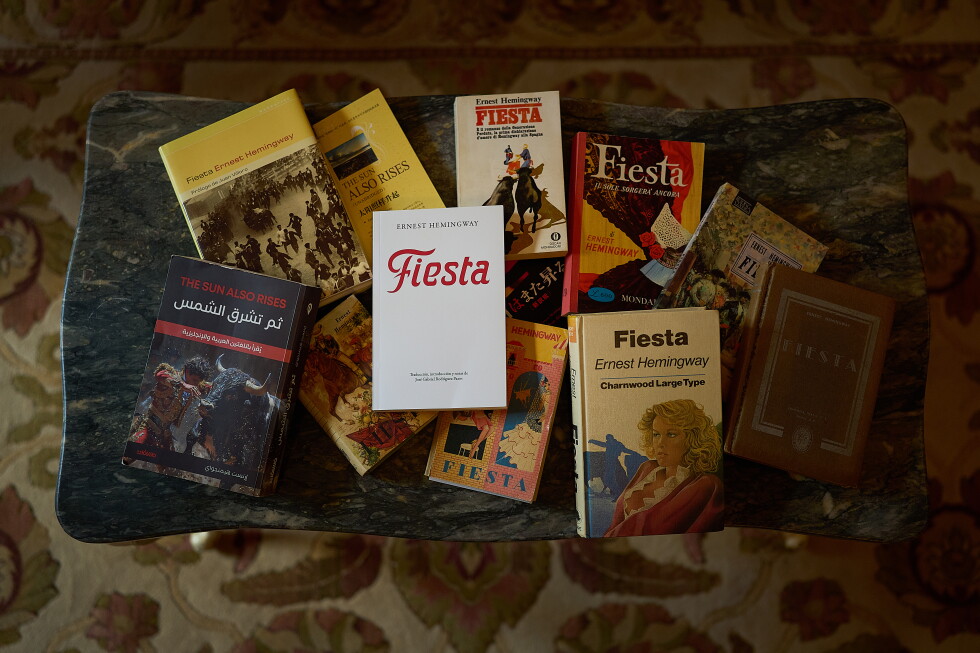
Hemingway’s presence is impossible to escape across Pamplona. Hotels and bars display busts and commemorative plaques marking where the author ate and drank during his visits. A large statue stands outside the city’s bullring, where a centennial banner hangs bearing one of Hemingway’s most famous lines about the festival: “At noon of Sunday, the 6th of July, the fiesta exploded. There is no other way to describe it.” The suite where Hemingway stayed during his final visits to the city at the Perla Hotel remains preserved with 1950s-era furniture, overlooks the bull run route, and houses two glass bookcases filled with dozens of copies of *The Sun Also Rises*. “Hemingway did a lot for Pamplona because he made it known around the world,” said Fernando Hualde, a former 40-year receptionist at the hotel.
Yet for all its enduring fame, Hemingway’s legacy in Pamplona is far from universally celebrated. Critics have pushed back against his hyper-masculine public persona from a feminist perspective, while animal rights activists condemn his glorification of bullfighting — a subject that takes up far more space in *The Sun Also Rises* than the bull runs themselves. “Hemingway wrote about many, many themes that today would not be accepted into society. He writes about hunting, about war, and we don’t want to be appreciating these themes today,” animal welfare activist Brook Spurling said during a recent protest against the festival’s bullfights.
Many locals also blame Hemingway for the overtourism that has transformed the once-sleepy provincial city of 200,000 residents. Every year, more than a million additional visitors flood into Pamplona for the festival, and many follow the excessive drinking culture Hemingway depicted in his novel. Some local businesses even lean into the backlash: one popular bar displays a sign reading “Hemingway was not here,” a point of pride for locals seeking to avoid the tourist crowds. Gabriel Insausti, a literature professor at Pamplona’s University of Navarra, notes that commercialization has overshadowed the novel itself for many visitors. “In general, Hemingway has become a product of a franchise associated with San Fermin festival that has obscured his novel,” Insausti said. “People know who Hemingway is, but they haven’t read his novel.”
Still, admirers argue that the core themes of Hemingway’s work remain as relevant today as they were 100 years ago. Hillmann, who has repeatedly returned to running even after life-threatening injuries, says there is a quiet art to bull running that many casual observers miss, a nuance Hemingway captured perfectly in his prose. Mariel Hemingway, the author’s granddaughter and a well-known actress, says her grandfather’s exploration of identity, love, grief, and purpose after devastating loss gives his work enduring power. “Identity, love, purpose, and how to rebuild after profound loss … those themes haven’t ever changed. That’s what’s great about my grandfather,” she told the AP from her home in Idaho. “I think he captured something that will never go away.”