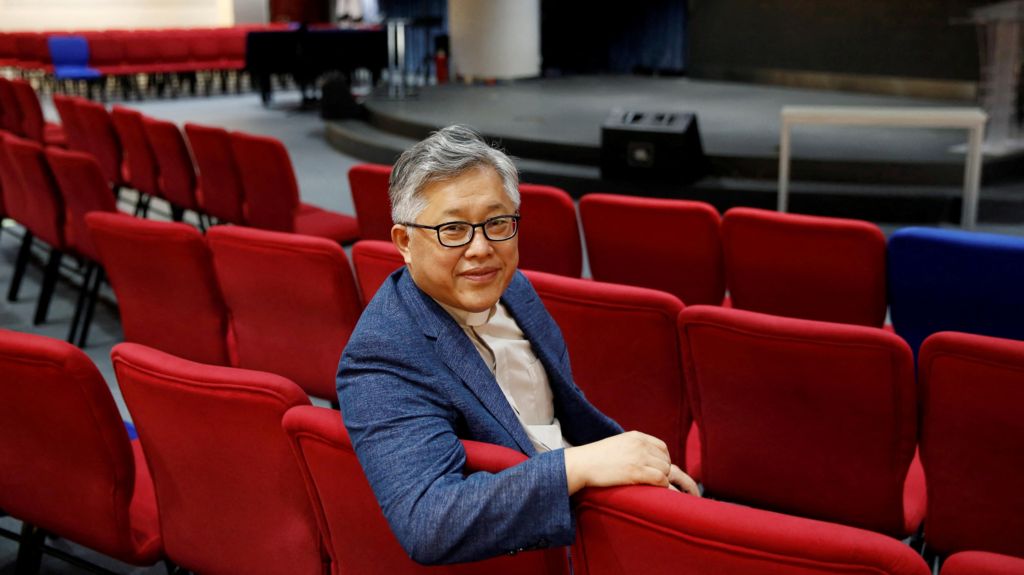
In a development that has drawn international attention, Jin Mingri, the founder of China’s unregistered Zion Church, has been released from detention and arrived in the United States, just two months after former U.S. President Donald Trump personally raised his case with Chinese leadership.
Jin, also known by the name Ezra Jin, was taken into custody during a series of coordinated overnight raids targeting religious communities across China in October 2025. Christian advocacy groups described that round of detentions as one of the most sweeping crackdowns on independent religious activity in modern Chinese history. Thirty church leaders were detained across the country in that operation, and a subsequent crackdown on another unregistered religious community in January 2026 led to nine additional detentions.
China’s government maintains strict regulatory controls over all religious practice within its borders and officially promotes state atheism. All registered religious congregations must operate under state oversight, led by government-appointed clergy and required to align with official government policy. Independent congregations that refuse state supervision are classified as illegal underground organizations and regularly targeted for enforcement.
Jin founded the Zion Church in 2007, launching the congregation with just 20 initial followers. Over the years, the independent church grew into one of China’s largest unregistered religious networks, expanding to 40 cities and boasting a total community of roughly 10,000 believers. The movement was formally banned by Chinese authorities in 2018, after leaders refused government demands to install state surveillance cameras at the church’s Beijing property. In the years following the ban, dozens of the church’s regional branch congregations were raided, shut down, and dispersed by authorities.
Following Jin’s release, his family released a public statement expressing gratitude to supporters, saying, “We truly witnessed a miracle and we are feeling so overwhelmed with joy.” The family specifically extended thanks to Donald Trump and his administration for what they called “tremendous leadership” on the issue, and acknowledged that the release would not have been possible without direct consideration from Chinese President Xi Jinping. The statement added that the family hopes Jin’s release “is a signal of a positive turn for people of faith in China and relations between our two nations.”
China’s Ministry of Foreign Affairs has not issued any formal public comment on Jin’s case or his release to date. U.S.-based religious rights organization ChinaAid, which monitors reports of religious persecution in China, confirmed that Jin has safely arrived in Los Angeles following his release. Bob Fu, founder of ChinaAid, welcomed Jin’s release but cautioned that “countless” other religious practitioners remain in detention in China, including eight current members of the Zion Church.
The Inter-Parliamentary Alliance on China, an international coalition of Western lawmakers that includes dozens of members of the United Kingdom’s Parliament, also released a statement saying it was “overjoyed” by the news of Jin’s release.
Trump first raised Jin’s detention during high-level direct talks with Xi during an official state visit to Beijing in May 2025. Following the meeting, Trump told reporters, “He said he’s gonna strongly consider the pastor,” confirming that the case had been raised directly at the highest diplomatic level. During the same meeting, Trump also raised the case of Jimmy Lai, the Hong Kong pro-democracy media tycoon who was sentenced to 20 years in prison earlier in 2025 on charges of colluding with foreign forces under Hong Kong’s national security law, a piece of legislation that has drawn widespread international criticism for its use to target political opposition.