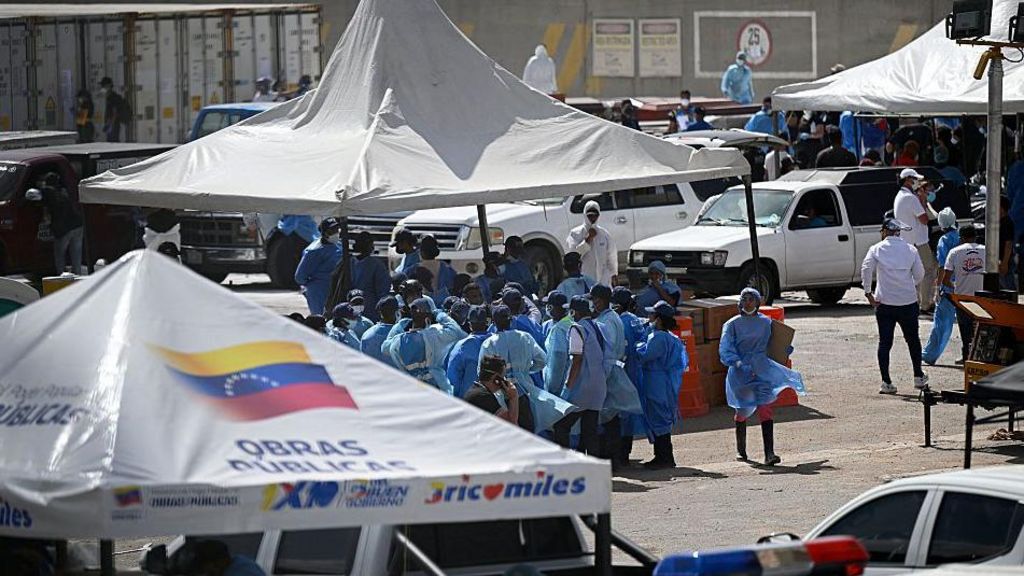
Nine days after devastating twin earthquakes tore through Venezuela’s coastal state of La Guaira, the death toll has climbed above 2,600, overwhelming local emergency and mortuary services and forcing authorities to repurpose a disused port storage facility at Los Silos into a makeshift morgue. What was once a working hub of commerce now stands as a grim center of grief, where exhausted, anguished families wait for hours, even days, to confirm the fates of loved ones missing since the tremors collapsed buildings and buried neighbourhoods across the region.
Many of the people gathered at the site have already spent days searching through damaged hospitals, emergency shelters, and piles of rubble, chasing every faint lead to find their relatives. Rows of empty chairs line the facility’s interior and exterior walkways, and a thick, heavy silence hangs over the crowd. Sadness spreads through the gathered families like a contagion: few speak, some stare vacantly into open space, while others refresh news feeds or mechanically reply to messages of condolence on their phones. Armed Bolivarian National Armed Forces personnel control access to the facility, a necessary security measure that does little to soften the raw anxiety of those waiting to enter.
Before stepping through the gate, one woman waiting to identify her missing nephew, who has been unaccounted for for nearly a week, summed up the conflicting feelings that grip every family: “I’m afraid of what I’m going to see in there, but it’s the only way to end this agony.” She told reporters she had searched every possible location for him—through the rubble of his collapsed apartment building, at every local hospital, speaking to every survivor and rescue worker she could find—with no answers.
Inside the makeshift morgue, the acrid smell of decomposition hits visitors first, a product of sweltering tropical heat that speeds the breakdown of remains left uncovered or stored in basic temporary tents, after the disaster destroyed most standing infrastructure in the region. Hundreds of recovered bodies are laid out in rows, wrapped only in thin plastic bags, sorted by the date they were pulled from the rubble. Many families cover their mouths with bare hands or low-quality cloth masks, which offer barely any relief from the stench; within minutes, most grow numb to the scent, their emotions too drained to react further.
Forensic and medical teams work around the clock against overwhelming odds to identify victims. At one end of the facility, a temporary tent offers free cremation services for unclaimed or identified remains. At the other, specialists rely on the few tools they have—mostly dental records—to match bodies to names when decomposition has left remains unrecognizable to family members.
Relatives face two paths to identification. Those confident they can recognize a loved one by their clothing are escorted to the area where bodies are laid out. The vast majority, however, are directed to two large television screens, where they begin a new, grueling ordeal: scrolling through more than 1,000 photos of recovered bodies, displayed in an endless loop. Many of the photos show remains swollen from decomposition, with darkened skin or severe traumatic injury, making positive identification extremely difficult. Families scan each image for any small, unique marker: a tattoo, a favorite bracelet, a distinctive piece of clothing, a trinket carried from home.
Occasionally, the scrolling pauses, sparking a flicker of hope. Forensic workers use iPads to zoom in on a tattoo, a unique dental structure, or a scar that matches a family’s description. In one harrowing moment in front of the screens, a woman broke down into loud sobs when she recognized her son from a frayed, dusty blanket wrapped around his remains; a stranger standing beside her immediately wrapped her in a quiet embrace, sharing in her grief. When a phone cut through the heavy silence, a young man whispered into the line that he was searching for his mother, but the condition of the remains made it impossible to confirm if he had found her. “This is like a horror movie,” he quietly shared.
For 60-year-old Liliana González, a Catia La Mar resident who traveled to Los Silos to search for her missing aunt, the unthinkable became reality when she spotted her 37-year-old nephew’s distinctive tattoo in the photo stream. “He wasn’t on the list,” she explained as she left the facility. “I had to look at the images.” González, who had seen her own mother after her death, said the experience was unlike anything she had ever endured. She still has not found her aunt, who remains buried under rubble, and fears she will have to return to the morgue in coming days to go through the agonizing process again. After she was told she would have to identify her nephew alone, two forensic workers stayed with her through the entire process to help her through the trauma. “Thank God, because in a moment like that, it’s good to feel someone’s hand,” she said.
For others, the agony of waiting and the dread of seeing a loved one’s remains leads them to wait outside, letting younger relatives handle the identification process. Fifty-six-year-old Modesta Alemán traveled from Carayaca, in western La Guaira, to search for her older sister Matilde, who lived in Playa Grande—one of the hardest hit neighborhoods hit by the quakes. “They told us there were no survivors,” Alemán said. She added that volunteers had reported hearing voices calling out from the rubble of her sister’s building days after the quake, but that no rescue teams were able to reach them. Alemán chose not to enter the morgue, waiting outside as other relatives went in to check for Matilde. “Perhaps it is better this way,” she said quietly.
Forty-two-year-old Jéssica Soto has already waited two full days at the entrance to Los Silos for the remains of her 15-year-old daughter and three-year-old granddaughter, who were trapped in their apartment when the earthquakes struck. Their bodies were recovered nearly a week later, on a Tuesday. “They keep you waiting and waiting for the paperwork, the trucks, and who knows what else,” Soto told reporters. “They have had them there in a coffin, sitting out in the sun since yesterday. I have no choice but to wait and trust in God.”
Once a positive identification is made, the bureaucratic process of releasing remains begins: technicians collect fingerprints when possible, bodies are transferred to coffins, and families must fill out the paperwork for an official death certificate—required before funeral homes can take possession of the remains for burial. For thousands of Venezuelan families already reeling from the destruction of the disaster, this slow, agonizing process at the Los Silos makeshift morgue is just the latest hurdle in navigating the aftermath of one of the deadliest natural disasters in the country’s recent history.