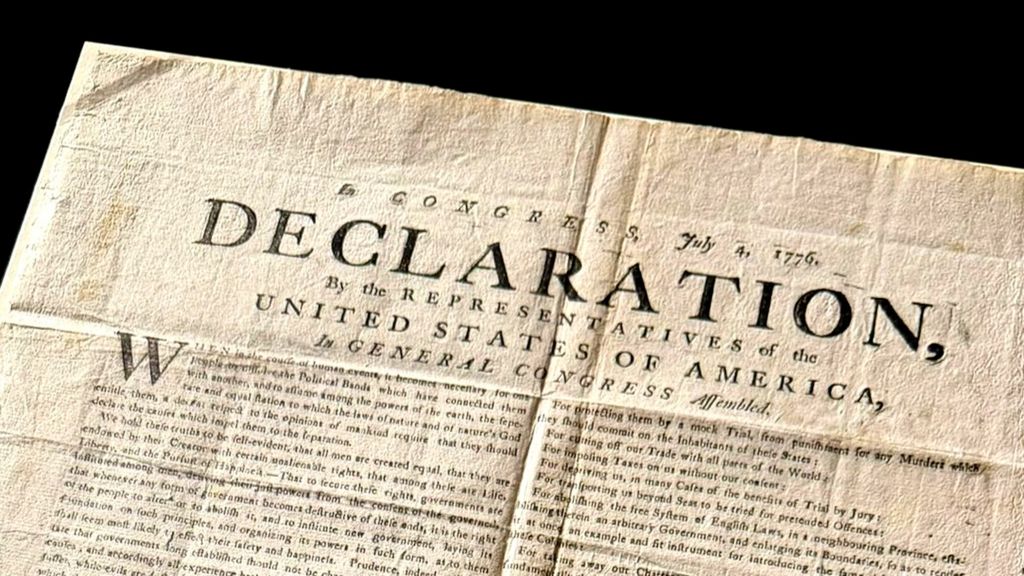
In a landmark historical find that has electrified global academic circles, a rare surviving copy of the 1776 Declaration of Independence — the only confirmed example located outside the United States — has been uncovered at The National Archives in Kew, UK. The extraordinary discovery was made in February this year, when volunteer archivist Michael Scurr was cataloging a collection of personal papers belonging to Royal Navy officers who served during the American Revolutionary War.
This particular copy is one of just 11 surviving printings produced in Exeter, New Hampshire, between July 16 and 19 1776. Just 12 days after the original Declaration was signed in Philadelphia, colonial printers rushed out these regional reprints to spread news of American independence across the 13 colonies, turning a private legislative act into a mass public movement. Unlike formal government copies intended for long-term preservation, these regional broadsides were produced quickly for wide distribution, making their survival over 250 years extremely unlikely.
Scurr recalled the moment of discovery to BBC News, describing a rush of excitement: “I had butterflies in my stomach after I opened up the folded paper and immediately realised what I was holding. I called over to my supervisor and said, ‘I think you need to come see this.’”
Records traced the document’s journey across the Atlantic to a dramatic Christmas Eve 1776 naval engagement. Off the coast of Portugal, the British Royal Navy warship HMS Raisonable chased down the American privateer ship Dalton for seven hours before capturing it. Among the seized papers was the Declaration of Independence copy, alongside the privateer’s official commission and printed instructions from the Continental Congress.
The captured ship was brought to the British port of Plymouth in January 1777, and all seized documents were transferred to London’s Whitehall for government review. At the time, the Declaration was listed casually as just “another paper” among Captain Thomas Fitzherbert’s correspondence, and it remained unrecognized and hidden in Britain’s national archival collections for nearly 250 years.
Dr. Graham Moore, a senior historical researcher at The National Archives, explained that this find is unparalleled in historical circles. “This is one of the rarest versions of the Declaration we know of,” he said. “Because these regional reprints were meant for immediate distribution, they were never intended to be preserved long-term. Of the 11 Exeter printings that survive, this is the only one ever captured by British military forces, and the only copy confirmed to exist outside U.S. borders.”
Saul Nassé, Chief Executive of The National Archives, called the find an extraordinary archaeological discovery of documentary history. “It is a vanishingly rare surviving copy of the Declaration of Independence, found not in a U.S. archive or private collection, but right here in the UK,” he noted.
After undergoing targeted conservation work to stabilize its aging paper and repair a small tear, the document is now prepared for public display. It will be featured as a centerpiece of The National Archives’ Revolution 250: America’s Independence Story, 1763-1783 exhibition, which opened to the public last month. The National Archives already holds three of the iconic original John Dunlap broadside copies printed in Philadelphia on July 4, 1776 — of the roughly 200 copies printed that night, only 26 are known to survive today.