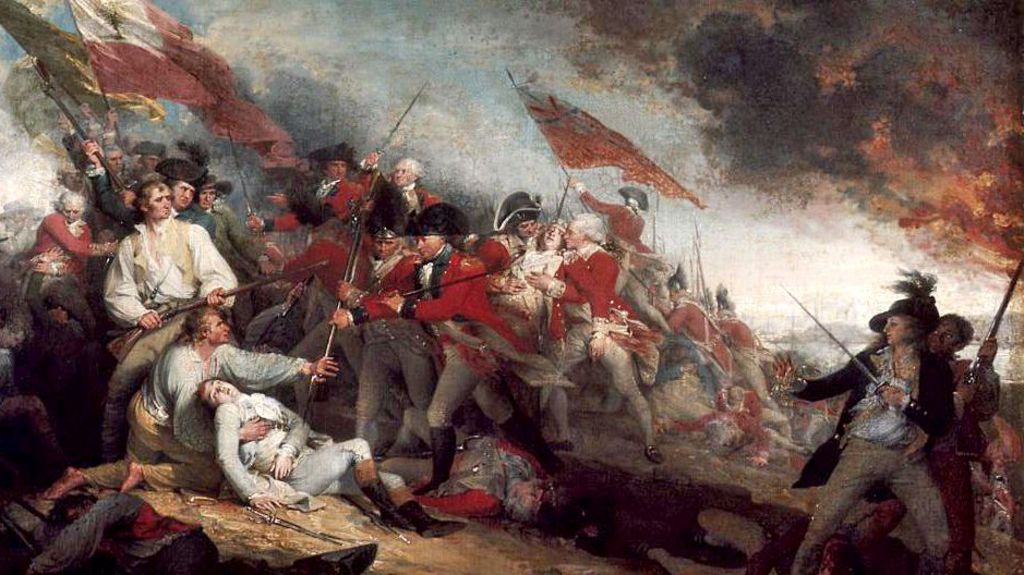
Two and a half centuries after the 13 British North American colonies severed their political ties to the British Crown, the United Kingdom is marking the 250th anniversary of American independence not with lingering resentment, but with a vibrant calendar of special events that highlight under-explored shared history, cross-cultural exchange, and overlapping ideological roots between the two nations.
What might seem like an unlikely place to unpack the story of American independence is the forecourt of London’s iconic St Paul’s Cathedral. There, a little-known statue dating back to 1712, decades before the United States emerged as an independent nation, stands as an early artifact of British fascination with the North American continent: the sculpture personifies America as an Indigenous woman wearing a headdress and holding a bow and arrow, a window into how the distant territory captured the imagination of those at the heart of the British Empire, according to tour guide Mark Grant.
Grant is one of dozens of history enthusiasts across the UK organizing commemorative programming for the semiquincentennial. His walking tours, run through the City of London Guides Lecturers Association, shine a spotlight on the little-recognized connections between London’s historic financial district, the Square Mile, and the founding of the United States. The tours draw a mixed audience of British locals and American visitors, each taking away different perspectives. For UK residents, the tour offers unexpected new trivia to layer onto the city’s already rich Roman and medieval heritage; for American guests, the experience is deeply personal, offering a side of the independence story rarely taught in U.S. classrooms.
Patricia Windham, a tourist from Chicago, joined the tour to understand how the American Revolution was perceived in Britain at the time of the split. “You only get one side of the picture from the US,” she explained. “I think it’s important to get various perspectives from people, not just the one that you get from home, because that’s the party line.” As the tour winds through the Square Mile, it stops at sites ranging from the church where Founding Father Benjamin Franklin once worked as a printer to the former locations of 18th-century coffee houses where transatlantic merchants struck trade deals, revealing that American history runs deep in central London.
The 1776 Declaration of Independence itself is a core focus of many UK anniversary events. At Washington Old Hall in Tyne and Wear, the ancestral family home of George Washington, local young people will perform a public reading of the foundational document on 4 July. In Bath, the American Museum & Gardens has made history as the first institution in England to display a rare, annotated original printing of the Declaration. This copy, printed the same day the Declaration was adopted in July 1776, was intercepted by British forces and sent back to London with their handwritten notes, a remarkable historical artifact that traveled across the Atlantic at a time when the Revolutionary War was already being fought.
Beyond showcasing the rare document, the museum has invited visitors to craft their own declarations of independence, a project that has yielded thoughtful and playful responses alike, according to museum director Lucy Littlewood. “That’s producing some really lovely responses, particularly from young people about what’s important in the world,” she said. “Peace and equity are the main two themes there, but we’ve also had comments about free ice-cream for children… so lots of humorous ones as well.”
Far from ignoring the UK’s connection to the ideological origins of American independence, many events are centered on highlighting how the revolution’s core ideas and key thinkers had deep British roots. In the East Sussex town of Lewes, a Festival of Democracy will be held on 4 July, headlined by a colorful parade inspired by the values that drove the American Revolution. Leading the procession is an 8-foot giant puppet of Thomas Paine, the English philosopher and one-time Lewes resident whose influential 1776 pamphlet arguing for American independence cemented his status as one of the nation’s founding fathers.
Puppet creator Paul Fitzgerald, a graphic artist who goes by the professional name Polyp, designed the puppet as a skeleton to honor the mysterious fate of Paine’s remains after his death, which were lost after exhumation. He argues that the 1776 independence moment is a cause for celebration far beyond U.S. borders. “I’d see it as a part of a global movement towards people being in charge of their own lives in their own countries,” he said. Organized alongside the Thomas Paine Legacy project and the Lewes Climate Hub, Fitzgerald says the parade carries a modern message: “A democracy is something that wants to be constantly renewed.”
Other events lean into the tangible cultural and culinary exchange that shaped both nations, tracing the movement of people, ideas, and recipes across the Atlantic. Near Omagh, Northern Ireland, the Ulster American Folk Park’s weekend programming celebrates the profound impact of Ulster migrants on the development of American culture, particularly through food. Celebrity chef Paula McIntyre, who trained in the U.S. and has hosted a BBC series on American cuisine, will lead a demonstration of classic Appalachian dishes, many of which grew from traditional food preservation techniques brought by Ulster migrants to the New World.
“It would have been people using what they had,” McIntyre explained. “There was absolutely no waste, and I mean, there was nothing luxurious at this stage. It was all about survival.” Dishes including buttermilk, cornbread, apple butter, and pork and kale will feature in the demonstration. McIntyre also notes that culinary influence flowed both ways: Irish migrants brought whiskey distilling expertise to the U.S., refining corn-based whiskey through triple distilling techniques honed in Ireland.
Back in London, participants on Grant’s walking tours say the deep dive into American independence history has revealed hidden layers of their own city. Peter Tidmarsh, a London local, said “It took me to a few alleys I’d never been to, I’m just amazed.” Grant, a 13-time contestant on the BBC’s quiz show *Mastermind* thanks to his encyclopedic knowledge of London, builds tours around everything from historic blue plaques and centuries-old pubs to the site of a London church that was disassembled brick-by-brick and reconstructed in Missouri. For Grant, the Square Mile is a quiet character in the American founding story, offering an unfiltered look at the transatlantic foundations of the modern U.S. “The cities [in the UK and the US] would have been the same, and so this is kind of the foundation of it all,” he said.
Born in Australia, Grant brings a neutral perspective to the story of the 18th-century “breakup” between the colonies and the Crown, and British attendees echo that neutrality. Asked if the UK holds any lingering regret over the split, Tim Parry, a participant from Essex, joked “Well, there’s some regret. But I think we got over it.” Fellow attendee Tidmarsh agreed: “I think 250 years is long enough.”