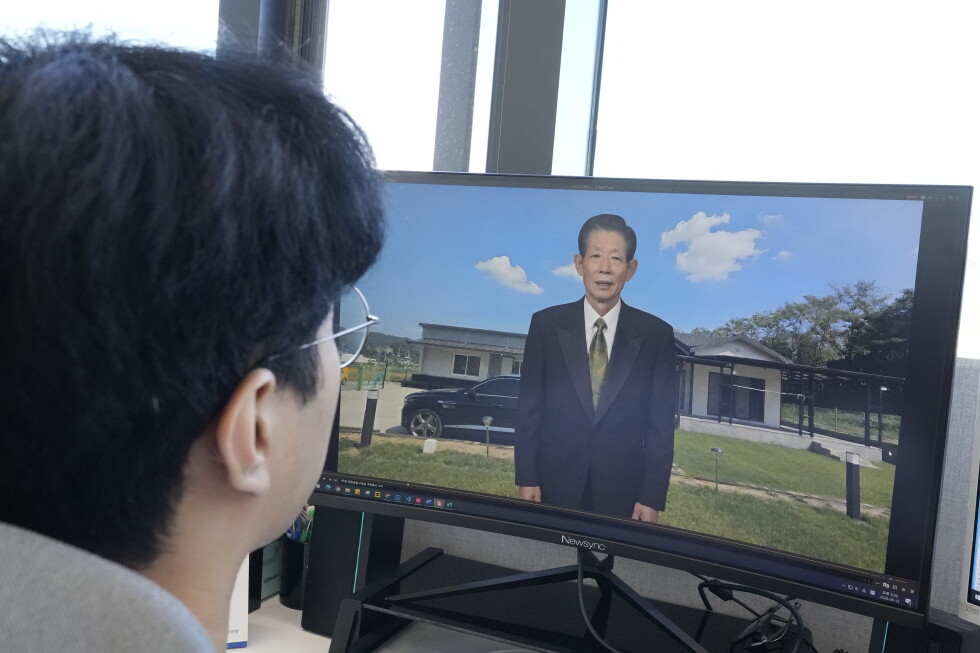
For 28-year-old South Korean office worker Lee Geon Hui, creating a meaningful gift for his single father meant turning to cutting-edge artificial intelligence to resolve a decades-old unspoken regret. Lee’s grandfather — the man his father had grieved for years after his unexpected death in a car crash before Lee was born — was brought back as a digital AI avatar to deliver a heartfelt personal message.
Lee worked with Seoul-based AI startup Vaice in December 2024, crafting a script that reflected the words his father had never gotten to hear. Using a small collection of old photos and voice samples from the late grandfather, the company built a three-dimensional animated likeness that delivered the message: calling Lee’s father “my most precious son,” apologizing for pushing him into childhood farm labor and for opposing his dream of becoming a hairstylist. Though Lee’s father initially said he would not watch the clip, he ultimately sat down to view it, and left the experience in tears.
Lee’s custom video is far from an isolated case. Across South Korea, an expanding group of digitally fluent consumers are embracing a new AI-powered service that lets people create re-creations of deceased loved ones, giving rise to a fast-growing niche industry populated by local startups. The trend has been amplified by mainstream media, where AI-generated versions of deceased K-pop stars and beloved actors have made broadcast appearances, gradually shifting public acceptance of the technology.
Vaice, one of the early leaders in this emerging space, currently serves around 300 clients per month, according to CEO Jeongu Won. Most customers are adults in their 40s and 50s seeking AI videos of their own late parents, while others, like Lee, commission videos of grandparents to gift to their still-living parents. A basic three-to-five-minute custom production costs 600,000 South Korean won, equal to roughly $390, and clients almost always write their own scripts. Won says most of these scripts include a simple “I love you,” and many address long-held unresolved conflicts, giving grieving people a chance to close emotional loops they thought were permanently closed. Many families screen the AI videos during annual ancestral memorial rituals or major national holidays, when extended families gather to honor deceased relatives.
But while many consumers and providers report that the technology brings profound comfort to mourners, it has also sparked intense debate over thorny ethical, psychological and legal questions that existing regulatory frameworks have not caught up to. Experts broadly describe the innovation as a double-edged sword: as AI integrates deeper into daily personal life, it delivers unprecedented cultural experiences that also force society to confront unanticipated ethical shocks.
Choi Yu Ha, an executive at JL Standard, a company that launched a similar AI recreation service five years ago, notes that early public reception was deeply skeptical. Many bereaved people feared that reopening their grief through a digital simulation would cause more pain than healing. That attitude has shifted dramatically in recent years, however, as simulated appearances of dead celebrities on television have normalized the technology for wider audiences.
To date, Vaice’s CEO Won says the company has not received any reports from customers that the service worsened their grief. But outside observers warn that the technology carries inherent risks, particularly for vulnerable people who may struggle to distinguish between the virtual simulation and the reality of their loved one’s death.
Choung Wan, an emeritus law professor at Seoul’s Kyung Hee University, argues that new legislation is urgently needed to protect the dignity and personality rights of deceased people. He says regulations should explicitly ban creating an AI likeness of a person if they explicitly opposed such a use before their death, and set clear boundaries to limit unregulated commercial exploitation of deceased people’s images and voices.
As the technology advances, the ethical questions are only expected to grow more complex. Many South Korean startups are already experimenting with the next iteration of grief-focused AI: interactive “griefbots” or “deathbots” that allow for two-way real-time conversations between mourners and AI avatars of their dead loved ones. Choung warns that this kind of persistent interaction could do lasting psychological harm. A healthy mourning process, he explains, requires people to accept the permanent absence of the deceased and work through the pain of loss. Simulated ongoing conversation, he argues, undermines that healing process, trapping bereaved families in a fantasy that prevents them from moving forward.
Even industry leaders are approaching this next step with caution. Vaice’s Won says the company has no plans to launch an interactive chatbot service any time soon, because real-time conversations cannot be pre-vetted or supervised by the company, raising the risk of unforeseen ethical harms.
Even so, both technological progress and public acceptance are accelerating rapidly. JL Standard’s Choi notes that modern AI can now replicate the fine details of a deceased person’s face — down to individual wrinkles and skin pores — with stunning accuracy, and most customers now report that the AI likenesses are indistinguishable from the real person they remember.
Yong Man Ro, an AI expert at the Korea Advanced Institute of Science and Technology, who was quoted highlighting the technology’s dual nature, has personal experience with its impact. After his own parents died last year, Ro created a one-minute AI video of their likenesses, which he played for his siblings at a family gathering. When the digital avatars told the assembled family “Don’t worry” and “Take care of yourselves,” everyone in the room was deeply moved. Ro says he and his siblings have never rewatched the clip: one viewing was enough to honor their parents, and they have moved forward with their grief. But for him, the experience illustrates how AI can occupy a gentle, meaningful place in mourning — if it is guided by careful ethical boundaries that society has yet to put in place.