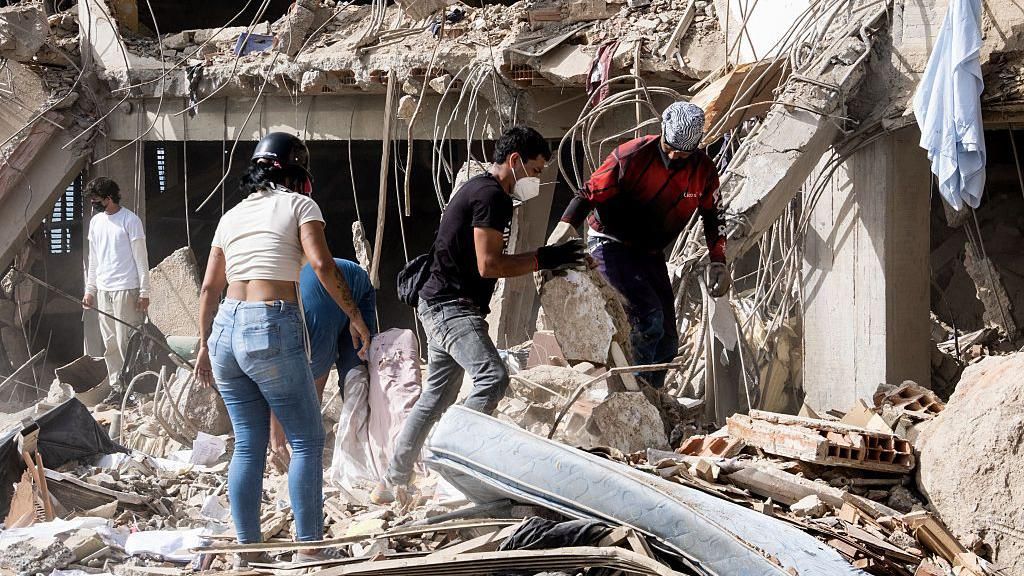
A frantic race against time is unfolding across Venezuela’s coastal state of La Guaira, where back-to-back massive earthquakes have left a trail of unprecedented destruction, leaving thousands dead, missing, and trapped beneath crumbling infrastructure. On Wednesday, a magnitude 7.2 quake was followed just hours later by a 7.5 tremor — one of the most powerful seismic events recorded in Venezuela in the past 100 years — turning entire neighborhoods into mounds of concrete and twisted metal debris. To date, national officials have confirmed at least 1,430 fatalities, a number that climbs steadily with every passing hour, and the United Nations estimates that roughly 50,000 people remain unaccounted for.
Against this backdrop of ruin, untrained residents are leading much of the initial search effort, digging through rubble with bare hands, rusted shovels, and whatever makeshift tools they can scrounge up, with little to no heavy rescue equipment to aid their work. Drones operated by local volunteers scan hard-to-reach sections of collapsed structures from above, while crowds of anxious relatives huddle around live video feeds, scanning the rubble for any small, familiar trace of a missing loved one: a fragment of clothing, a personal belonging, any sign that might confirm they are still alive. Soldiers and international rescue teams repeatedly call for silence across search zones, pausing all activity to listen for faint taps, voices, or groans that could signal a survivor trapped beneath the wreckage.
Stories of heartbreak and desperate hope are scattered across the disaster zone. Jesús Suárez traveled more than 200 kilometers from his home to Catia La Mar, one of La Guaira’s hardest-hit coastal towns, to search for his 20-something son Jean, who he believes remains trapped under a fallen apartment building. “There’s no information at all. People who know him say they didn’t see him come out or anything,” Suárez explained, gesturing toward the unstable pile of rubble. “I believe he might be in there. But it’s impossible to rescue him… There is no sophisticated equipment here. A human being alone cannot do it – it’s too dangerous.”
For the family of 31-year-old Carlos Eduardo, who is also trapped, there is a fragile thread of hope: an hour and a half before they spoke to reporters, they heard him groan from beneath the debris, a sign he was still alive after similar moments of sound followed by silence the day before. “And so here we are, waiting for help, hoping we can get him out alive,” his cousin told BBC News Mundo.
Humanitarian experts warn that the first 48 to 72 hours after a major seismic event are the most critical window for rescuing survivors alive, though that window can extend if trapped people have access to clean water and food. Venezuelan national assembly president Jorge Rodríguez emphasized the government’s commitment to transparency in the wake of the disaster, saying “Every person saved is a miracle. We will not hide anything about the scale of this tragedy.” Interim President Delcy Rodríguez said the government has deployed all available resources to the region, and has distributed emergency food and water to displaced survivors. But the scale of the disaster has overwhelmed local and national rescue capacity, even with the arrival of international assistance.
By Friday, 861 volunteer rescuers from Mexico, the United States, Spain, the United Kingdom, El Salvador, Switzerland, Colombia, and other nations had arrived to join the effort, with more teams and supplies en route. Interim President Rodríguez confirmed she had spoken with U.S. President Donald Trump and U.S. Secretary of State Marco Rubio, who reaffirmed their commitment to sending additional rescue teams and critical aid supplies. Even with this growing international support, however, many remote neighborhoods in the hardest-hit region have yet to receive any official assistance.
As days pass, new public health risks are emerging. Many survivors report a strong odor of decaying bodies across search zones, raising fears of outbreaks of disease that could put local residents and children at particular risk. “There’s a smell… the dead are already being felt. That’s going to make us and the children sick,” said Glendys Delgado, a La Guaira resident whose neighborhood has not received any government support, even as private volunteers from the capital Caracas have stepped in to bring donated food.
For thousands of displaced survivors, the disaster has erased decades of hard work in an instant. Many are now sleeping in open, public spaces like the damaged but still usable closed Simón Bolívar International Airport car park, where families can avoid the risk of falling debris from damaged structures. Alexandra Gabino, a 28-year-old mother of two young children aged two and seven, lost her entire home in the quake, and is now sleeping in her family’s car alongside her husband and kids. “It’s painful to be left with nothing. My mother lost her home, we lost our home, we have nothing. You try to stay strong for your children,” she said. “Everyone says what matters is that you’re alive – and yes, but everything you’re going through hurts: seeing people suffer, hearing people scream, seeing children trapped, and the helplessness of not being able to do anything because you have to stay and look after your own children. You try to be strong, but it hurts.”
Across the disaster zone, survivors echo the same desperate plea: more help, more equipment, and faster action to pull their loved ones out alive before the critical window for rescue closes. As one survivor put it, after returning to the ruins of her home to retrieve just a single usable appliance: “It’s a very difficult situation, we’re not prepared for this. The sacrifices and efforts you make to achieve things – and in the blink of an eye, everything collapses. But what matters is life. We are waiting for humanitarian aid – we need them to come to help us.”