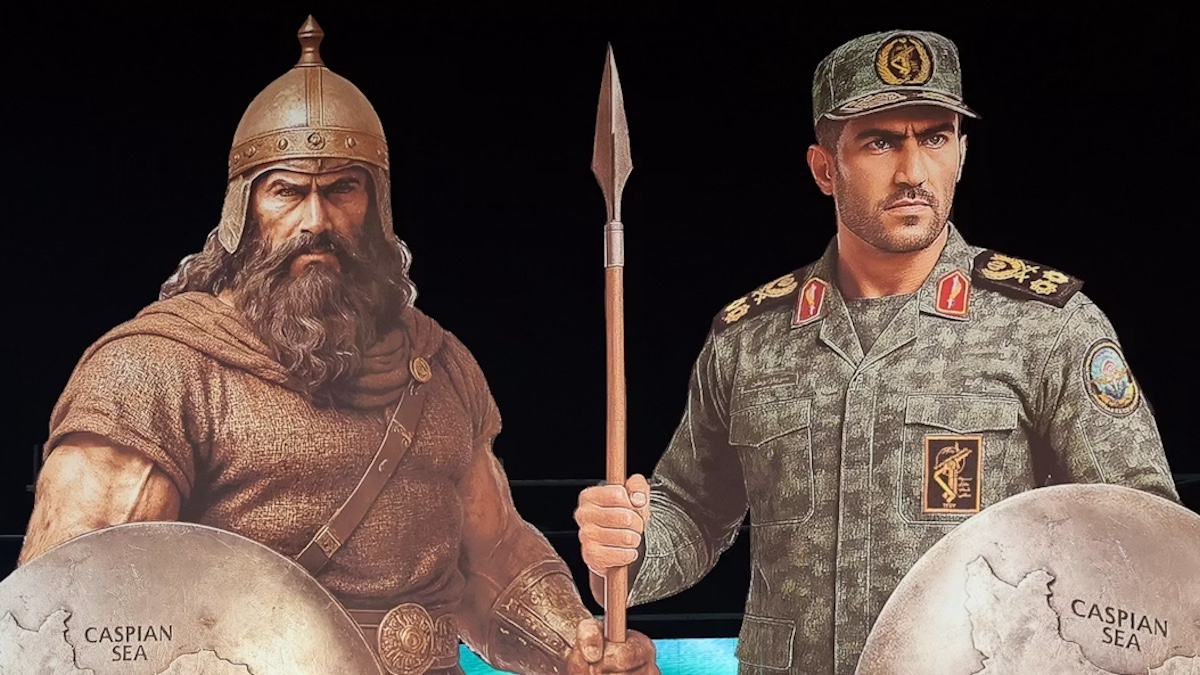
Against the backdrop of fragile ongoing ceasefire talks between the United States and Iran, a striking historical parallel drawn by an ancient history scholar offers a stark warning: reaching a lasting peace may prove just as destabilizing and painful as enduring open conflict. As the future of any potential US-Iran agreement remains uncertain, with no clear consensus on its terms or longevity, Peter Edwell, an associate professor of ancient history at Australia’s Macquarie University and a specialist on ancient Persia (the historical predecessor to modern Iran), argues that the current diplomatic gridlock facing the Trump administration should come as no surprise.
For centuries, the two great competing powers of the ancient world — the Roman Empire and the Persian Empire, ruled first by the Parthian dynasty from 247 BCE to 224 CE, then by the Sasanian dynasty until 651 CE — cycled endlessly between open war and fragile peace deals that rarely resolved core disputes, and often left underlying tensions worse than before. For these ancient rivals, peace treaties were rarely tools of lasting reconciliation; instead, they were most often just strategic pauses to buy time for military rearmament and preparation for the next conflict.
The first major military clash between Rome and Parthia came in 53 BCE, when Roman general Marcus Crassus launched a disastrous invasion of Parthian territory. The campaign ended in catastrophic defeat on the plains of Carrhae, in modern-day southern Turkey, where Crassus himself was killed and thousands of Roman troops lost their lives. The defeat emboldened Parthia, and by 20 BCE, Rome was forced to accept a peace agreement that formalized the Euphrates River as the official border between the two empires — a major concession for a power that had previously known unbroken territorial expansion.
Conflict reignited in the mid-first century CE, this time over control of strategically located Armenia, a buffer state nestled between the two empires in what is now modern Armenia and eastern Turkey. After the conclusion of hostilities, Roman Emperor Nero and Parthian King Vologases I agreed to the Treaty of Rhandeia in 63 CE, which allowed Parthia to nominate Armenia’s king, on the condition that the coronation be performed by the Roman emperor in Rome. While the treaty resolved the immediate crisis, its awkward power-sharing structure proved unworkable over time. When Parthia ultimately disregarded the agreement’s terms, Roman Emperor Trajan launched a full-scale invasion of Parthia in 114 CE. Though Trajan’s forces won early victories, including capturing the Parthian capital, the invasion ultimately collapsed, and all Roman territorial gains were lost within just three years, by the time of Trajan’s death in 117 CE.
After the Sasanian dynasty replaced the Parthians as rulers of Persia in 224 CE, tensions with Rome escalated dramatically, with control of Armenia once again at the center of most disputes and peace agreements. When Roman Emperor Gordian III died during an invasion of the Sasanian Empire in 244 CE, the two powers struck a new treaty that imposed heavy financial reparations on Rome and included a clause banning any Roman interference in Armenian affairs. Within just a few years, however, Rome violated the agreement, triggering a wave of devastating Sasanian invasions of Roman territory that culminated in the capture of Roman Emperor Valerian by Sasanian forces in 260 CE. A famous rock relief from the period, which depicts Valerian kneeling in submission to Sasanian King Shapur I, remains a lasting symbol of this humiliating Roman defeat.
Rome won a major victory over Sasanian King Narseh in the late 290s CE, and the resulting 299 CE Treaty of Nisibis extended Roman influence deep into the east and gave Rome full control of Armenia. But the lopsided agreement planted deep seeds of resentment among the Sasanians. By the 350s CE, Sasanian King Shapur II launched a major invasion of Roman territory explicitly to overturn the 60-year-old treaty. The conflict escalated when Roman Emperor Julian launched a counter-invasion of the Sasanian Empire in 363 CE, a campaign that ended in devastating Roman defeat and Julian’s death on the battlefield.
While conflict between the two empires cooled slightly in the fifth century CE, it intensified dramatically again in the sixth and seventh centuries CE, when Rome and Persia were almost continuously at war. Dozens of peace treaties were negotiated during this period, but none endured. The most infamous example was the so-called Eternal Peace of 532 CE, which collapsed completely in less than eight years.
Edwell notes that history repeatedly demonstrates that even highly celebrated peace agreements, celebrated as breakthroughs at the time of signing, often lay the groundwork for future discord and renewed conflict. It took more than 400 years of intermittent war and dozens of failed negotiations before Rome and Persia finally reached a lasting agreement to partition Armenia between the two powers in the 380s CE.
Centuries of cyclical conflict, broken treaties, and stalemate preceded even that partial resolution. Today, as the US pursues a peace deal with Iran against the backdrop of a shaky ceasefire, the question lingers: will the current negotiations follow the same fraught path as the ancient clashes between Rome and Persia? Only time will reveal the answer — but the scholar’s hope is that a lasting resolution will not take centuries this time around.