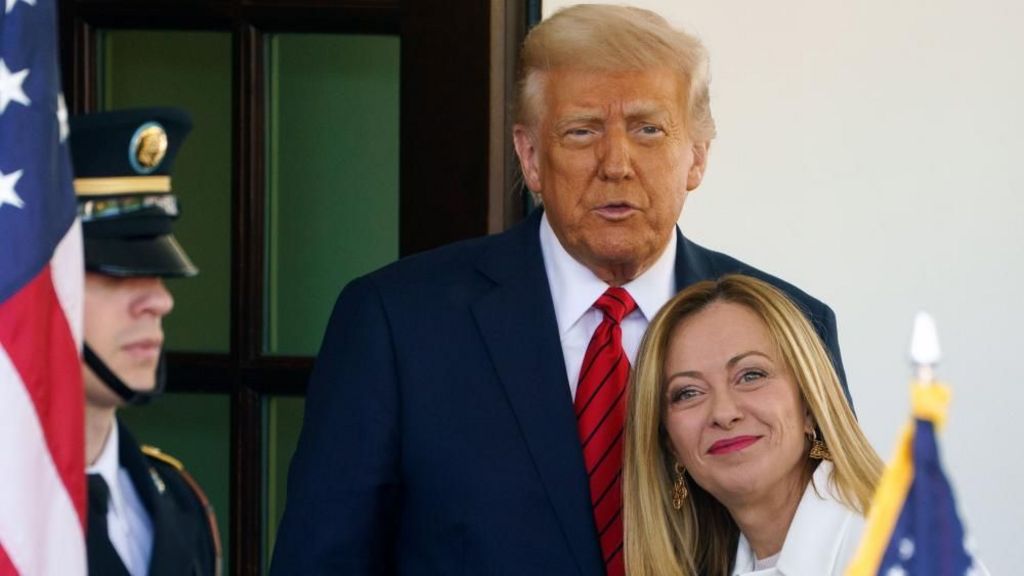
Viral AI-generated memes circulating across Italian social media have perfectly captured a dramatic shift in transatlantic politics: the once-close alliance between Italian Prime Minister Giorgia Meloni and U.S. President Donald Trump has devolved into a very public, very messy political breakup. The memes, which show Meloni engaging in classic post-breakup activities from getting a new haircut to signing up for a dating app, lean into a joke that has resonated deeply with the Italian public because it reflects a very real rupture that has unfolded over the past six months.
It was not long ago that Meloni was widely known as Washington’s favorite European right-wing leader, nicknamed the “Trump whisperer.” She held the distinction of being the only European head of government to claim a front-row seat at Trump’s January 2025 inauguration, and just months later, she was tapped as the European Union’s top envoy to the White House for high-stakes talks aimed at defusing rising tensions over U.S. steel and aluminum tariffs on European goods. For Meloni, who spent years rebranding from a fringe post-fascist politician to a mainstream, credible leader of the European right, this close relationship with Trump was far more than a convenient diplomatic tie. It was global validation that she had arrived as a major player on the world stage.
But Trump’s well-documented unpredictability has created a minefield that Meloni has been unable to navigate, eroding her credibility at home and abroad. The first major crack in the relationship emerged in late March, when Italy’s defense ministry announced it would require parliamentary approval before allowing U.S. military aircraft bound for the Middle East to use the NATO Sigonella airbase in Sicily. The decision aligned with Italy’s constitutional requirements and reflected overwhelming public opposition to expanded conflict in the region, but it set the stage for escalating friction.
The dispute boiled over in April, when Trump launched a public attack on Pope Leo XIV on Truth Social after the pontiff criticized the U.S.-led campaign against Iran, calling the Pope “weak on crime.” As the leader of a deeply Catholic nation, Meloni had no choice but to push back, labeling Trump’s attack “unacceptable.” The U.S. president reacted sharply, telling Italian daily *Corriere della Sera* that he had been wrong about Meloni’s political courage. “I thought she had courage, but I was wrong,” he said. “She is unacceptable… she is not the same person, Italy is not the same country.”
By the June G7 summit in Évian-les-Bains, France, it looked like the pair had smoothed over their differences. Photographs showed the two leaders holding an extended, closed-door conversation on a summit sofa, and Meloni told reporters the discussion had been “very positive,” with “no friction.” But the truce collapsed within days. In a leaked, Italian-dubbed phone interview with Italian broadcaster La7 that was never aired in English, Trump claimed Meloni had “begged” him for the summit photograph. “She wanted a picture with me so badly,” the voiceover quoted Trump as saying. “I wouldn’t have taken it, but I felt sorry for her.”
Meloni responded immediately with a scathing video address posted to her social channels, calling Trump’s claims “completely fabricated.” “I don’t know why the president of the United States behaves this way toward his own allies,” she said. “I can only say it’s a pity he doesn’t show the same resolve toward the enemies of the West… But there’s one thing he must remember: neither I nor Italy ever beg.” The political fallout across Italy was swift and unified: President Sergio Mattarella called Meloni to express full solidarity, government lawmakers called the comments an insult to Italian dignity that demanded an apology, and opposition parties joined in condemning the remarks as an unacceptable affront to the entire nation. Italy’s foreign minister Antonio Tajani went a step further, canceling a planned official trip to Washington.
Trump doubled down on his claims from Camp David, posting to Truth Social that Meloni had asked for the photograph “over and over” and accusing her of only seeking to repair ties now that the U.S. had “defeated Iran militarily.” Before the original dispute could cool, a second controversy erupted over comments from NATO Secretary General Mark Rutte. Appearing on Fox News last Wednesday, Rutte claimed around 500 U.S. aircraft had taken off from bases in Italy to support “Operation Epic Fury,” the U.S.-Israeli military campaign against Iran, framing the movement as part of broad European support for the operation. Rome rejected the account forcefully, with the defense ministry calling Rutte’s claims “fallacious” and “totally misleading,” emphasizing that Italy had only authorized technical and logistical flights, not combat operations, and had rejected all requests that crossed that line. A NATO spokesperson later walked back the comments, clarifying that Rutte had only meant to note that all allies, including Italy, had upheld existing bilateral basing agreements. Still, the incident reignited domestic pressure on Meloni, who has repeatedly insisted her government never authorized the use of Italian territory for direct military action against Iran.
For Meloni, who is already navigating political headwinds after a recent defeat in a national constitutional referendum and faces a general election next year, the feud has opened up pressing questions about her future political positioning. Analysts point out that her long-held strategy of balancing between competing European and U.S. interests has collapsed. “This might be a tough situation to turn around,” said Gianni Riotta, author and vice chairman of the Council for the United States and Italy, speaking to the BBC. “Meloni’s ability to build a bridge now looks like a mere illusion, she couldn’t stand between Europe and the US. She tried to please both sides, on Ukraine, on tariffs. Then the Pope broke it: she had to back him, and Trump doesn’t accept that. Trump has had a friend-or-foe outlook since his property days in New York, you’re either with me or against me, and once that understanding broke down, he pushed harder, and Meloni played up her tough-woman image.”
While neither Rome nor Washington is pushing for a full diplomatic rupture, public tensions remain high. Earlier this week, reports circulated that multiple Italian government ministers planned to boycott the U.S. Embassy’s annual Independence Day reception at Rome’s Villa Taverna, brought forward this year to July 2, in solidarity with Meloni, who was already not expected to attend. That talk of a boycott has since softened, with Tajani announcing he will attend “with my head held high” and Meloni’s allies saying ministers are now free to make their own choice about attendance. The real test of the relationship will come next month, when both leaders are scheduled to attend the NATO summit in Ankara, marking their first public appearance in the same room since the explosive G7 dispute.