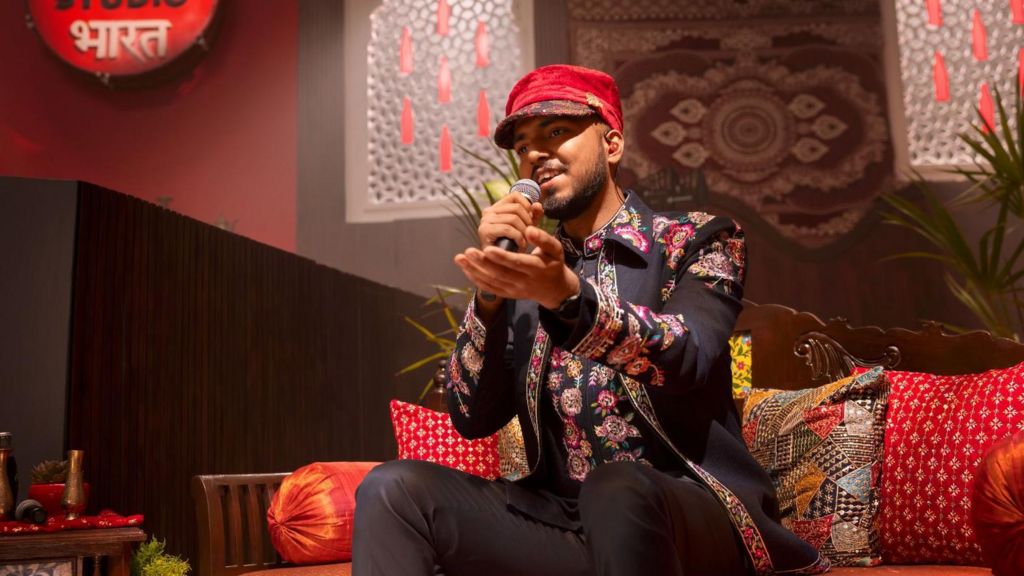
A haunting century-old Bhojpuri folk song performed on a hit Indian music platform has become a viral overnight sensation, igniting a long-overdue reckoning with harmful stereotypes that have obscured the language’s rich, layered cultural heritage for decades.
When 29-year-old folk singer Udit Utpal, hailing from the rural Saharsa district of India’s northern state of Bihar, took the stage for *Coke Studio Bharat* — the Indian iteration of the global popular music franchise that amplifies underrepresented regional sounds for cross-South Asian audiences — to perform *Kachaudi Gali* alongside acclaimed vocalist Rekha Bhardwaj, the track quickly amassed millions of views. Beyond launching Utpal’s national career, the unexpected breakout hit has drawn renewed attention to Bhojpuri, a language spoken by tens of millions across northern India and a global diaspora stretching from the Caribbean to the South Pacific, yet one long reduced to harmful, one-note stereotypes in mainstream Indian culture.
For most modern Indians, Bhojpuri is synonymous with a commercial entertainment industry dominated by crude, sexually charged lyrics and misogynistic tropes. On film and television, Bihari characters and accents are routinely pushed into one-dimensional roles: comic sidekicks, impoverished migrant laborers, or unrefined rural outsiders. This persistent caricature has completely overshadowed Bhojpuri’s centuries-deep literary and folk canon, which includes thousands of folk songs, epic poetry, theatrical works, and oral storytelling traditions rooted in the lived experiences of Bihar’s people. For decades, regional folk artists have worked to preserve these traditions, but their work has been largely eclipsed by the language’s more visible, negative mainstream image.
For Utpal, changing that misperception has become a life’s mission. Growing up moving across different regions of Bihar for his father’s government job, he absorbed local folk melodies from childhood; in his early 20s, he began diving deeper into the work of iconic Bhojpuri playwrights and poets like Bhikhari Thakur and Mahendra Misir, who shaped the state’s folk artistic identity. A defining throughline of Bhojpuri folk music, he learned, is the experience of migration — a theme that has shaped Bihar for centuries, from the forced colonial labor systems that shipped Bihari workers across the British Empire to the modern pattern of outmigration to India’s wealthy urban centers for work. *Kachaudi Gali* itself embodies this history: it tells the story of a colonial-era woman mourning as her husband leaves to fight in a distant British war, cursing the empire that tore him from her and even imagining taking up arms herself.
“It hurts when you are deeply connected to the music of your roots, yet others perceive it poorly,” Utpal told reporters. “I really want to change that. I want people to realise that Bhojpuri and Bihari music have much more depth than the stereotypes suggest. I want them to hear the stories the music conveys.”
To make these stories accessible to new audiences, Utpal shares detailed contextual explanations of the history and cultural meaning of every song he posts to social media, pairing short performances with reflections on colonialism, migration, and the legacies of Bhojpuri’s greatest artists. It was this commitment to context that caught the eye of Khwab, producer of *Kachaudi Gali* for *Coke Studio Bharat*, who discovered Utpal a year ago through an Instagram video of the singer performing the track in his village.
“Utpal is obviously a brilliant singer, but when I read his explanation of the song’s history, I literally sat up in bed. I knew then that something significant had to come from this,” Khwab recalled.
For the *Coke Studio* reimagining, Khwab crafted a production that balances modern pop polish with uncompromising respect for the song’s traditional roots: all core traditional instruments — including shehnai, tabla, dholak, harmonium, and dotara — were recorded live, rather than relying on synthesized backing tracks. “It’s about preserving what might be lost while creating something fresh. I wanted others to realise that folk music can be cool too,” Khwab explained of the project’s mission.
Utpal’s folk revival is not the only effort to rewrite mainstream narratives about Bhojpuri: hundreds of kilometers away, independent rapper Sanket Shikriwal is challenging stereotypes from an entirely different angle, blending Bhojpuri language and themes with jazz, spoken word, and hip-hop to create a completely contemporary sound that bridges Bihar’s rural past and India’s digital present. Where Utpal’s work centers recovering forgotten traditional heritage, Shikriwal’s thrives on creative collision: his verses weave together village childhood memories with references to Franz Kafka and John Coltrane, pairing stories of migration with modern internet culture, and creating an ongoing conversation between past and present, village and city.
His music often uses raw street language and profanity to express social agitation, a choice he says is no different from the profanity long accepted as a tool for commentary in global hip-hop or even mainstream Punjabi music, which has grown into one of India’s most successful cultural exports under artists like Diljit Dosanjh and Sidhu Moosewala. Shikriwal argues that Bhojpuri is held to a double standard: other regional genres are allowed to experiment and work through raw emotion, but Bhojpuri is constantly expected to sanitize itself to prove its respectability.
“The question isn’t whether Bhojpuri can be made respectable. It’s why Bhojpuri speakers are always expected to prove that they are,” Shikriwal said. “What I hope for is not a sanitised version of Bhojpuri culture, but a more confident one — secure enough to define itself on its own terms. I want people to look at Bihar and see philosophers again. We call it the Land of Buddha, yet we treat its people with such disrespect.”
For Utpal, the viral success of *Kachaudi Gali* is already a sign that change is coming. Millions of listeners across India and beyond have connected with the song’s raw, centuries-old story of grief and resistance, proving that audiences are hungry for the full, unfiltered story of Bhojpuri culture. “It was a reminder that one of India’s most widely spoken languages is still waiting to be heard on its own terms,” Utpal said.