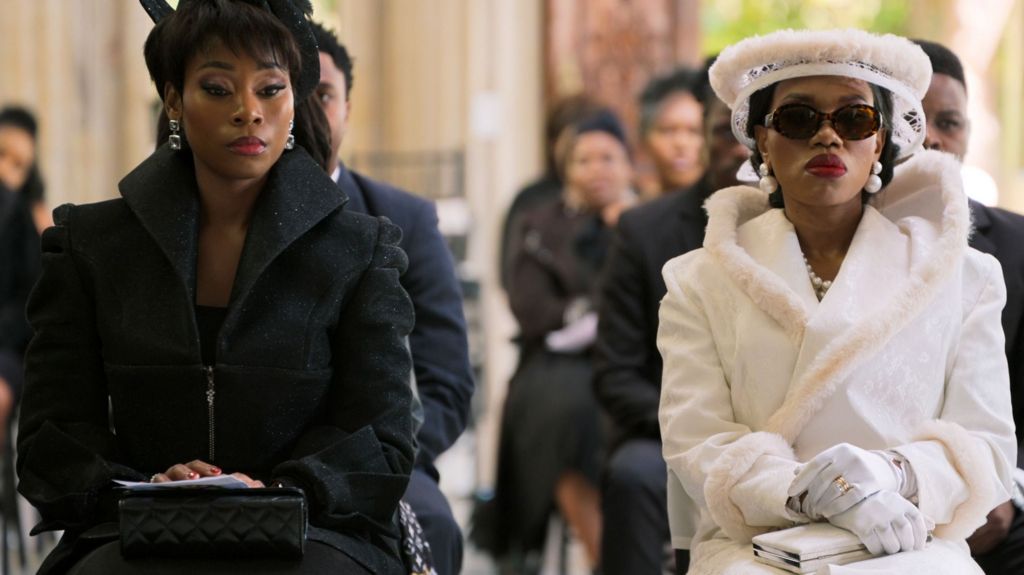
When the opening credits of Netflix’s breakout hit *The Polygamist* roll, audiences are immediately plunged into a charged, tense moment: the funeral of Johannesburg tycoon Jonasi Gomora, where the carefully constructed facade of his life shatters before viewers’ eyes. Standing front and center as chief mourners are not one, but two of his secret wives, flanked by a third spouse and a long-hidden mistress — all dressed in mourning black, while his public-facing social media influencer widow stands out in a striking white ensemble. What unfolds from this explosive opening is a 22-episode non-English drama that has not only dominated streaming charts across Africa and beyond, but also ignited fierce global conversation about polygamy, infidelity, and intergenerational trauma in modern African families.
Adapted from Zimbabwean author Sue Nyathi’s 2012 novel of the same name, the Zulu-language series traces the toxic, tangled dynamics of Gomora’s household over five years, unspooling the secrets and betrayals that led to the emotional confrontation at his funeral. Produced through a partnership between streaming giant Netflix and South African production house Stained Glass TV, the series counts two daughters of former South African president Jacob Zuma — a well-known public polygamist with deep roots in Zulu traditional culture — among its executive producers. Gugu Zuma-Ncube, one of the Zuma sisters leading the project, opened up about how her own upbringing shaped the show’s raw, authentic storytelling.
“A lot of the scenes that you see in the show are taken directly out of our lives. I famously come from a very polygamist family… [so] I brought that in,” Zuma-Ncube told the BBC. She added that the production team was completely caught off guard by the overwhelming global response to the series, which far outstripped even their most optimistic expectations. Within its first week of release on June 12, *The Polygamist* claimed the number one spot on Netflix’s viewing charts in both South Africa and Kenya, cracked the top 10 in Nigeria and Mauritius, and climbed to number four on the streamer’s global list of most-watched non-English series, racking up two million views worldwide. Its popularity extended far beyond the African continent, too, earning top spots in Trinidad and Tobago, Romania, and the Dominican Republic.
For Zuma-Ncube, the pan-African embrace of the series carries extra weight amid rising continental tensions sparked by recent anti-migrant unrest in South Africa. Beyond geographic reach, the series has struck a surprising emotional chord with diverse audiences, particularly women navigating unfaithful relationships and people raised in fractured family structures. It is the charismatic, ruthless patriarch Jonasi, masterfully portrayed by South African actor Sdumo Mtshali, who has emerged as the show’s most divisive figure, splitting viewers and critics alike.
Critics and everyday viewers have condemned Gomora as a manipulative serial cheater and narcissistic opportunist, whose secretive, duplicitous approach to multiple relationships has laid bare normalized social ills plaguing modern South African society. Letlhogonolo Mogale, a 35-year-old viewer from South Africa who binged the series shortly after release, told the BBC that the show’s unflinching portrayal of broken family dynamics hit particularly close to home, even though she does not come from a polygamous background. “What stuck out for me personally was how broken families are and how broken society is,” she said. Unlike the culturally rooted, consensual polygamy recognized under South African law and practiced in many traditional Zulu, Xhosa, Ndebele, and Venda communities, Mogale argues that the series depicts a coercive, hidden form of polygamy that warps every relationship in the household — a dynamic she says is rarely discussed openly. The show also confronts overlapping public health and social issues, including HIV transmission risks in plural unions (a particularly pressing topic in South Africa, where 13% of the population lives with HIV), gender-based violence, and intergenerational trauma.
Not everyone has reacted positively to the series, however. The show has drawn vocal criticism from defenders of traditional polygamy, most notably Kenyan civil servant Geoffrey Mosiria, who has amassed a large social media following calling for *The Polygamist* to be banned entirely in Kenya. Mosiria, who grew up as the youngest of 22 children in a happy polygamous household, argues the series paints a misleadingly negative picture of the practice, which he says builds strong community bonds and is a common cultural norm across parts of Kenya. “Polygamy is the best way to find love,” he told the BBC, adding that the show’s plot will only fuel unnecessary distrust among married couples.
Prominent South African film critic Phil Mphela pushed back on this criticism, noting that the series is not an attack on cultural polygamy as an institution, but rather a character study of one man’s selfish, harmful behavior. He also framed *The Polygamist* as a pivotal turning point for African television, noting that while South Africa has long produced world-class content, the series’ global breakout marks a major milestone for authentic African stories reaching and resonating with international audiences. “It’s doing exactly what it’s supposed to be doing because these stories are supposed to evoke something within our society,” Mphela said.
The series’ runaway popularity has already had ripple effects beyond the streaming space: demand for Nyathi’s original source novel has surged, prompting the author to issue a public warning this week about pirated counterfeit copies being sold in Nairobi bookstores. “Please don’t buy pirated copies. I am working day and night (like Michael Jackson) to make sure the book becomes available in the East African region. Copyright infringement is a crime and a violation of my rights,” she wrote on Instagram.
A-list celebrities from across the globe have also weighed in on the viral hit: Nigerian Afrobeats star Davido tweeted simply, “Yo JONASI is WILD,” while Emmy-winning host and actress Sherri Shepherd joked on Instagram, “I thought Crazy Rich Asians was something, but crazy rich Africans is a whole ‘nother level.” Academy Award-nominated actress Taraji P. Henson replied to Shepherd’s post, admitting the show had her in a “chokehold” and that she binged the entire first season in a single day. The show’s popularity is so intense in Kenya that local matatu minibus taxis have already been redecorated with Jonasi’s face and name to capitalize on the hype.
As Netflix and the producers celebrate the show’s unprecedented success, fans across the world are already demanding a second season. When pressed for details on future installments, Zuma-Ncube remained coy, telling reporters: “I think ultimately what we’ll be guided by is serving the story and serving the audience… [but] who knows where we end up.”