Canada’s Prime Minister Mark Carney has staked his government’s economic legacy on an ambitious goal: transforming the country into the most dynamic, high-performing economy among the G7 group of wealthy nations. Over the past year, Carney has crisscrossed the globe on trade and investment missions, pitching Canada as an attractive destination for global business capital. But for millions of Canadian households and industry leaders, the gap between this long-term vision and current economic realities is growing increasingly stark.
To unpack the true state of Canada’s economy, and how it stacks up against peer nations, five key economic indicators paint a mixed picture of sluggish near-term growth, uneven pain across demographics and sectors, and underlying long-term potential that remains untapped.
Forecasts from leading global economic bodies point to modest growth for Canada in the coming years. The International Monetary Fund projects 1.6% GDP expansion for 2026 – a rate that outpaces all European G7 economies, but still lags behind the United States, Canada’s largest trading partner. The Organisation for Economic Co-operation and Development forecasts a slight uptick to 1.7% growth in 2027 as the country gradually recovers from the slowdown caused by U.S. tariffs. That recovery comes after Canada slipped into a technical recession – defined as two consecutive quarters of contracting GDP – in the final months of 2025 and early 2026, according to Statistics Canada. While most economists have warned against widespread panic, noting the country is unlikely to face a prolonged deep downturn, they agree the underlying trajectory remains weak. “Whether one chooses to divine the fact that we’re in a recession or not really does miss the point,” explained Jeremy Kronick, president of the non-partisan Canadian economic think tank CD Howe Institute. “The economy is weak, right?”
For most ordinary Canadians, weak growth translates directly to daily financial strain, with cost of living topping the list of national worries. A recent poll from the non-profit Angus Reid Institute found 61% of respondents rank cost of living as their top personal concern, outpacing housing affordability, crime and U.S. trade tariffs. Inflation rose to 3.2% in May 2026, up from 2.8% in April, driven by spiking global energy prices linked to the ongoing conflict in Iran. While that figure remains well below the post-pandemic peak of 7% to 8% hit in summer 2022, and aligns with inflation rates across major European economies (and is lower than the U.S.’s current rate), the steady rise in everyday costs has hit vulnerable households hard.
Housing costs have emerged as a particularly crippling pressure, described by Paul Kershaw, a University of British Columbia professor and founder of intergenerational fairness advocacy group Generation Squeeze, as a “third kind of inflation.” This dynamic has created a stark divide: current homeowners have seen significant growth in their home equity, while younger and lower-income Canadians are increasingly locked out of homeownership and squeezed by rising rent. Overall, Canadian households carry the highest debt burden of any G7 nation, most of it tied to mortgage debt. While analysts note mortgage debt can build household net worth, the burden remains heavy for new buyers and renters. Recent polling bears out this divide: seven in 10 Canadians rate their current household finances as good or very good, but 27% report being in poor financial shape, with far more pessimism about the future among that group. More than a third of all Canadians say their current living situation is financially tough or very difficult, a share that jumps to 45% for renters. Low-income mortgage holders with household incomes under CA$100,000 also face significant ongoing strain.
The labor market similarly reflects an uneven recovery. Canada’s overall unemployment rate hit 6.6% in May, with youth unemployment standing at 13.4%. While that marked the first drop in youth unemployment since January 2026, it remains far above the pre-pandemic average of roughly 10%. Kershaw argues that the current economic system is disproportionately failing younger Canadians and new immigrants of all ages, and that Carney’s long-term growth plans – which center on large-scale infrastructure investments and increased defense spending – do little to address the immediate needs of households struggling to make ends meet.
Carney has not ignored the affordability crisis; his government recently introduced a one-time grocery benefit payment for eligible low- and middle-income Canadians, and has urged the public to be patient as long-term reforms take root. “This government’s been in the process of laying the foundations for a stronger, more resilient, more independent Canadian economy,” Carney said earlier this month. “That process is settling in during that time as the major investments, major changes to how the government operates, how we do major projects, how we have new trade agreements with other countries.” Beyond his global investment push, Carney’s Liberal government has set a target to double Canada’s non-U.S. exports over the next decade by expanding trade ties across Europe and Asia, and to cut red tape to speed up the delivery of major infrastructure projects.
But business leaders warn that time is running out to deliver tangible progress. Dave McKay, CEO of Royal Bank of Canada, the country’s largest financial institution, warned during a recent Bloomberg-hosted event that global capital is impatient. “We have to see tangible progress on a couple of these big ideas,” McKay said. “The capital is impatient, and it will move where it thinks they can get the most sure and fastest return.”
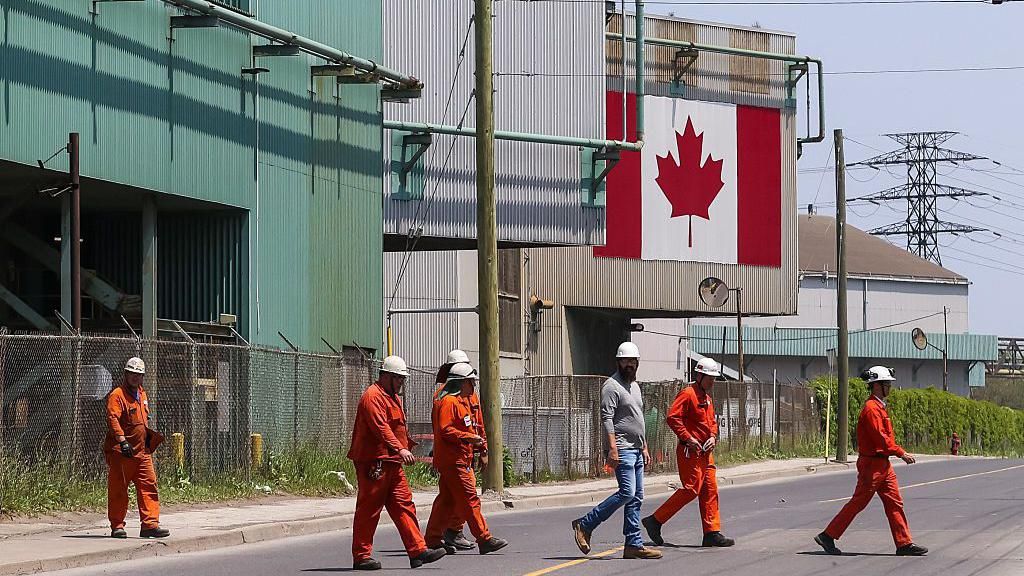
One of the biggest headwinds facing the Canadian economy remains trade uncertainty with the United States, which receives more than 70% of Canada’s exports and has deeply integrated supply chains with its northern neighbor. While most goods are exempt from tariffs under the USMCA free trade agreement, the White House has imposed targeted sectoral tariffs ranging from 15% to 50% on steel, aluminum and copper, and a 25% tariff on vehicles, after tit-for-tat tariffs were introduced last year.
Those tariffs have already caused tangible damage for Canadian businesses like Wellmaster, an Ontario-based manufacturer of drilling products owned and operated by the White family. Company president and CEO James White says 60% of the firm’s profitability depends on access to the U.S. market, and since the tariffs took effect, sales have dropped 20%. “I’m being pulled down in my ability to make investments in my people and my technology and my equipment. That’s not happening with my competitors,” White explained.
The impact of these tariffs is not felt evenly across the country: auto manufacturing hubs like Brampton and Windsor, and regions reliant on metal production, have faced far more acute disruption than urban centers like downtown Toronto, Kronick noted. The Canadian government is currently negotiating with U.S. officials both to roll back the sectoral tariffs and to review the USMCA agreement, but no deal has been reached yet. Kronick says what businesses need most right now is clarity: “If I know it’s 10% fine, it’s a 10% tax, and I can make my adjustments to my business accordingly, and we move on.”
Beyond trade uncertainty, Kronick says Canada’s slow growth is also fueled by long-standing structural issues, including internal trade barriers between provinces that range from differing trucking regulations to inconsistent professional licensing, and a tax system that is increasingly uncompetitive compared to peer jurisdictions Canada competes with for global investment.
Even with these near-term challenges, economists remain optimistic about Canada’s underlying fundamentals. “If you were drawing up a country from scratch, a well-educated, well-resourced, not overpopulated country would be what you would want, right? So, I think Canada has all those things, all those features,” Kronick said. “I think we just have to unlock them.”