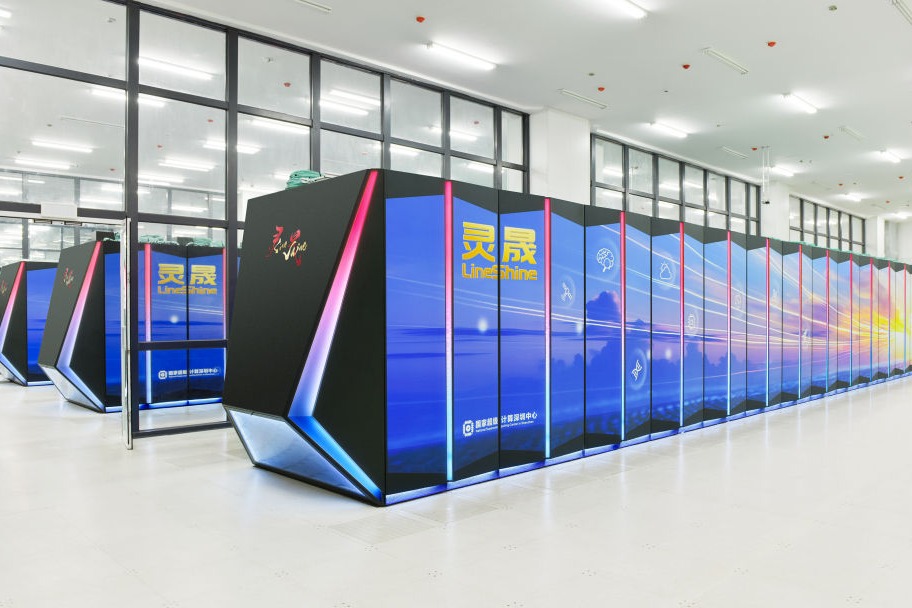
In a landmark advance for global high-performance computing, China’s domestically developed LineShine supercomputer has secured the top position on the latest edition of the industry-standard TOP500 supercomputer ranking, marking a transformative breakthrough in the long-sought convergence of supercomputing and intelligent computing. The Shenzhen National Supercomputing Center, which houses the new system, announced that LineShine delivers a sustained double-precision performance of 2.198 exaflops on the High Performance Linpack benchmark, making it the first supercomputer in history to cross the 2 exaflops threshold in real-world sustained operation.
For decades, supercomputing and intelligent computing developed along separate hardware trajectories, tailored to their distinct computational requirements. Traditional high-performance supercomputing was built to handle double-precision floating-point operations, critical for demanding scientific work such as complex physical modeling and large-scale engineering simulation. By contrast, intelligent computing — which powers modern AI model training and inference — relies primarily on lower-precision or integer operations. In recent years, however, demand for integrated systems that can handle both workloads has grown rapidly, driving researchers to explore new hardware architectures that bridge this divide.
The dominant industry approach to this integration has been heterogeneous CPU-GPU architecture, which splits workloads between central processing units that manage scheduling and control, and graphics processing units that handle accelerated computational tasks. Yet this widely adopted model carries inherent flaws: it incurs steep data transfer costs between the two hardware types, requires complex specialized programming frameworks, and often leaves a significant share of system hardware resources underutilized.
LineShine upends this conventional model with its pioneering all-CPU “Online Acceleration” architecture. Rather than relying on external GPU accelerators, the system embeds AI matrix acceleration units directly into its domestically designed processors. This native integration allows standard CPUs to run AI workloads efficiently without offloading processing to discrete GPUs, eliminating the persistent CPU-GPU data transfer bottleneck that plagues traditional heterogeneous architectures.
The innovations are not limited to processor design, according to LineShine’s chief designer Lu Yutong, who also serves as director of the Shenzhen National Supercomputing Center. The system delivers large-scale improvements across networking, storage, system architecture, and energy efficiency, resulting in dual breakthroughs: it delivers unmatched top-tier computing performance while also supporting broad deployment across real-world use cases. Lu noted that LineShine offers a fully practical, scalable solution for the long-debated goal of converging supercomputing and intelligent computing.
Lei Kai, deputy director of the Shenzhen Computer Federation, told Xinhua that LineShine is already powering cutting-edge research and applications across a wide range of scientific and industrial fields. Current use cases include atmospheric and oceanographic climate modeling, large-scale advanced engineering simulation, new materials development, targeted drug discovery, brain science research, general-purpose scientific AI, and large language model inference.
China has a long history of leadership in global supercomputing, with domestic systems claiming the TOP500 crown on multiple prior occasions. The TOP500 ranking, which benchmarks the world’s most powerful supercomputers, is updated twice annually. China first reached the number one position in 2010 with the Tianhe-1 system, followed by Tianhe-2, which held the top spot for six consecutive TOP500 editions from 2013 to 2015. From 2016 to 2017, China’s Sunway TaihuLight claimed the number one ranking four times, cementing the country’s position as a global leader in high-performance computing innovation.