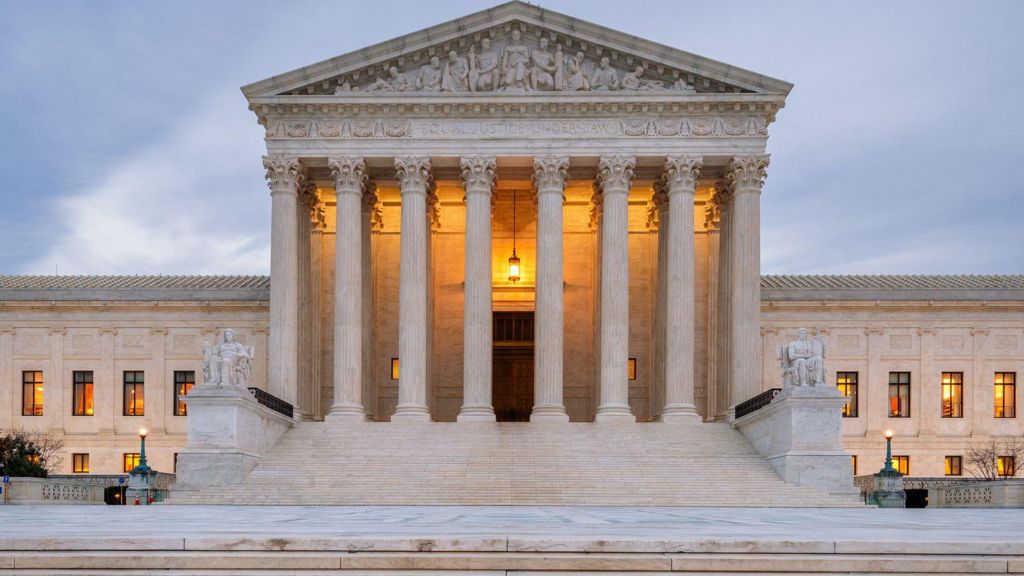
In a closely watched decision that will reshape how asylum claims are processed along the US-Mexico border, the Supreme Court has delivered a 6-3 ruling upholding the Trump administration’s long-debated ‘metering’ policy, which restricts asylum access for migrants who have not yet physically entered US territory. The decision ends a years-long legal battle and paves the way for the policy to be reimplemented, nearly four years after it was rolled back by the preceding Biden administration.
The core of the legal fight centered on interpreting a key line of US federal asylum law, which states that only migrants who have ‘arrived in the United States’ are eligible to apply for protection from persecution on political, racial, or religious grounds. The Trump administration has long argued that this language explicitly excludes asylum seekers stopped while still on the Mexican side of the border, a position that was rejected by a lower court before the case was appealed to the nation’s highest court.
Writing the majority opinion for the court’s conservative majority, Justice Samuel Alito framed the question as a straightforward matter of common language interpretation. ‘In ordinary speech, no one would say that a person ‘arrives in’ a place . . . before the person enters that place,’ Alito wrote. The ruling reverses the lower court’s finding that the metering policy was unlawful, in the case titled Noem v. Al Otro Lado, a prominent immigrant advocacy organization.
During oral arguments held in March, justices from both sides of the ideological spectrum pushed attorneys on both sides to clarify the legal threshold for what counts as ‘arriving in the US.’ Conservative Justice Amy Coney Barrett questioned what specific, dispositive marker would qualify a migrant as having arrived in the country, while fellow conservative Justice Neil Gorsuch asked whether a migrant waiting in a queue at a port of entry, or standing at the water’s edge of the Rio Grande, would meet the standard.
Vivek Suri, an assistant solicitor general arguing on behalf of the Trump administration, told the court the answer was unambiguous: ‘You can’t arrive in the United States while you’re still standing in Mexico. That should be the end of this case.’ But Kelsi Corkran, an attorney from the Institute for Constitutional Advocacy and Protection representing the migrant plaintiffs, argued that migrants meet the arrival requirement once they reach the threshold of a port of entry, waiting to cross into the country.
The ‘metering’ policy gets its name from its core function: it allows US Customs and Border Protection officials to cap the number of asylum claims processed each day, citing limited staffing and overburdened processing systems as justification for turning away additional seekers. First introduced by the Trump administration in 2016, the policy was formally rescinded in 2021 when Democratic President Joe Biden took office. With Trump’s return to the White House in 2025, the administration moved to reinstate the policy, leading to the latest legal challenge that ended at the Supreme Court.
This ruling is not the final word on Trump’s broader border asylum agenda. Shortly after returning to office in 2025, Trump announced a separate, far more sweeping ban on asylum eligibility for most border arrivals, a policy that remains tied up in ongoing litigation and has yet to reach the Supreme Court.