Forty years after political upheaval stole her chance at a Commonwealth Games gold medal, Annette Cowley Nel is set to watch her twin daughters step onto the very Scottish stage she was never allowed to compete on, closing one of sport’s most emotional chapters of generational healing.
In 1986, Edinburgh played host to the Commonwealth Games that would become far more remembered for political protest than sporting glory. Thirty-two nations across Africa, Asia and the Caribbean boycotted the event to oppose then-UK Prime Minister Margaret Thatcher’s refusal to impose economic sanctions on South Africa’s brutal apartheid regime, which enforced state-led racial segregation and barred South African athletes from most international competition.
Then 19-year-old Annette Cowley, a South African native who qualified to compete for England through her mother’s heritage, was already a British champion and one of the clear favorites to take gold in the 100m freestyle. A rising talent who split her time studying in Texas, U.S. and racing across the U.K. in the summer, she had done everything required to earn her spot at the Games. But as the boycott pushed the event to the brink of financial collapse, and media tycoon Robert Maxwell stepped in with controversial backing to rescue the competition, pressure mounted on organizers to appease protesting nations.
In a move widely seen as a political concession, officials banned Cowley and fellow white South African athlete Zola Budd from competing, citing technical residency rule violations despite Cowley being a legal British citizen. On the eve of her race, police escorted her out of the athletes’ village, and her lifelong dream of a Commonwealth Games medal ended before it began. She watched from the stands as Canadian Jane Kerr won gold with a time slower than Cowley had posted in qualifying. The disappointment left her disillusioned with competitive swimming; when apartheid ended and she sought selection for South Africa at the 1992 Olympics, she was passed over because of her prior representation of England.
Looking back on the era, Cowley Nel calls apartheid a “terrible time” for South Africa, and says she personally supported equality for all. While she acknowledges the enormous positive progress the country has made in the decades since apartheid fell, she still expresses frustration that all South African athletes of the era were lumped together and punished regardless of their individual beliefs. That youthful hardship, though, shaped her resilience: “I had a lot to deal with at a young age, and that stood me in good stead for life,” she said.
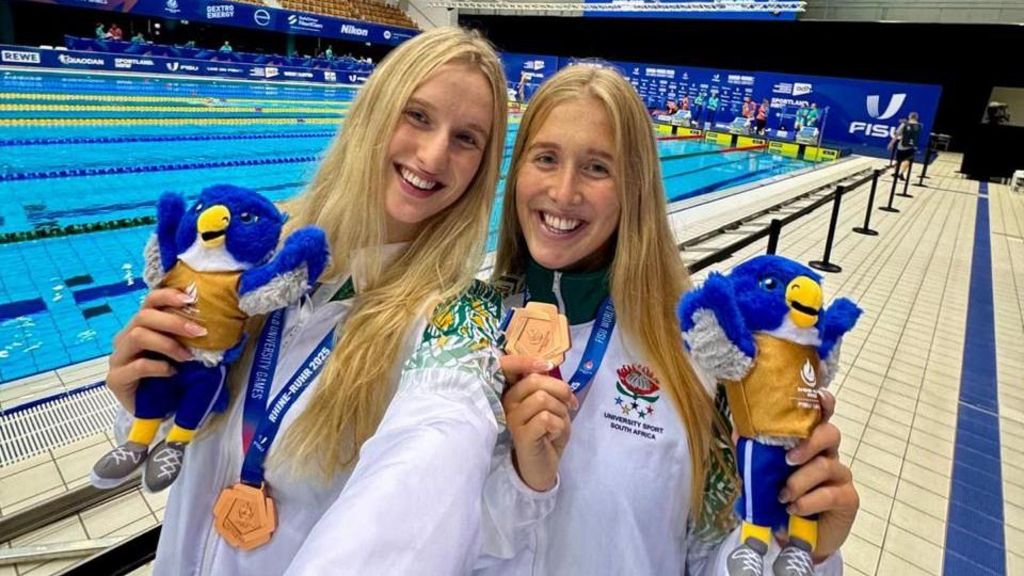
Now, four decades on, the 2026 Commonwealth Games return to Scotland, this time hosted in Glasgow. When the Games open next month, they will fall on the 24th birthday of twins Georgia and Olivia Nel, Cowley Nel’s daughters, who have both been named to South Africa’s official swimming team. For the Nel family, the moment is a full-circle emotional reckoning decades in the making.
Olivia, who already has 2022 Birmingham Commonwealth Games experience under her belt, says the family history adds extra meaning to the moment. “I do it for myself, I do it for my family, but having that history really makes me so much more inclined to want to do it and represent my country and to do well,” she said, noting that holding the Games in Scotland makes the moment “quite special.”
For Georgia, it will be her first appearance at the Commonwealth Games. She called the opportunity to compete alongside her sister, and step into the spot their mother was forced to leave empty, “a really unique opportunity.” “I’m very grateful not only to represent South Africa, but to represent her at these Commonwealth Games,” she said, adding that she often gets emotional thinking about her mother’s hard work cut short by politics.
The sisters could even share the pool together, with a strong chance both will compete in the women’s 4x100m freestyle relay. Annette Cowley Nel and her husband Jeremy will be in the Glasgow stands to watch, and she says the moment is beyond anything she could have imagined four decades ago. “It is incredibly special that they have both made the Commonwealth Games,” she said. “It will be quite an emotional moment.”