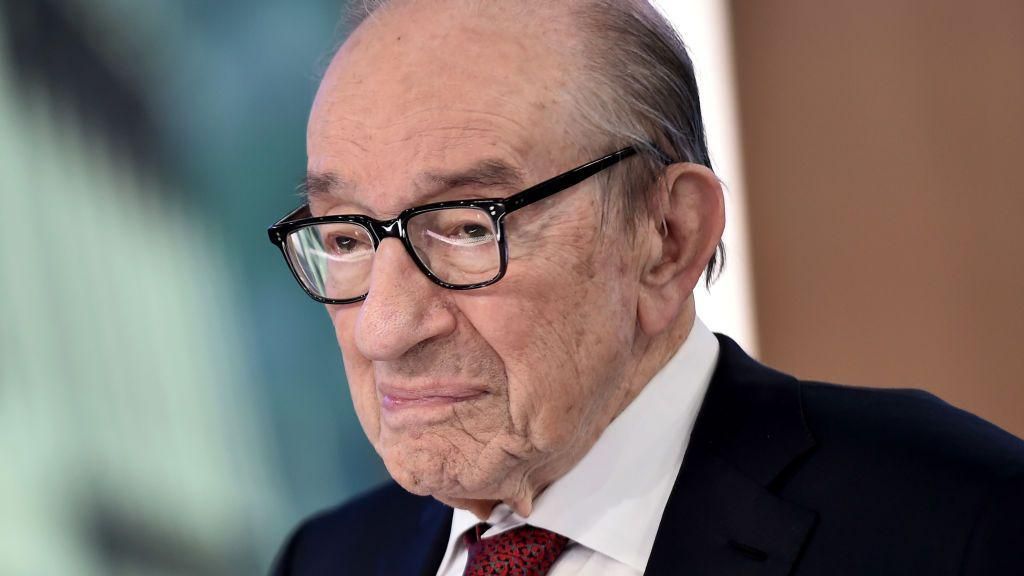
Alan Greenspan, the legendary former chair of the U.S. Federal Reserve who steered the American economy through nearly 20 years of historic growth and polarizing policy decisions, has died at the age of 100. His wife, NBC News chief foreign affairs correspondent Andrea Mitchell, confirmed the news in a statement released by the network, noting he passed away from complications related to Parkinson’s disease.
In her statement, Mitchell remembered Greenspan as “a giant of a man who helped shape the US economy for decades under presidents of both parties, but was always honest in acknowledging his mistakes.” For 19 years between 1987 and 2006, Greenspan held what is widely described as the most powerful unelected position in the United States, second only to the presidency in its influence over global financial markets. His tenure at the Fed overlapped with the longest period of sustained economic expansion the U.S. had seen in a generation, earning him a reputation as the quiet “god in the machine” of American finance.
Born in New York City in 1926, Greenspan’s path to the top of global finance was far from conventional. Raised by a single mother who worked at a local furniture store, Greenspan first trained as a musician, studying clarinet at the prestigious Juilliard School and touring nationally with big bands alongside jazz legend Stan Getz. While his bandmates spent off-hours socializing, Greenspan occupied himself by balancing the band’s books and teaching himself economic theory, eventually switching studies to economics at New York University at age 19. There, he adopted the free-market principles that would define his entire career, later coming under the profound influence of objectivist philosopher Ayn Rand, who nicknamed him “the undertaker” for his preference for dark, muted formal wear. Greenspan embraced Rand’s core belief that unconstrained self-interest creates the most efficient society, a view that led him to denounce the welfare state as a system that only confiscated wealth from productive members of society early in his career.
Greenspan first entered national politics during Richard Nixon’s 1968 presidential campaign, after earning a reputation as an accurate forecaster who had correctly predicted the Eisenhower-era recession. He went on to lead Nixon’s Council of Economic Advisers, a post he retained under President Gerald Ford. Later, President Ronald Reagan tapped him to lead a bipartisan commission on Social Security reform before appointing him to the top Fed role in 1987. Greenspan faced his first major crisis within months of taking office: the October 1987 stock market crash that erased more than 30% of U.S. equity value in a single session. His deft response—issuing a public statement reinforcing confidence in the U.S. economy and opening the Fed’s liquidity taps to stabilize banks—earned him widespread acclaim, and established a playbook he would reuse for decades to come during market crises, from the savings and loan meltdown to the Mexican peso crisis and the 1997 Asian financial crisis. That approach, built on cutting interest rates and injecting liquidity during downturns, would later evolve into the policy known as quantitative easing that central banks around the world still use today.
Over his five consecutive terms as Fed chair, Greenspan retained his post through bipartisan presidential administrations. Though George H.W. Bush later blamed him for a slow economic recovery that cost him re-election, President Bill Clinton, a Democrat, asked Greenspan to stay on, a decision that was followed by the late 1990s tech-driven boom that became the high point of his tenure. Away from the boardroom, Greenspan was an enthusiastic tennis player, and after a short early marriage and a high-profile relationship with broadcast legend Barbara Walters, he married Mitchell in 1997.
For all his success, Greenspan’s legacy remains deeply contested. His policy of maintaining low interest rates through the 1990s was blamed for fueling the dot-com bubble, which popped in 2000, leading to a broad market downturn. Nobel Prize-winning economist Paul Krugman was among the most prominent critics, arguing that Greenspan refused to raise rates to cool irrational market exuberance, opting instead to clean up the damage after the bubble burst. After the 9/11 terrorist attacks, Greenspan again cut rates aggressively to shore up the economy, a decision that critics argue fueled an unprecedented housing bubble in the mid-2000s. His long-held opposition to financial regulation, particularly oversight of complex derivative products, allowed risky subprime mortgage lending to expand unchecked, culminating in the 2008 global financial crisis that triggered the worst recession since the Great Depression—just two years after Greenspan retired from the Fed.
In a striking 2008 congressional testimony following the crash, Greenspan openly acknowledged his mistakes, admitting he had placed too much faith in the ability of banks to self-regulate. “I have found a flaw. I don’t know how significant or permanent it is. But I have been very distressed by that fact,” he told lawmakers, a rare display of humility from a figure who had been treated as an infallible financial guru for decades.
Even in his 90s, Greenspan remained an active and influential voice in global economic discourse. He was awarded the Presidential Medal of Freedom, the highest civilian honor in the U.S., and an honorary knighthood by Queen Elizabeth II for his contributions to global economic stability. He publicly criticized Brexit as the “worst possible outcome” for the global economy, pushed back against former President Donald Trump’s populist economic agenda, and as recently as 2023 warned that the Biden administration was raising interest rates too quickly, risking recession. He celebrated his 100th birthday in March 2026, just three months before his death.
Today, Greenspan is remembered as the figure more than any other who shaped the modern U.S. economy. Over his 19-year tenure, U.S. gross domestic product contracted just once, a record of steady growth that few central bank leaders have ever matched. Though his reputation was permanently damaged for many by the 2008 crisis and his long-standing ideological resistance to regulation, his policy innovations and ability to steady financial markets during crises remain a core part of central banking practice around the world.