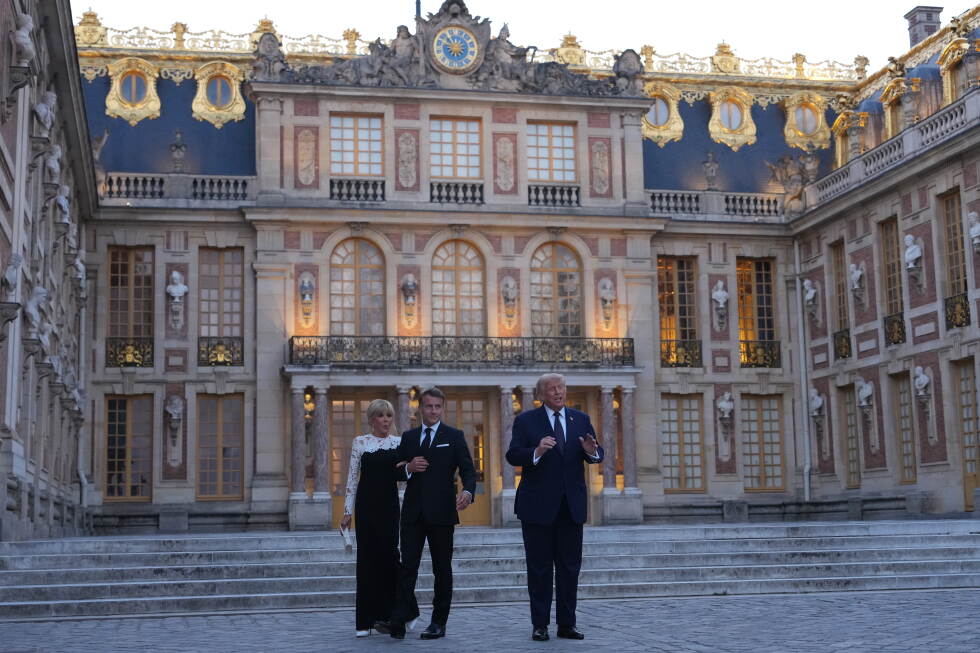
In what is shaping up to be one of the final defining foreign policy achievements of Emmanuel Macron’s tenure as French president, a landmark gathering at the Palace of Versailles this week has delivered two transformative breakthroughs for European diplomacy: a surprise initial peace deal to end the Iran war brokered on French soil, and a firm new commitment from U.S. President Donald Trump to ramp up support for Ukraine in its defense against Russia’s invasion. The dual wins capped a week of high-stakes diplomacy at the G7 summit, where Macron leveraged years of political experience and carefully cultivated networks to pull off agreements that align U.S. priorities more closely with European interests, months before his term is set to end next spring.
The centerpiece of Macron’s diplomatic push was a state dinner at Versailles, originally billed as a celebration of centuries of Franco-American friendship. What attendees did not expect was an impromptu signing ceremony that turned the 17th-century royal palace into the stage for a historic end to the Iran conflict. Even senior French government officials were caught off guard by the moment. French Economy Minister Roland Lescure, who was in attendance at the dinner, confirmed to RTL radio that Trump only notified Macron of his plan to sign the initial agreement shortly before the event, leaving cabinet ministers completely unaware of what was to come. “But for us, ministers in the French government, it was a surprise,” Lescure said. When Trump put pen to paper, the room of assembled officials and guests broke into spontaneous applause, with Macron immediately declaring “Bravo” to mark the occasion.
Macron had long framed the iconic Versailles venue as a deliberate “instrument of influence” for the summit, designed to keep Trump engaged through the full duration of the G7 gathering in Evian, a sharp contrast to 2024 when Trump left the Canada-hosted summit early before its official conclusion. For more than 300 years, French leaders have used the gilded palace to welcome and honor visiting heads of state, a tradition Trump himself acknowledged when he praised the site’s understated grandeur. Following the signing, Macron outlined the tangible benefits of the deal, saying it would not only end active hostilities in the region but also reopen the critical Strait of Hormuz, a key global oil chokepoint that has been closed during the conflict, a change that is expected to bring down global energy prices.
While Macron did not take part in the direct negotiations between the U.S. and Iran that led to the agreement, his role in securing the historic venue for the signing carries major symbolic weight: it puts Europe back at the center of a conflict that the U.S. and Israel launched in 2025 without any prior consultation with their Western NATO allies. Even before the Versailles dinner, Macron had spent months laying groundwork for the summit, holding repeated phone calls with Trump to align positions on both Iran and Ukraine, repairing a relationship that got off to a famously awkward start nearly a decade ago with an uncomfortably prolonged handshake that made global headlines. While the two leaders have had their share of friction over the years, with Trump criticizing European NATO members for inadequate defense spending and European leaders angered by Trump’s failure to consult them on the Iran war decision, Macron’s outreach this cycle paid off.
The second, equally consequential win for European and Ukrainian leaders was securing Trump’s commitment to a more forceful stance supporting Ukraine, a breakthrough that comes after Ukrainian President Volodymyr Zelenskyy faced a widely noted diplomatic setback during his March 2025 visit to the White House. On the sidelines of the G7 summit, Trump held a meeting with Zelenskyy, who shared photos of recent damage inflicted by Russian bombing on the Dormition Cathedral in Kyiv to underscore the human cost of the ongoing invasion. Later, Trump joined a three-way call with Zelenskyy and Macron from Versailles, where he reaffirmed U.S. backing for Ukraine. “America is with us on Ukraine. That is very important,” Macron said after the call.
In their joint G7 statement, leaders from the group of seven major advanced economies formalized this new commitment, agreeing to accelerate deliveries of air defense systems and long-range weapons to Ukraine, while also ramping up economic pressure on Moscow through expanded sanctions targeting Russia’s core oil and gas sectors. European officials noted that while Macron had previously expressed caution over Trump’s shifting public positions on Russia and President Vladimir Putin, the written commitments released this week represent a far more durable agreement, as the text was personally approved by Trump. A European diplomat briefed on the closed-door talks, speaking on condition of anonymity due to the sensitivity of the discussions, confirmed the quiet bargain struck between Trump and G7 leaders: “We certainly gave him some reassurance on the Middle East,” the diplomat said. “And President Trump, for his part, delivered for us on Ukraine.”
The official G7 communique highlighted what it called a “breakthrough” in Middle East peace efforts, and praised Trump’s “strong leadership” on the Iran deal three separate times. In addition to the Iran and Ukraine breakthroughs, Macron used the summit to push for continued international support for Lebanese sovereignty, drawing on France’s long historical ties to the country. During discussions in Evian, Trump repeatedly expressed sympathy for the people of Lebanon and voiced criticism of Israeli Prime Minister Benjamin Netanyahu, echoing European concerns over escalating regional tensions.
For Macron, the dual diplomatic wins cap a years-long effort to position France as a key bridge between Washington and European capitals, and stand as a major late-term legacy achievement as he prepares to leave office next spring.