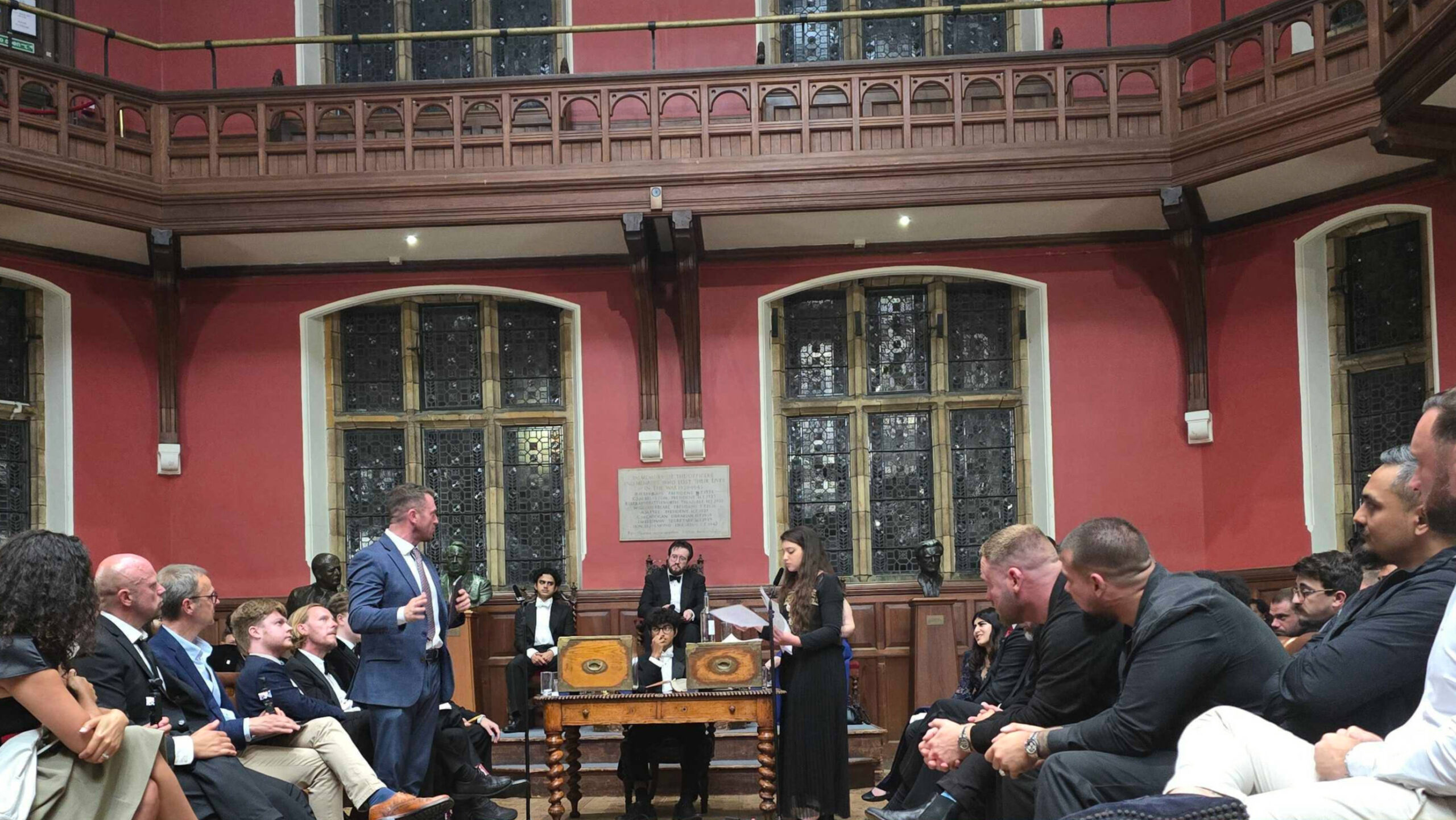
In a highly charged night of controversy that tested Britain’s long-held commitment to open debate, the Oxford Union — one of the world’s most prestigious academic debating institutions — hosted far-right anti-Islam activist Tommy Robinson for a divisive debate, culminating in a clear defeat for the motion claiming the West is justified in viewing Islam with suspicion. The event, organized by 20-year-old Oxford Union president Arwa Elrayess, a Muslim of Palestinian heritage from Gaza, drew hundreds of furious protesters who blocked access to the venue, delayed the debate by more than two hours, and left the chamber with a drastically reduced audience far below its 400-person capacity.
Elrayess has long framed her decision to invite Robinson as a defense of free speech principles: rather than silencing extremist anti-Muslim views, she argued, they should be confronted openly through rigorous debate. This was not her first clash over free speech: just weeks earlier, she defied the UK Home Office after the government barred two American progressive commentators, Hasan Piker and Cenk Uygur, from entering the country over critical remarks they made about Israel, hosting the pair via a live stream instead. The decision to invite Robinson, a convicted criminal, drew condemnation from across the political spectrum, including from sitting and former parliamentarians, and Elrayess only survived a no-confidence vote from Union members over the controversy.
The lead-up to the May 21, 2026 debate was marked by escalating tension, coming just one week after riots targeting ethnic minorities in Belfast that broke out hours after Robinson urged his online followers to hold demonstrations. By 5:30 p.m. on the day of the debate, roughly 60 left-wing protesters had gathered outside the Union, blocked off by police. The crowd quickly swelled to over 500, many wearing masks, who physically prevented ticket holders — including student speakers and Elrayess’ own family, who had traveled from Doha to attend — from entering the venue. Two adjacent streets were closed, and local businesses shut early in anticipation of unrest. While the crowd outside raged with chants of “refugees are welcome here” and anti-fascist slogans, the small group that managed to slip inside — including the author of this report — described an eerily calm atmosphere inside the Union grounds.
Among those who gained entry were Robinson, fellow pro-motion speaker Laurence Fox, founder of the small right-wing Reclaim Party, and senior Conservative former cabinet minister Jacob Rees-Mogg, who spoke against the motion alongside Elrayess and multiple Muslim student debaters. Ahead of the debate starting close to 10 p.m. — two and a half hours behind schedule — informal exchanges between far-right guests and Muslim debaters remained cordial, with pro-motion podcaster Liam Tuffs even joking that he had enjoyed the event’s halal chicken catered meal.
When the debate formally opened, Elrayess surprised attendees by announcing she would step down from chairing the event to speak for the opposition against the motion. Opening for the pro side, Union committee member Oliver Jones-Lyons argued that Islam is fundamentally irreconcilable with Western liberal democratic values, pointing to the historic jizya tax on non-Muslims in Islamic states. Muslim debater Abdullah al-Andalusi pushed back, noting that religious minorities in some Muslim-majority states receive specific legal privileges that challenge claims of universal discrimination, a distinction Jones-Lyons dismissed as segregation by another name.
Student opposition speaker Aisha Khan opened her remarks with a sharp rebuke of Robinson, introducing him as “Stephen Yaxley-Lennon, known to his hooligans as Tommy Robinson” and noting that he would have been “quite literally cooked” without the protection of the Union’s Muslim Palestinian president and majority South Asian executive committee. She took aim at Fox too, mocking his party’s poor electoral performance: “Founder of the Reclaim Party, which at the last general election reclaimed approximately 0.02 percent of the British vote.” Khan centered her argument on the value of open scrutiny, arguing that Western critical thinking allows believers to question their own faith without fearing its collapse: “a thing that cannot survive a question probably deserves to be questioned.”
When Robinson took the stage, the anti-Islam activist opened with a lighthearted joke about preferring to watch the England football game before praising Elrayess for upholding his right to speak. He then outlined his core claim, citing Islamic scripture and laws in Muslim-majority countries to argue that Islam promotes violence, intolerance of LGBTQ+ people, and punitive laws for extramarital sex and child marriage. Multiple opposition speakers challenged his claims: al-Andalusi pressed Robinson to produce a scripture citation supporting the death penalty for homosexuality, which Robinson failed to provide, instead pointing to high-profile cases of execution in the Middle East. Luton-based debater Michael Doward, who shares Robinson’s hometown, refuted Robinson’s misquotation of a Quranic verse on child marriage and called out his selective framing: “Tommy is desperate to make connections between crime and Islam. But when it comes to Muslims working as NHS workers, doctors, nurses, charity workers — does he ever connect good deeds to Islam?”
The most powerful speech of the night came from Elrayess, who systematically dismantled Robinson’s reading of the Quran, pointing out that the verse he cited calling for violence against unbelievers was context-specific, referring exclusively to a 7th-century Arab tribe that had broken a peace treaty with early Muslim communities during wartime, a interpretation agreed by 1400 years of classical Quranic scholarship. She cited the Prophet Muhammad’s final sermon emphasizing universal equality regardless of race, and shared polling data showing that 85 percent of British Muslims support democracy as the best system of government — compared to just 71 percent of the general British public — and 70 percent feel fully or mostly loyal to the UK, against 50 percent of the broader population. “British Muslims are more committed to British values than the British average,” she declared, earning applause even from some attendees who had supported Robinson. She closed with a powerful defense of her decision to host the debate rooted in her faith: “Free speech and debate is not something I do despite being a Muslim, it is something I do because of it. I’m not betraying my religion, I’m practicing it. My faith has survived empires, it will survive this evening.”
A moment of light relief came when a tipsy Laurence Fox attempted to display a controversial cartoon as a prop, only to be called out for violating Union rules by Rees-Mogg — before revealing the cartoon was a drawing of Rees-Mogg himself, drawing widespread laughter.
When the final vote was counted, the motion “This House believes the West is right to be suspicious of Islam” was defeated 41 votes in favor to 57 against. Though the audience was small due to the protest blockade — most of the blocked students who could not enter were expected to oppose the motion, which would have produced a larger margin of defeat — the result was nonetheless clear.
As attendees left the building late that night, protesters outside chanted angrily against the Union and the debate. The event has already sparked fierce national debate: critics argue that giving Robinson a platform at a prestigious institution legitimizes anti-Muslim bigotry and far-right extremism at a moment of rising ethnic tension in the UK. But supporters of Elrayess’ approach frame the outcome as a victory for open discourse: young Muslim leaders did not shy away from confronting hateful views, they extended the right of free speech even to those who oppose their own faith, and defeated them on the open, democratic battleground of debate. Outside the Oxford train station early the next morning, a young British Muslim man who had traveled from London to attend the debate summed up this perspective: he had been blocked from entering by protesters, he said, but he saw no reason to fear open debate about his faith — and suspects many other young British Muslims feel the same.